4c. FIMI prediction

NoteWhere am I in the pipeline?
  • Inputs: The predictor-side measurement and representation catalogue validated on 4a Measurement architecture, the FIMI dependent-variable definitions validated on 4b FIMI DV operationalisation, and the S1-S4 wrangled item files in data/wrangled_data/.
  • This page: FIMI prediction (Stage 5 owner page). Builds a cached, parallelisable model repository crossing predictor representation (first-order parents only, higher-order composites only, hybrid MIMIC, pure formative, reflective second-order) with FIMI criterion choice (Full, Russian, Chinese, Short). The construct catalogue and per-study item key are inherited from 4a (S1 = all-item development catalogue with borrowed directs; S2 / S3 = pooled retained keys; S4 = deployment short form). S4 contributes only the composite (COMP) family because its deployed short form did not field the first-order parent batteries. Full FIMI is the core DV; source-specific and short FIMI are reported as robustness checks.
  • Hands off to: 4d Deployment and invariance for scale-reduction and invariance evidence, 4e Nomological network for external anchors, and the per-study pages for wave-specific estimation context.

Overview

This page build a full Stage-5 analysis repository. 4a decides which predictor-side measurement architectures are empirically defensible, and 4b decides how the FIMI dependent variable is defined. This page then asks the prediction question under a single reproducible grid:

  1. Core DV: Full FIMI in S1-S4.
  2. Core predictor families: FO (first-order parents only), COMP (higher-order composites only), and HYB (hybrid formative-reflective MIMIC).
  3. Robustness analyses: Russian-origin FIMI, Chinese-origin FIMI, Short FIMI, pure formative composites (<~), and reflective second-order composites (=~).

The repository is estimated with MLR and FIML via lavaan::sem(), cached under outputs/prediction_models/fimi_prediction/, and exported to outputs/tables/fimi_prediction_*.csv. Rerenders reuse unchanged fits and parallelise changed jobs across 12 workers by default (DISINFORMETER_SEM_WORKERS controls this). S5 is excluded from Stage 5 because it deliberately did not administer the FIMI news battery.

The interpretive rule is conservative: Full FIMI × core predictor models carries the main claim. Everything else is a named sensitivity analysis. A predictor is treated as stable when its sign replicates and the standardized path drift is small (the working descriptive rule is |Δβ| ≤ .10, not a formal equivalence test).

Model family definitions

The three core families answer related but distinct prediction questions, and the two robustness families act as representation sensitivities. The definitions below are the contract the repository enforces — the validation section at the end of Analysis Repository cross-checks every fitted model against these rules.

  • FO — First-order parents only. FIMI is regressed on the lower-order parent factors in the representation catalogue (e.g. EXPL, GAY, MIGR, ABANH, ABANF, PRAGR, PRAGCH, SUPR in S1). FO is the least-compressed predictor-side test; it asks which narrow first-order constructs carry signal when allowed to compete.
  • COMP — Higher-order composites only. FIMI is regressed on the broad DisInforMeter composites. The composite layer follows the 04a higher-order CFA: THREAT, ABAND, FEAR, SUPF, and GEN wherever each composite’s indicators were fielded. Each composite is reflectively identified by its direct affective indicators. No first-order parents enter the regression. COMP asks whether the broad dimensions predict FIMI without the lower-order parent layer.
  • HYB — Hybrid formative-reflective MIMIC. Each broad composite with first-order parents (THREAT, ABAND, FEAR, SUPF) is reflectively identified by its direct affective indicators and simultaneously regressed on its parents. GEN, which has no first-order parents in any wave, enters as a reflective-only composite (GEN =~ gen items) alongside the MIMIC composites. FIMI is regressed on all five composites. HYB asks whether the broad dimensions still predict FIMI when those with parent blocks are explicitly anchored in them.
  • FORM — Pure formative composite (<~) [robustness]. Composites with parents are formative aggregates of their parents (<~) with direct indicators retained for identification; GEN again enters reflectively because it has no parents to aggregate.
  • REF — Reflective second-order (=~) [robustness]. First-order parents are treated as reflective effects of the broad composite; GEN remains a reflective composite on its own direct indicators.

Relation to the 04a representation catalogue. The prediction repository now inherits its construct catalogue directly from 4a: the same mapping-driven item lists, the same five-composite layout (THREAT/ABAND/FEAR/SUPF/GEN), the same S1 borrowed-direct development items, and the same exclusion of CET pending a separate construct-placement review. The single shape difference is that 04a’s “Higher-order representation comparison” emits HYB/FORM/REF only for composites with first-order parents; the prediction repository augments those families with the direct-only composites (GEN, plus any S5-style direct-only SUPF block) so FIMI is regressed on the full higher-order layer present in the wave. CET never enters the predictor set in any family.

Selected item keys feed prediction. 04a estimates each composite under two item keys — all available mapped items and the retained IDs from the pooled S2/S3/S5 refinement — and selects the better-performing key per study from converged FORM/HYB rows. The Stage-5 repository uses those selected keys verbatim so that the prediction layer reads exactly the construct catalogue the measurement layer validated:

  • S1 uses the all key. S1 was the development wave for the affective higher-order architecture, and the borrowed direct indicators (lgb2, exp4, aban1, aban6, aban7, pru6, pkin6, sru14, sru15) are part of that development evidence. S1 FORM and HYB therefore inherit 04a’s exploratory tuning: marker-variable scaling (std.lv = FALSE) and lower-bounded composite residual variances. The bound lines are emitted by build_representation_syntax(); the std.lv toggle is wired in R/fimi_prediction_repository.R::.fit_one_prediction().
  • S2 and S3 use the retained key. The optimized retained item IDs from outputs/tables/first_order_pooled_optimized_map_s2_s3_s5.csv and …higher_order_pooled_optimized_map…csv remove weak, unstable, or locally redundant indicators without changing construct meaning. Both waves field the full first-order parent layer, so all five families remain identifiable.
  • S4 uses the all key. The pooled retained list is derived from S2/S3/S5 and does not address S4’s deployment short form. S4 carries no first-order parent batteries, so it contributes only the COMP family — every other family requires a parent layer and is correctly marked ineligible by the inventory. S4’s COMP composites are GEN, THREAT, ABAND, FEAR, and SUPF; SUPF reflects both Russia-favouring (fru*) and China-favouring (fch*) affect items as direct indicators, matching the mapping-driven catalogue. The deployed Chinese-affect items are not declared as a separate SUPFCH predictor.

Analysis Repository

Model grid

The repository intentionally keeps the modelling choices visible. A model card is one row in the grid below: study, item-selection key inherited from 04a, predictor representation, FIMI version, model identifier, and cache status. S4 only contributes the COMP (higher-order composites only) family because the deployed short form did not field the first-order parent batteries needed to identify FO, HYB, FORM, or REF representations.

Specification validation

Before any tables or figures are drawn, the realised repository is cross-checked against the family definitions above. The blocking checks (FO predictors must be first-order parents only, S4 must contribute only the COMP family, SUPFCH must never appear as a predictor, no *_dir suffixes in FO models) abort the render if anything fails. The full audit data are always written to outputs/tables/fimi_prediction_validation.csv and outputs/tables/fimi_prediction_predictor_audit.csv for external review. To keep the rendered report readable, the per-check tables below are only surfaced when a flag is raised.

All 6 specification checks passed: FO predictors are first-order parents only, S4 contributes only the COMP family, and no *_dir, SUPFCH, or DEP-family flags were raised.

Table 1
Table 2
Table 3
Table 4
Table 5: Item key inherited from 04a for each study. The Stage-5 prediction repository builds its construct catalogue using these selected keys.
Study Selected item key Source
S1 All items 04a development wave; all-item borrowed-direct catalogue.
S2 Retained items 04a main-text selection (better-performing converged FORM/HYB row).
S3 Retained items 04a main-text selection (better-performing converged FORM/HYB row).
S4 All items Deployment short form; pooled retained IDs do not cover S4.
Table 6: FIMI prediction model repository coverage. Each row aggregates model cards by study, item key, representation, eligibility, convergence, and cache status.
Study Item key Tier Predictor representation Eligible Converged Cache Models
S1 All items Core model First-order parents only yes yes hit 1
S1 All items Core model Higher-order composites only yes yes hit 1
S1 All items Core model Hybrid formative-reflective MIMIC yes yes hit 1
S1 All items Robustness model First-order parents only yes yes hit 3
S1 All items Robustness model Higher-order composites only yes yes hit 3
S1 All items Robustness model Hybrid formative-reflective MIMIC yes yes hit 3
S1 All items Robustness model Pure formative composite (`<~`) yes yes hit 4
S1 All items Robustness model Reflective second-order (`=~`) yes yes hit 4
S2 Retained items Core model First-order parents only yes yes hit 1
S2 Retained items Core model Higher-order composites only yes yes hit 1
S2 Retained items Core model Hybrid formative-reflective MIMIC yes yes hit 1
S2 Retained items Robustness model First-order parents only yes yes hit 3
S2 Retained items Robustness model Higher-order composites only yes yes hit 3
S2 Retained items Robustness model Hybrid formative-reflective MIMIC yes yes hit 3
S2 Retained items Robustness model Pure formative composite (`<~`) yes yes hit 4
S2 Retained items Robustness model Reflective second-order (`=~`) yes yes hit 4
S3 Retained items Core model First-order parents only yes yes hit 1
S3 Retained items Core model Higher-order composites only yes yes hit 1
S3 Retained items Core model Hybrid formative-reflective MIMIC yes yes hit 1
S3 Retained items Robustness model First-order parents only yes yes hit 3
S3 Retained items Robustness model Higher-order composites only yes yes hit 3
S3 Retained items Robustness model Hybrid formative-reflective MIMIC yes yes hit 3
S3 Retained items Robustness model Pure formative composite (`<~`) yes yes hit 4
S3 Retained items Robustness model Reflective second-order (`=~`) yes yes hit 4
S4 All items Core model First-order parents only no no skipped 1
S4 All items Core model Higher-order composites only yes yes hit 1
S4 All items Core model Hybrid formative-reflective MIMIC no no skipped 1
S4 All items Robustness model First-order parents only no no skipped 3
S4 All items Robustness model Higher-order composites only yes yes hit 3
S4 All items Robustness model Hybrid formative-reflective MIMIC no no skipped 3
S4 All items Robustness model Pure formative composite (`<~`) no no skipped 4
S4 All items Robustness model Reflective second-order (`=~`) no no skipped 4
Table 7: Core model cards: Full FIMI as the dependent variable crossed with the core predictor representations, using each study's selected item key.
Study Item key Predictor representation FIMI DV FIMI items model_id Converged Cache
S1 All items Higher-order composites only Full FIMI 15 `s1_pred_comp_full` yes hit
S1 All items First-order parents only Full FIMI 15 `s1_pred_fo_full` yes hit
S1 All items Hybrid formative-reflective MIMIC Full FIMI 15 `s1_pred_hyb_full` yes hit
S2 Retained items Higher-order composites only Full FIMI 8 `s2_pred_comp_full` yes hit
S2 Retained items First-order parents only Full FIMI 8 `s2_pred_fo_full` yes hit
S2 Retained items Hybrid formative-reflective MIMIC Full FIMI 8 `s2_pred_hyb_full` yes hit
S3 Retained items Higher-order composites only Full FIMI 8 `s3_pred_comp_full` yes hit
S3 Retained items First-order parents only Full FIMI 8 `s3_pred_fo_full` yes hit
S3 Retained items Hybrid formative-reflective MIMIC Full FIMI 8 `s3_pred_hyb_full` yes hit
S4 All items Higher-order composites only Full FIMI 8 `s4_pred_comp_full` yes hit
S4 All items First-order parents only Full FIMI 8 `s4_pred_fo_full` no skipped
S4 All items Hybrid formative-reflective MIMIC Full FIMI 8 `s4_pred_hyb_full` no skipped
s1_pred_comp_full: Higher-order composites only · Full FIMI · all key

Rationale. FIMI is regressed on the broad DisInforMeter composites only. Each composite is reflectively identified by its direct affective indicators; no first-order parents enter the regression.

THREAT =~ lgb2 + exp4
ABAND =~ aban1 + aban6 + aban7
FEAR =~ pru6 + pkin6
SUPF =~ sru14 + sru15

FIMI =~ news3 + news4 + news7 + news8 + news9 + news12 + news14 + news15 + news1 + news2 + news5 + news6 + news10 + news11 + news13

FIMI ~ THREAT + ABAND + FEAR + SUPF
s1_pred_fo_full: First-order parents only · Full FIMI · all key

Rationale. FIMI is regressed on the first-order DisInforMeter parent constructs only. No higher-order composite or direct-affective (*_dir) factors enter the regression — this is the least compressed predictor-side test.

EXPL =~ poi3 + exp2 + exp3 + dec1 + exp1
GAY =~ lgb1 + lgb3 + lgb4
MIGR =~ unp3 + unp4
ABANF =~ unp1 + unp5 + unp6 + unp8 + unp2 + unp7
ABANH =~ aban2 + aban3 + aban4 + aban5 + aban8
PRAGR =~ pru1 + pru2 + pru3 + pru4 + pru5
PRAGCH =~ pkin1 + pkin2 + pkin3 + pkin4 + pkin5
SUPR =~ sru1 + sru2 + sru3 + sru4 + sru6 + sru7 + sru8 + sru9 + sru10 + sru11 + sru13 + sru5 + sru12
SUPCH =~ ski1 + ski2 + ski3 + ski4 + ski5 + ski7 + ski8 + ski9 + ski10 + ski11 + ski6

FIMI =~ news3 + news4 + news7 + news8 + news9 + news12 + news14 + news15 + news1 + news2 + news5 + news6 + news10 + news11 + news13

FIMI ~ EXPL + GAY + MIGR + ABANF + ABANH + PRAGR + PRAGCH + SUPR + SUPCH
s1_pred_hyb_full: Hybrid formative-reflective MIMIC · Full FIMI · all key

Rationale. Each broad composite is reflectively identified by its direct affective indicators and simultaneously regressed on its first-order parents; FIMI is then regressed on the composites. FO-style direct paths from *_dir factors are not part of this family.

EXPL =~ poi3 + exp2 + exp3 + dec1 + exp1
GAY =~ lgb1 + lgb3 + lgb4
MIGR =~ unp3 + unp4
ABANF =~ unp1 + unp5 + unp6 + unp8 + unp2 + unp7
ABANH =~ aban2 + aban3 + aban4 + aban5 + aban8
PRAGR =~ pru1 + pru2 + pru3 + pru4 + pru5
PRAGCH =~ pkin1 + pkin2 + pkin3 + pkin4 + pkin5
SUPR =~ sru1 + sru2 + sru3 + sru4 + sru6 + sru7 + sru8 + sru9 + sru10 + sru11 + sru13 + sru5 + sru12
SUPCH =~ ski1 + ski2 + ski3 + ski4 + ski5 + ski7 + ski8 + ski9 + ski10 + ski11 + ski6
THREAT =~ lgb2 + exp4
THREAT ~ EXPL + GAY + MIGR
ABAND =~ aban1 + aban6 + aban7
ABAND ~ ABANF + ABANH
FEAR =~ pru6 + pkin6
FEAR ~ PRAGR + PRAGCH
SUPF =~ sru14 + sru15
SUPF ~ SUPR + SUPCH
lgb2 ~~ lgb1
lgb2 ~~ lgb3
lgb2 ~~ lgb4
exp4 ~~ exp1
exp4 ~~ exp2
exp4 ~~ exp3
aban1 ~~ aban2
aban1 ~~ aban3
aban1 ~~ aban4
aban1 ~~ aban5
aban6 ~~ aban7
pru6 ~~ pru1
pru6 ~~ pru2
pru6 ~~ pru4
pru6 ~~ pru5
pkin6 ~~ pkin1
pkin6 ~~ pkin2
pkin6 ~~ pkin4
pkin6 ~~ pkin5
sru14 ~~ sru15
THREAT ~~ t_resvar*THREAT
ABAND ~~ a_resvar*ABAND
FEAR ~~ f_resvar*FEAR
SUPF ~~ s_resvar*SUPF
t_resvar > 0.001
a_resvar > 0.001
f_resvar > 0.001
s_resvar > 0.001

FIMI =~ news3 + news4 + news7 + news8 + news9 + news12 + news14 + news15 + news1 + news2 + news5 + news6 + news10 + news11 + news13

FIMI ~ THREAT + ABAND + FEAR + SUPF
s2_pred_comp_full: Higher-order composites only · Full FIMI · retained key

Rationale. FIMI is regressed on the broad DisInforMeter composites only. Each composite is reflectively identified by its direct affective indicators; no first-order parents enter the regression.

THREAT =~ th9 + th10 + th11 + th12
ABAND =~ ab3 + ab4 + ab5 + ab6
FEAR =~ pa2 + pa3 + pa5 + pa6
SUPF =~ fch2 + fch3 + fru1 + fru2
GEN =~ gen1 + gen2 + gen3 + gen4

FIMI =~ news1 + news2 + news3 + news4 + news5 + news6 + news7 + news8

FIMI ~ THREAT + ABAND + FEAR + SUPF + GEN
s2_pred_fo_full: First-order parents only · Full FIMI · retained key

Rationale. FIMI is regressed on the first-order DisInforMeter parent constructs only. No higher-order composite or direct-affective (*_dir) factors enter the regression — this is the least compressed predictor-side test.

EXPL =~ exp1 + exp2 + exp3 + exp5
GAY =~ lgb2 + lgb3 + lgb4 + lgb5
MIGR =~ mi2 + mi3 + mi4 + mi5
ABANF =~ unp1 + unp2 + unp3 + unp4
ABANH =~ aban1 + aban2 + aban3 + aban4
ABANM =~ cen2 + cen4 + cen5 + cen6
PRAGR =~ pru1 + pru2 + pru3 + pru4
PRAGCH =~ pch1 + pch3 + pch4 + pch6
SUPR =~ sru2 + sru9 + sru10 + sru11
SUPCH =~ ski2 + ski6 + ski8 + ski9

FIMI =~ news1 + news2 + news3 + news4 + news5 + news6 + news7 + news8

FIMI ~ EXPL + GAY + MIGR + ABANF + ABANH + ABANM + PRAGR + PRAGCH + SUPR + SUPCH
s2_pred_hyb_full: Hybrid formative-reflective MIMIC · Full FIMI · retained key

Rationale. Each broad composite is reflectively identified by its direct affective indicators and simultaneously regressed on its first-order parents; FIMI is then regressed on the composites. FO-style direct paths from *_dir factors are not part of this family.

EXPL =~ exp1 + exp2 + exp3 + exp5
GAY =~ lgb2 + lgb3 + lgb4 + lgb5
MIGR =~ mi2 + mi3 + mi4 + mi5
ABANF =~ unp1 + unp2 + unp3 + unp4
ABANH =~ aban1 + aban2 + aban3 + aban4
ABANM =~ cen2 + cen4 + cen5 + cen6
PRAGR =~ pru1 + pru2 + pru3 + pru4
PRAGCH =~ pch1 + pch3 + pch4 + pch6
SUPR =~ sru2 + sru9 + sru10 + sru11
SUPCH =~ ski2 + ski6 + ski8 + ski9
THREAT =~ th9 + th10 + th11 + th12
THREAT ~ EXPL + GAY + MIGR
ABAND =~ ab3 + ab4 + ab5 + ab6
ABAND ~ ABANF + ABANH + ABANM
FEAR =~ pa2 + pa3 + pa5 + pa6
FEAR ~ PRAGR + PRAGCH
SUPF =~ fch2 + fch3 + fru1 + fru2
SUPF ~ SUPR + SUPCH
GEN =~ gen1 + gen2 + gen3 + gen4

FIMI =~ news1 + news2 + news3 + news4 + news5 + news6 + news7 + news8

FIMI ~ THREAT + ABAND + FEAR + SUPF + GEN
s3_pred_comp_full: Higher-order composites only · Full FIMI · retained key

Rationale. FIMI is regressed on the broad DisInforMeter composites only. Each composite is reflectively identified by its direct affective indicators; no first-order parents enter the regression.

THREAT =~ th9 + th10 + th11 + th12
ABAND =~ ab3 + ab4 + ab5 + ab6
FEAR =~ pa2 + pa3 + pa5 + pa6
SUPF =~ fch2 + fch3 + fru1 + fru2
GEN =~ gen1 + gen2 + gen3 + gen4

FIMI =~ news1 + news2 + news3 + news4 + news5 + news6 + news7 + news8

FIMI ~ THREAT + ABAND + FEAR + SUPF + GEN
s3_pred_fo_full: First-order parents only · Full FIMI · retained key

Rationale. FIMI is regressed on the first-order DisInforMeter parent constructs only. No higher-order composite or direct-affective (*_dir) factors enter the regression — this is the least compressed predictor-side test.

EXPL =~ exp1 + exp2 + exp3 + exp5
GAY =~ lgb2 + lgb3 + lgb4 + lgb5
MIGR =~ mi2 + mi3 + mi4 + mi5
ABANF =~ unp1 + unp2 + unp3 + unp4
ABANH =~ aban1 + aban2 + aban3 + aban4
ABANM =~ cen2 + cen4 + cen5 + cen6
PRAGR =~ pru1 + pru2 + pru3 + pru4
PRAGCH =~ pch1 + pch3 + pch4 + pch6
SUPR =~ sru2 + sru9 + sru10 + sru11
SUPCH =~ ski2 + ski6 + ski8 + ski9

FIMI =~ news1 + news2 + news3 + news4 + news5 + news6 + news7 + news8

FIMI ~ EXPL + GAY + MIGR + ABANF + ABANH + ABANM + PRAGR + PRAGCH + SUPR + SUPCH
s3_pred_hyb_full: Hybrid formative-reflective MIMIC · Full FIMI · retained key

Rationale. Each broad composite is reflectively identified by its direct affective indicators and simultaneously regressed on its first-order parents; FIMI is then regressed on the composites. FO-style direct paths from *_dir factors are not part of this family.

EXPL =~ exp1 + exp2 + exp3 + exp5
GAY =~ lgb2 + lgb3 + lgb4 + lgb5
MIGR =~ mi2 + mi3 + mi4 + mi5
ABANF =~ unp1 + unp2 + unp3 + unp4
ABANH =~ aban1 + aban2 + aban3 + aban4
ABANM =~ cen2 + cen4 + cen5 + cen6
PRAGR =~ pru1 + pru2 + pru3 + pru4
PRAGCH =~ pch1 + pch3 + pch4 + pch6
SUPR =~ sru2 + sru9 + sru10 + sru11
SUPCH =~ ski2 + ski6 + ski8 + ski9
THREAT =~ th9 + th10 + th11 + th12
THREAT ~ EXPL + GAY + MIGR
ABAND =~ ab3 + ab4 + ab5 + ab6
ABAND ~ ABANF + ABANH + ABANM
FEAR =~ pa2 + pa3 + pa5 + pa6
FEAR ~ PRAGR + PRAGCH
SUPF =~ fch2 + fch3 + fru1 + fru2
SUPF ~ SUPR + SUPCH
GEN =~ gen1 + gen2 + gen3 + gen4

FIMI =~ news1 + news2 + news3 + news4 + news5 + news6 + news7 + news8

FIMI ~ THREAT + ABAND + FEAR + SUPF + GEN
s4_pred_comp_full: Higher-order composites only · Full FIMI · all key

Rationale. FIMI is regressed on the broad DisInforMeter composites only. Each composite is reflectively identified by its direct affective indicators; no first-order parents enter the regression.

THREAT =~ th1 + th5 + th6 + th7 + th8 + th9 + th10
ABAND =~ ab1 + ab2 + ab3 + ab4 + ab7 + ab8
FEAR =~ pa1 + pa2 + pa4
SUPF =~ fch1 + fch2 + fch3 + fru1 + fru2 + fru3
GEN =~ gen1 + gen2 + gen5 + gen7 + gen3

FIMI =~ news1 + news2 + news3 + news4 + news5 + news6 + news7 + news8

FIMI ~ THREAT + ABAND + FEAR + SUPF + GEN
s4_pred_fo_full: First-order parents only · Full FIMI · all key

Rationale. FIMI is regressed on the first-order DisInforMeter parent constructs only. No higher-order composite or direct-affective (*_dir) factors enter the regression — this is the least compressed predictor-side test.

NA
s4_pred_hyb_full: Hybrid formative-reflective MIMIC · Full FIMI · all key

Rationale. Each broad composite is reflectively identified by its direct affective indicators and simultaneously regressed on its first-order parents; FIMI is then regressed on the composites. FO-style direct paths from *_dir factors are not part of this family.

NA

Exported artefacts

Table 8: Stage-5 prediction repository exports written by this page.
Artefact Path
inventory /Users/jannis/Documents/dev/deconspirator/disinformeter/disinformeter-scale-development/outputs/tables/fimi_prediction_model_repository.csv
fit /Users/jannis/Documents/dev/deconspirator/disinformeter/disinformeter-scale-development/outputs/tables/fimi_prediction_fit_summary.csv
r2 /Users/jannis/Documents/dev/deconspirator/disinformeter/disinformeter-scale-development/outputs/tables/fimi_prediction_r2.csv
paths /Users/jannis/Documents/dev/deconspirator/disinformeter/disinformeter-scale-development/outputs/tables/fimi_prediction_paths.csv
stability /Users/jannis/Documents/dev/deconspirator/disinformeter/disinformeter-scale-development/outputs/tables/fimi_prediction_path_stability.csv
predictor_audit /Users/jannis/Documents/dev/deconspirator/disinformeter/disinformeter-scale-development/outputs/tables/fimi_prediction_predictor_audit.csv
validation /Users/jannis/Documents/dev/deconspirator/disinformeter/disinformeter-scale-development/outputs/tables/fimi_prediction_validation.csv

Core Analyses: Full FIMI

Core analyses use the Full FIMI criterion because it is the most information-rich dependent variable in every FIMI wave. The three core predictor families answer different substantive questions. FO asks which narrow first-order parent constructs carry signal when allowed to compete. COMP asks whether the broad DisInforMeter dimensions predict FIMI without the lower-order parent layer. HYB asks whether the broad dimensions still predict FIMI when they are explicitly anchored in their first-order parent blocks. S4 contributes only the COMP family because its deployed short form did not field the parent batteries.

Fit and explained variance

Table 9: Core model fit and explained variance for Full FIMI, using each study's selected item key.
Study Item key Representation model_id N CFI TLI RMSEA SRMR FIMI R²
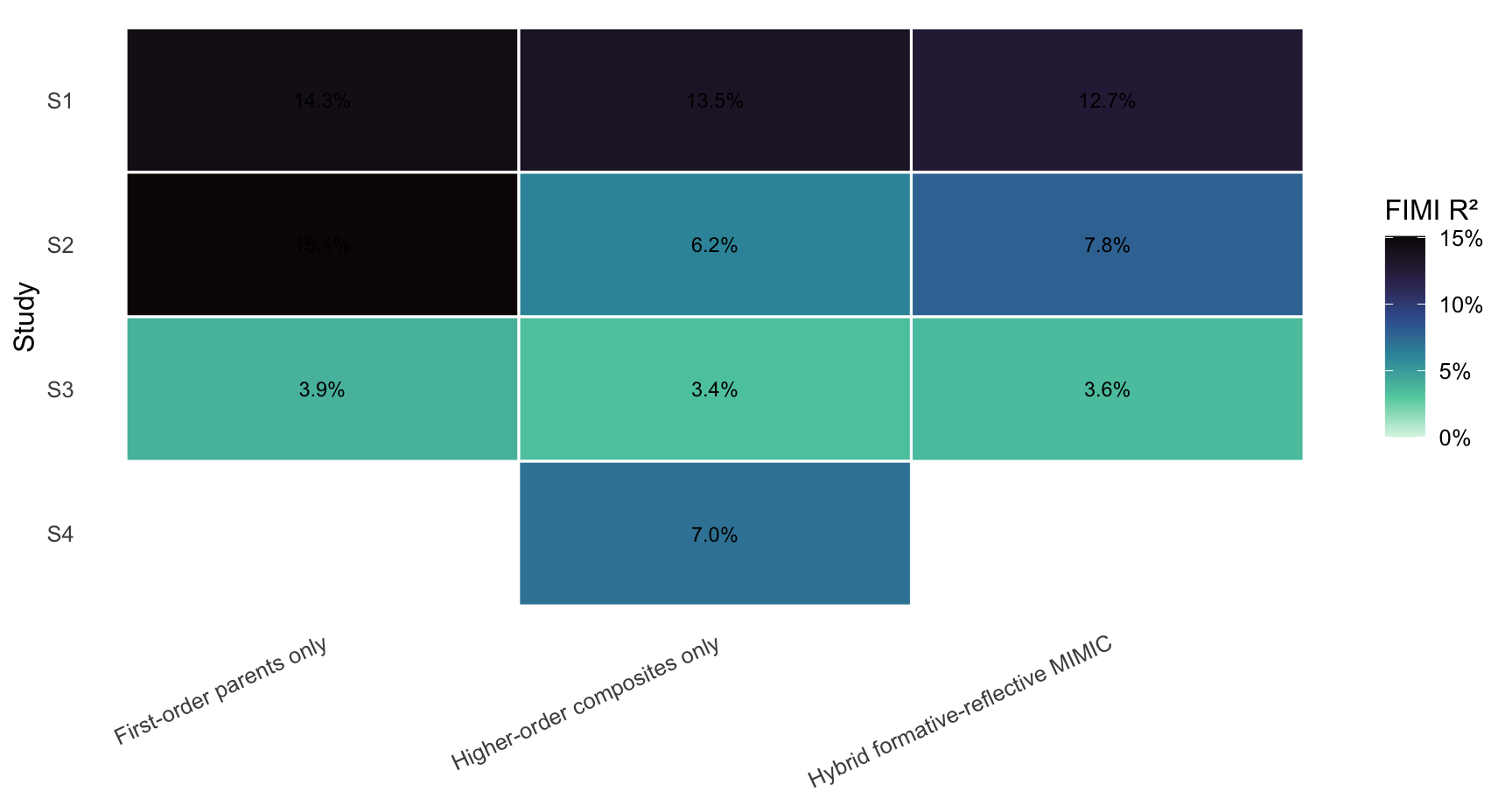
S1 All items Higher-order composites only `s1_pred_comp_full` 681 0.892 0.876 0.078 0.077 13.5%
S1 All items First-order parents only `s1_pred_fo_full` 681 0.882 0.876 0.057 0.070 14.3%
S1 All items Hybrid formative-reflective MIMIC `s1_pred_hyb_full` 681 0.885 0.880 0.054 0.068 12.7%
S2 Retained items Higher-order composites only `s2_pred_comp_full` 582 0.861 0.843 0.083 0.090 6.2%
S2 Retained items First-order parents only `s2_pred_fo_full` 582 0.922 0.915 0.054 0.059 15.1%
S2 Retained items Hybrid formative-reflective MIMIC `s2_pred_hyb_full` 582 0.881 0.873 0.057 0.080 7.8%
S3 Retained items Higher-order composites only `s3_pred_comp_full` 782 0.863 0.845 0.088 0.103 3.4%
S3 Retained items First-order parents only `s3_pred_fo_full` 782 0.928 0.921 0.055 0.070 3.9%
S3 Retained items Hybrid formative-reflective MIMIC `s3_pred_hyb_full` 782 0.889 0.882 0.059 0.090 3.6%
S4 All items Higher-order composites only `s4_pred_comp_full` 8,040 0.685 0.656 0.111 0.112 7.0%
S4 All items First-order parents only `s4_pred_fo_full` NA - - - - -
S4 All items Hybrid formative-reflective MIMIC `s4_pred_hyb_full` NA - - - - -
Figure 1: Explained variance in Full FIMI across core predictor families. Cells are lavaan R² for the FIMI latent. S4 appears only under COMP because its deployed short form did not field the parent batteries that FO and HYB require.

The FO models are intentionally permissive: more first-order parent constructs compete directly for the criterion and therefore usually explain more variance. The more policy-relevant comparison is between the broad-dimension families. If the COMP and HYB rows recover similar R², the broad DisInforMeter dimensions retain prediction after the first-order item pools are compressed into interpretable families. Large gaps flag representation dependence rather than a simple “stronger” or “weaker” scale.

Structural paths

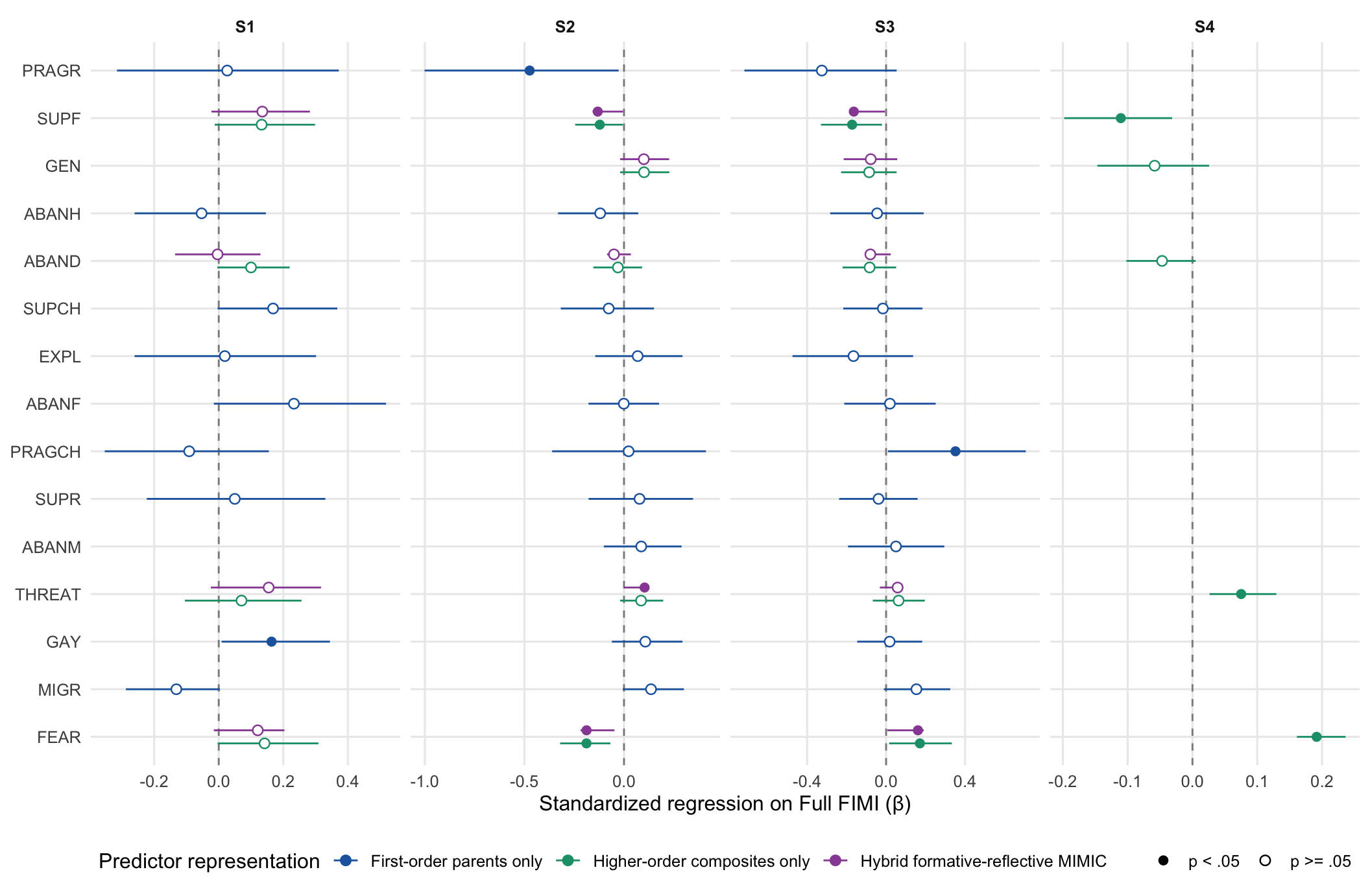
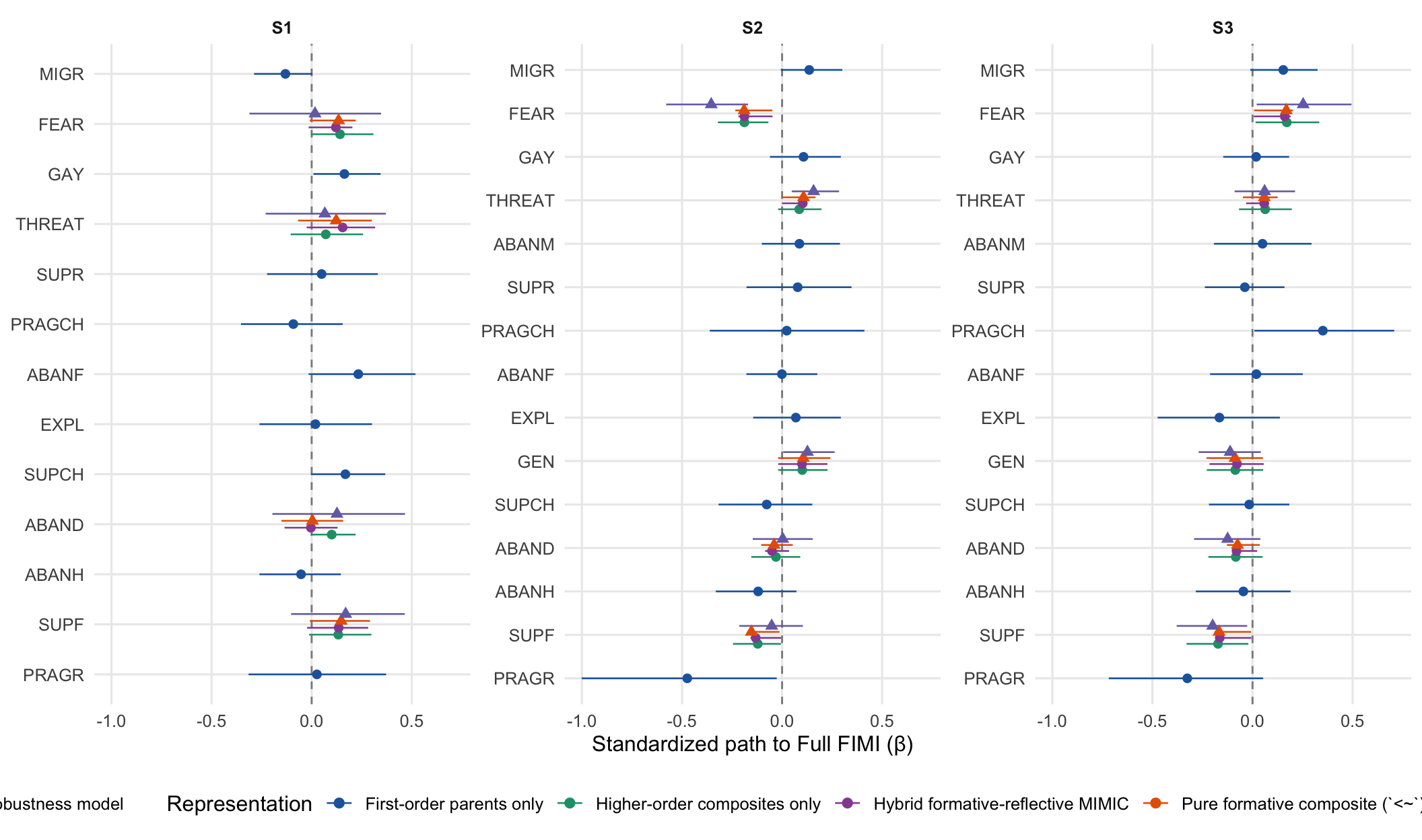
Figure 2: Standardized paths to Full FIMI for the core models. Points are std.all coefficients from lavaan::parameterEstimates(..., standardized = TRUE, ci = TRUE); whiskers are analytic 95% CIs. Open points mark p ≥ .05.
Table 10: Core standardized paths to Full FIMI. Coefficients are sorted by absolute magnitude within study and representation.
Study Representation Predictor beta 95% CI p
S1 Higher-order composites only FEAR 0.142 [-0.004, 0.309] 0.055
S1 Higher-order composites only SUPF 0.133 [-0.013, 0.298] 0.072
S1 Higher-order composites only ABAND 0.100 [-0.004, 0.220] 0.060
S1 Higher-order composites only THREAT 0.071 [-0.105, 0.256] 0.411
S1 First-order parents only ABANF 0.233 [-0.015, 0.519] 0.065
S1 First-order parents only SUPCH 0.168 [-0.004, 0.367] 0.055
S1 First-order parents only GAY 0.164 [0.009, 0.344] 0.039
S1 First-order parents only MIGR -0.131 [-0.288, 0.004] 0.056
S1 First-order parents only PRAGCH -0.092 [-0.353, 0.155] 0.446
S1 First-order parents only ABANH -0.053 [-0.261, 0.146] 0.580
S1 First-order parents only SUPR 0.050 [-0.223, 0.330] 0.704
S1 First-order parents only PRAGR 0.026 [-0.315, 0.372] 0.872
S1 First-order parents only EXPL 0.019 [-0.261, 0.302] 0.887
S1 Hybrid formative-reflective MIMIC THREAT 0.155 [-0.025, 0.317] 0.094
S1 Hybrid formative-reflective MIMIC SUPF 0.135 [-0.023, 0.282] 0.095
S1 Hybrid formative-reflective MIMIC FEAR 0.121 [-0.015, 0.203] 0.092
S1 Hybrid formative-reflective MIMIC ABAND -0.004 [-0.135, 0.129] 0.964
S2 Higher-order composites only FEAR -0.188 [-0.321, -0.068] 0.003
S2 Higher-order composites only SUPF -0.122 [-0.245, -0.006] 0.040
S2 Higher-order composites only GEN 0.101 [-0.019, 0.228] 0.099
S2 Higher-order composites only THREAT 0.086 [-0.020, 0.197] 0.109
S2 Higher-order composites only ABAND -0.031 [-0.154, 0.091] 0.612
S2 First-order parents only PRAGR -0.474 [-1.001, -0.027] 0.039
S2 First-order parents only MIGR 0.136 [-0.006, 0.301] 0.060
S2 First-order parents only ABANH -0.120 [-0.331, 0.072] 0.207
S2 First-order parents only GAY 0.107 [-0.061, 0.293] 0.199
S2 First-order parents only ABANM 0.087 [-0.101, 0.289] 0.346
S2 First-order parents only SUPR 0.078 [-0.178, 0.347] 0.528
S2 First-order parents only SUPCH -0.077 [-0.318, 0.151] 0.486
S2 First-order parents only EXPL 0.069 [-0.144, 0.294] 0.504
S2 First-order parents only PRAGCH 0.023 [-0.361, 0.411] 0.898
S2 First-order parents only ABANF -0.001 [-0.178, 0.176] 0.991
S2 Hybrid formative-reflective MIMIC FEAR -0.188 [-0.218, -0.048] 0.002
S2 Hybrid formative-reflective MIMIC SUPF -0.132 [-0.158, -0.005] 0.037
S2 Hybrid formative-reflective MIMIC THREAT 0.103 [0.000, 0.094] 0.048
S2 Hybrid formative-reflective MIMIC GEN 0.100 [-0.019, 0.227] 0.099
S2 Hybrid formative-reflective MIMIC ABAND -0.050 [-0.085, 0.035] 0.408
S3 Higher-order composites only SUPF -0.172 [-0.330, -0.021] 0.026
S3 Higher-order composites only FEAR 0.171 [0.015, 0.333] 0.032
S3 Higher-order composites only GEN -0.086 [-0.228, 0.053] 0.223
S3 Higher-order composites only ABAND -0.084 [-0.220, 0.051] 0.219
S3 Higher-order composites only THREAT 0.063 [-0.067, 0.196] 0.338
S3 First-order parents only PRAGCH 0.351 [0.009, 0.708] 0.044
S3 First-order parents only PRAGR -0.326 [-0.718, 0.053] 0.091
S3 First-order parents only EXPL -0.165 [-0.474, 0.137] 0.279
S3 First-order parents only MIGR 0.154 [-0.011, 0.325] 0.068
S3 First-order parents only ABANM 0.050 [-0.193, 0.295] 0.682
S3 First-order parents only ABANH -0.046 [-0.283, 0.190] 0.700
S3 First-order parents only SUPR -0.038 [-0.238, 0.160] 0.699
S3 First-order parents only ABANF 0.019 [-0.212, 0.251] 0.868
S3 First-order parents only GAY 0.018 [-0.146, 0.183] 0.827
S3 First-order parents only SUPCH -0.016 [-0.217, 0.184] 0.871
S3 Hybrid formative-reflective MIMIC SUPF -0.164 [-0.173, -0.006] 0.037
S3 Hybrid formative-reflective MIMIC FEAR 0.161 [0.006, 0.191] 0.037
S3 Hybrid formative-reflective MIMIC ABAND -0.080 [-0.093, 0.023] 0.241
S3 Hybrid formative-reflective MIMIC GEN -0.078 [-0.215, 0.056] 0.252
S3 Hybrid formative-reflective MIMIC THREAT 0.058 [-0.032, 0.083] 0.378
S4 Higher-order composites only FEAR 0.192 [0.161, 0.236] <0.001
S4 Higher-order composites only SUPF -0.111 [-0.198, -0.031] 0.007
S4 Higher-order composites only THREAT 0.075 [0.026, 0.129] 0.003
S4 Higher-order composites only GEN -0.058 [-0.147, 0.026] 0.169
S4 Higher-order composites only ABAND -0.047 [-0.102, 0.005] 0.074

Path diagrams

The diagrams below use the same visual grammar as the SEM figures elsewhere in the report, but they are generated directly from the fitted 04c prediction repository rather than from the older hand-maintained templates in figures/sem_templates/. The left column shows first-order parent factors where the model has a parent-to-composite layer; the middle column shows the broad DisInforMeter composites; the right column shows the FIMI criterion. Edge labels are fitted standardized coefficients.

S1 hybrid MIMIC -> Full FIMI

prediction_model S1 hybrid MIMIC -> Full FIMI EXPL EXPL GAY GAY THREAT THREAT EXPL->THREAT .75*** MIGR MIGR GAY->THREAT .13* ABANF ABANF MIGR->THREAT .15** ABANH ABANH ABAND ABAND ABANF->ABAND -.00 PRAGR PRAGR ABANH->ABAND 1.00*** PRAGCH PRAGCH FEAR FEAR PRAGR->FEAR .23* SUPR SUPR PRAGCH->FEAR .63*** SUPCH SUPCH SUPF SUPF SUPR->SUPF .90*** SUPCH->SUPF .02 FIMI FIMI THREAT->FIMI .15 ABAND->FIMI -.00 FEAR->FIMI .12 SUPF->FIMI .14

S2 hybrid MIMIC -> Full FIMI

prediction_model S2 hybrid MIMIC -> Full FIMI EXPL EXPL GAY GAY THREAT THREAT EXPL->THREAT -.06 MIGR MIGR GAY->THREAT .89*** ABANF ABANF MIGR->THREAT .08* ABANH ABANH ABAND ABAND ABANF->ABAND .18*** ABANM ABANM ABANH->ABAND .76*** PRAGR PRAGR ABANM->ABAND -.02 PRAGCH PRAGCH FEAR FEAR PRAGR->FEAR .22* SUPR SUPR PRAGCH->FEAR .53*** SUPCH SUPCH SUPF SUPF SUPR->SUPF .67 SUPCH->SUPF .19 FIMI FIMI THREAT->FIMI .10* ABAND->FIMI -.05 FEAR->FIMI -.19** GEN GEN SUPF->FIMI -.13* GEN->FIMI .10

S3 hybrid MIMIC -> Full FIMI

prediction_model S3 hybrid MIMIC -> Full FIMI EXPL EXPL GAY GAY THREAT THREAT EXPL->THREAT .06 MIGR MIGR GAY->THREAT .82*** ABANF ABANF MIGR->THREAT .06 ABANH ABANH ABAND ABAND ABANF->ABAND .06 ABANM ABANM ABANH->ABAND .93*** PRAGR PRAGR ABANM->ABAND -.09* PRAGCH PRAGCH FEAR FEAR PRAGR->FEAR .57*** SUPR SUPR PRAGCH->FEAR .24* SUPCH SUPCH SUPF SUPF SUPR->SUPF .80*** SUPCH->SUPF .06 FIMI FIMI THREAT->FIMI .06 ABAND->FIMI -.08 FEAR->FIMI .16* GEN GEN SUPF->FIMI -.16* GEN->FIMI -.08

S4 composites -> Full FIMI

prediction_model S4 composites -> Full FIMI THREAT THREAT ABAND ABAND FIMI FIMI THREAT->FIMI .08** FEAR FEAR ABAND->FIMI -.05 SUPF SUPF FEAR->FIMI .19*** GEN GEN SUPF->FIMI -.11** GEN->FIMI -.06

Core Full-FIMI path diagrams for the broad-dimension models. Edges and labels are extracted from the fitted lavaan objects in the Stage-5 prediction repository. Solid edges are p < .05; dashed edges are p >= .05. Blue coefficients are positive and red coefficients are negative.

Stability Across Waves

Stability is evaluated descriptively rather than by pretending the waves are exchangeable replications. S1 is the initial Lithuanian item-pool wave, S2 is the Lithuanian refinement, S3 is the German replication, and S4 is a short multinational deployment. The useful question is whether common predictors retain their sign and approximate magnitude when the same representation can be estimated in more than one wave.

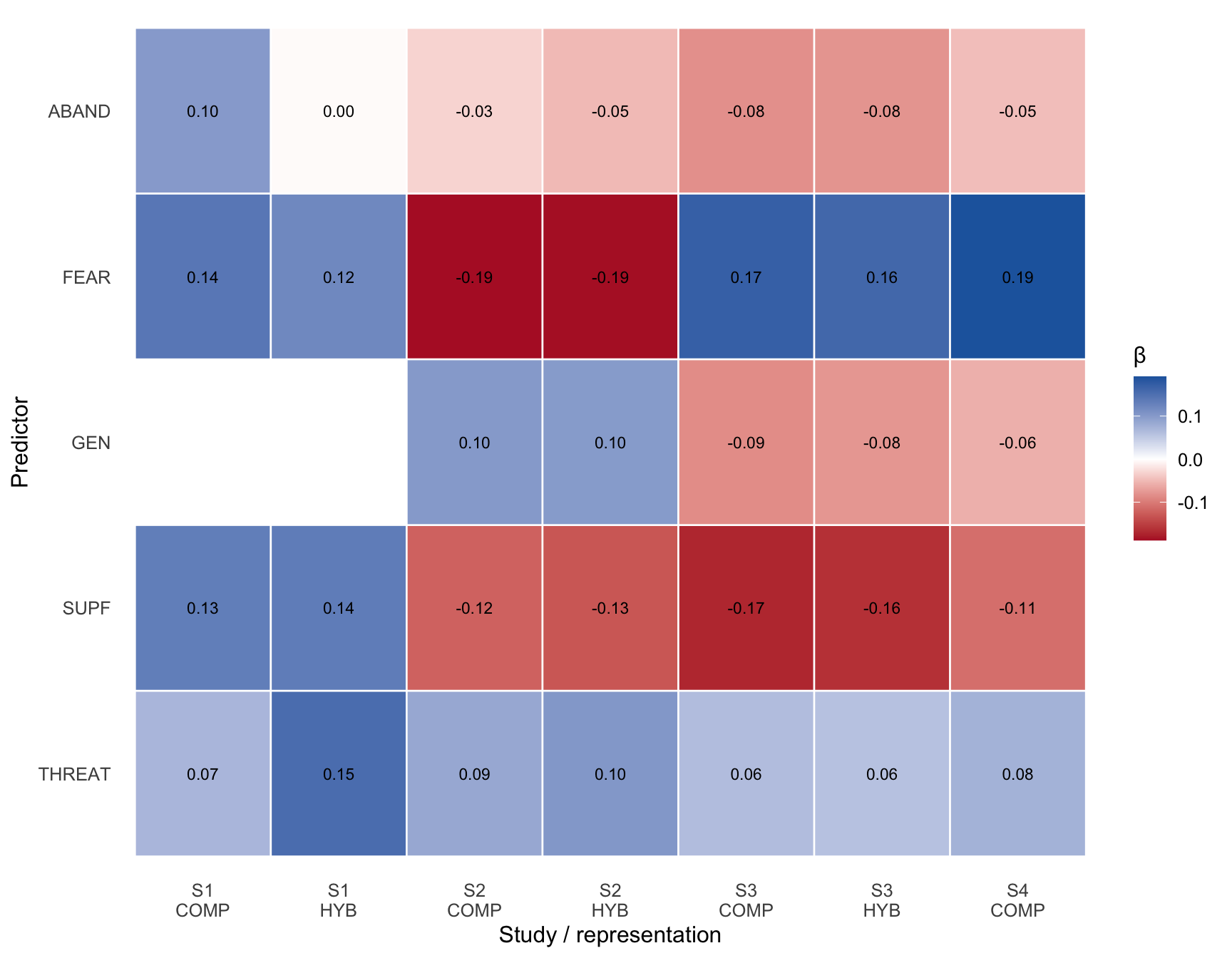
Table 11: Descriptive path-stability summary for Full-FIMI core representations. The table only compares predictors shared by both studies within the same representation.
Representation Study pair Shared paths Sign agreement &#124;Δβ&#124; <= .10 Mean &#124;Δβ&#124;
Higher-order composites only S1 -> S2 4 1 / 4 (25%) 1 / 4 (25%) 0.18
Higher-order composites only S1 -> S3 4 2 / 4 (50%) 2 / 4 (50%) 0.13
Higher-order composites only S1 -> S4 4 2 / 4 (50%) 2 / 4 (50%) 0.11
Higher-order composites only S2 -> S3 5 3 / 5 (60%) 3 / 5 (60%) 0.13
Higher-order composites only S2 -> S4 5 3 / 5 (60%) 3 / 5 (60%) 0.12
Higher-order composites only S3 -> S4 5 5 / 5 (100%) 5 / 5 (100%) 0.03
First-order parents only S1 -> S2 9 4 / 9 (44%) 4 / 9 (44%) 0.17
First-order parents only S1 -> S3 9 3 / 9 (33%) 2 / 9 (22%) 0.21
First-order parents only S2 -> S3 10 7 / 10 (70%) 6 / 10 (60%) 0.11
Hybrid formative-reflective MIMIC S1 -> S2 4 2 / 4 (50%) 2 / 4 (50%) 0.17
Hybrid formative-reflective MIMIC S1 -> S3 4 3 / 4 (75%) 3 / 4 (75%) 0.13
Hybrid formative-reflective MIMIC S2 -> S3 5 3 / 5 (60%) 3 / 5 (60%) 0.13
Figure 3: Path-stability heatmap for Full-FIMI broad-dimension models. Colour is the standardized path coefficient; blank cells indicate that a predictor is not defined for that study/representation.

Robustness Analyses

The robustness repository has two parts. The first changes the FIMI dependent variable while holding the predictor architecture explicit. The second changes the predictor architecture while keeping Full FIMI fixed. A result is robust when the substantive interpretation survives both checks: the same broad families carry prediction under Full versus source-specific FIMI, and the same path ordering is not an artefact of one higher-order operator.

FIMI DV choice

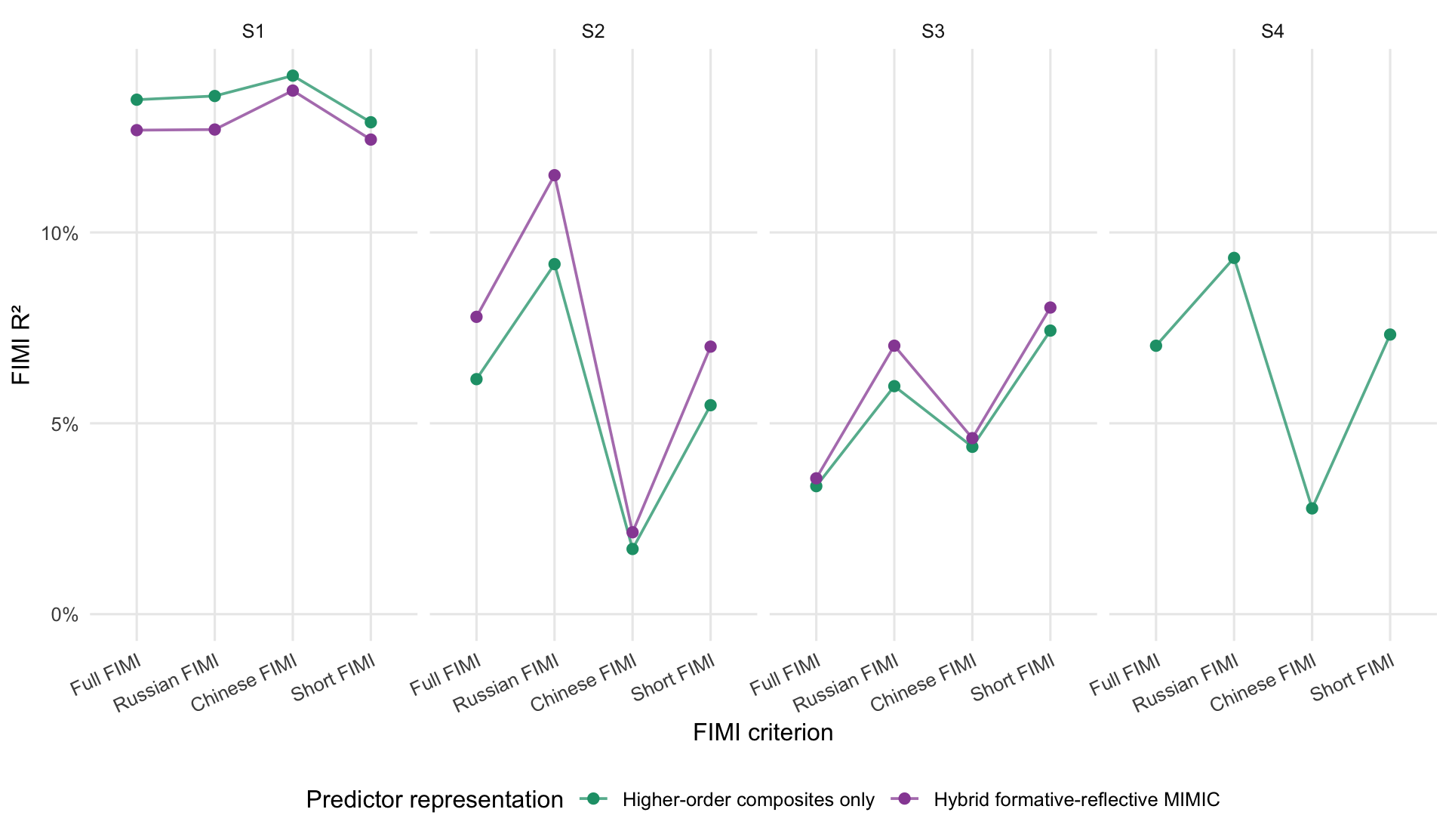
Figure 4: FIMI R² across dependent-variable operationalisations. Robustness cells use Russian-origin, Chinese-origin, or Short FIMI while preserving the predictor-side representation named on the x-axis.
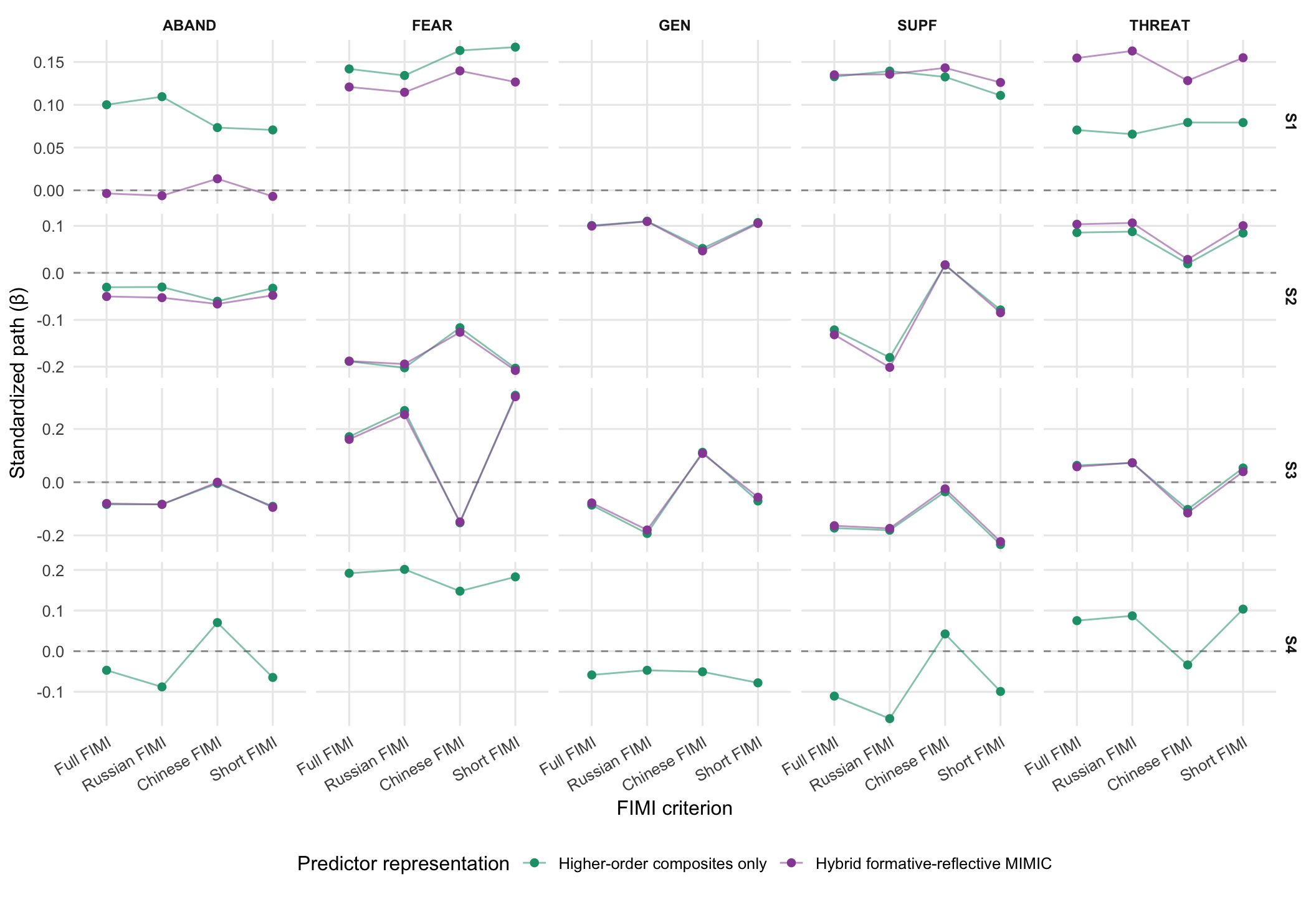
Figure 5: DV robustness of broad-dimension paths. The figure shows COMP and HYB paths across Full, Russian-origin, Chinese-origin, and Short FIMI. S4 contributes only the COMP rows.
Table 12: DV robustness deltas: source-specific and short-FIMI standardized paths minus the Full-FIMI path for the same study, representation, and predictor.
Study Representation Predictor β Full Δ Russian Δ Chinese Δ Short
S1 Higher-order composites only ABAND 0.100 - - -
S1 Higher-order composites only ABAND - - - -
S1 Higher-order composites only FEAR 0.142 - - -
S1 Higher-order composites only FEAR - - - -
S1 Higher-order composites only SUPF 0.133 - - -
S1 Higher-order composites only SUPF - - - -
S1 Higher-order composites only THREAT 0.071 - - -
S1 Higher-order composites only THREAT - - - -
S1 Hybrid formative-reflective MIMIC ABAND -0.004 - - -
S1 Hybrid formative-reflective MIMIC ABAND - - - -
S1 Hybrid formative-reflective MIMIC FEAR 0.121 - - -
S1 Hybrid formative-reflective MIMIC FEAR - - - -
S1 Hybrid formative-reflective MIMIC SUPF 0.135 - - -
S1 Hybrid formative-reflective MIMIC SUPF - - - -
S1 Hybrid formative-reflective MIMIC THREAT 0.155 - - -
S1 Hybrid formative-reflective MIMIC THREAT - - - -
S2 Higher-order composites only ABAND -0.031 - - -
S2 Higher-order composites only ABAND - - - -
S2 Higher-order composites only FEAR -0.188 - - -
S2 Higher-order composites only FEAR - - - -
S2 Higher-order composites only GEN 0.101 - - -
S2 Higher-order composites only GEN - - - -
S2 Higher-order composites only SUPF -0.122 - - -
S2 Higher-order composites only SUPF - - - -
S2 Higher-order composites only THREAT 0.086 - - -
S2 Higher-order composites only THREAT - - - -
S2 Hybrid formative-reflective MIMIC ABAND -0.050 - - -
S2 Hybrid formative-reflective MIMIC ABAND - - - -
S2 Hybrid formative-reflective MIMIC FEAR -0.188 - - -
S2 Hybrid formative-reflective MIMIC FEAR - - - -
S2 Hybrid formative-reflective MIMIC GEN 0.100 - - -
S2 Hybrid formative-reflective MIMIC GEN - - - -
S2 Hybrid formative-reflective MIMIC SUPF -0.132 - - -
S2 Hybrid formative-reflective MIMIC SUPF - - - -
S2 Hybrid formative-reflective MIMIC THREAT 0.103 - - -
S2 Hybrid formative-reflective MIMIC THREAT - - - -
S3 Higher-order composites only ABAND -0.084 - - -
S3 Higher-order composites only ABAND - - - -
S3 Higher-order composites only FEAR 0.171 - - -
S3 Higher-order composites only FEAR - - - -
S3 Higher-order composites only GEN -0.086 - - -
S3 Higher-order composites only GEN - - - -
S3 Higher-order composites only SUPF -0.172 - - -
S3 Higher-order composites only SUPF - - - -
S3 Higher-order composites only THREAT 0.063 - - -
S3 Higher-order composites only THREAT - - - -
S3 Hybrid formative-reflective MIMIC ABAND -0.080 - - -
S3 Hybrid formative-reflective MIMIC ABAND - - - -
S3 Hybrid formative-reflective MIMIC FEAR 0.161 - - -
S3 Hybrid formative-reflective MIMIC FEAR - - - -
S3 Hybrid formative-reflective MIMIC GEN -0.078 - - -
S3 Hybrid formative-reflective MIMIC GEN - - - -
S3 Hybrid formative-reflective MIMIC SUPF -0.164 - - -
S3 Hybrid formative-reflective MIMIC SUPF - - - -
S3 Hybrid formative-reflective MIMIC THREAT 0.058 - - -
S3 Hybrid formative-reflective MIMIC THREAT - - - -
S4 Higher-order composites only ABAND -0.047 - - -
S4 Higher-order composites only ABAND - - - -
S4 Higher-order composites only FEAR 0.192 - - -
S4 Higher-order composites only FEAR - - - -
S4 Higher-order composites only GEN -0.058 - - -
S4 Higher-order composites only GEN - - - -
S4 Higher-order composites only SUPF -0.111 - - -
S4 Higher-order composites only SUPF - - - -
S4 Higher-order composites only THREAT 0.075 - - -
S4 Higher-order composites only THREAT - - - -

The expected pattern is asymmetric. Russian-origin FIMI should track Full FIMI more closely because the full battery contains more Russian-origin items than Chinese-origin items. Chinese-origin FIMI is the harder test: if paths attenuate or reorder there, the result is not a failure of the scale, but evidence that receptivity to Chinese-origin narratives is a partly distinct criterion and should not be inferred from the full score alone.

Predictor representation choice

Figure 6: Representation robustness under Full FIMI. Core representations are shown alongside pure formative and reflective second-order robustness models.
Table 13: Representation comparison under Full FIMI. Formative and reflective second-order models are interpreted as robustness checks, not as replacements for the core models.
Study Tier Representation model_id FIMI R²
S1 Core model First-order parents only `s1_pred_fo_full` 14.3%
S1 Core model Higher-order composites only `s1_pred_comp_full` 13.5%
S1 Core model Hybrid formative-reflective MIMIC `s1_pred_hyb_full` 12.7%
S1 Robustness model Pure formative composite (`<~`) `s1_pred_form_full` 12.7%
S1 Robustness model Reflective second-order (`=~`) `s1_pred_ref_full` 12.4%
S2 Core model First-order parents only `s2_pred_fo_full` 15.1%
S2 Core model Higher-order composites only `s2_pred_comp_full` 6.2%
S2 Core model Hybrid formative-reflective MIMIC `s2_pred_hyb_full` 7.8%
S2 Robustness model Pure formative composite (`<~`) `s2_pred_form_full` 7.7%
S2 Robustness model Reflective second-order (`=~`) `s2_pred_ref_full` 10.7%
S3 Core model First-order parents only `s3_pred_fo_full` 3.9%
S3 Core model Higher-order composites only `s3_pred_comp_full` 3.4%
S3 Core model Hybrid formative-reflective MIMIC `s3_pred_hyb_full` 3.6%
S3 Robustness model Pure formative composite (`<~`) `s3_pred_form_full` 3.2%
S3 Robustness model Reflective second-order (`=~`) `s3_pred_ref_full` 3.4%
S4 Core model Higher-order composites only `s4_pred_comp_full` 7.0%

Pure formative and reflective second-order models are not treated as a horse race. They ask whether the core conclusion depends on whether broad DisInforMeter dimensions are treated as aggregates of their parents (<~) or as latent common causes of those parents (=~). The strongest claims are the ones that survive across the core hybrid MIMIC model and these two representation sensitivities.

Interpretation Synthesis

The repository supports three grounded conclusions.

First, Full FIMI should remain the primary dependent variable. It is the only criterion that fully uses the administered news battery in each FIMI wave and gives the most stable prediction surface. Russian-origin FIMI is usually close to Full FIMI because Russian-origin items dominate the full score. Chinese-origin FIMI is the important exception: it can attenuate or reorder paths, so Chinese-origin receptivity should be reported directly whenever the source-specific claim matters.

Second, broad DisInforMeter dimensions carry real predictive signal, but representation matters. The FO family is a valuable diagnostic because it shows where the signal originates among the first-order parents. It is not the cleanest final model because it allows many highly related parent constructs to compete. The COMP and HYB families are the central inferential layer: if they recover the same broad path pattern, the scale is not merely a pile of item-level associations.

Third, S4 is a deployment test, not a higher-order representation test. The multinational wave provides the most important generalisation evidence for Full/Russian/Chinese/Short FIMI prediction, but the instrument was shortened before fielding and lacks the first-order parent batteries required for the 04a representation comparison. S4 therefore enters the repository under the COMP family only — its broad composites (GEN, THREAT, ABAND, FEAR, SUPF) predict FIMI without an FO or HYB counterpart. The correct reading is that S4 tests whether the deployed broad factors predict FIMI across countries; it does not adjudicate whether formative, reflective, or hybrid higher-order operators fit better, and the deployed Chinese-affect items are folded into the broad SUPF composite rather than declared as a separate SUPFCH predictor.

A note on item-key selection. The Stage-5 grid is estimated on the selected 04a item key per study (S1 = all-item development catalogue with borrowed direct indicators; S2 / S3 = pooled retained keys; S4 = deployment short form). S1 FORM and HYB carry the same exploratory tuning as 04a — marker-variable scaling plus lower-bounded composite residuals — so their parameter estimates should be read as antecedent evidence of the higher-order architecture rather than as a definitive S1 deployment of it.

Together, these results give a defensible analysis strategy for the paper: report Full FIMI × core predictor representations as the main Stage-5 evidence; use Russian, Chinese, and Short FIMI as criterion robustness checks; and use pure formative plus reflective second-order fits as representation robustness checks. Claims that survive across those axes are stable enough for the manuscript. Claims that only appear under one criterion or one operator should be described as model-dependent and carried forward as revision targets rather than hidden.

References