This page: Fits the refined Study 2 first-order and higher-order representation, then estimates prediction of the harmonised eight-item FIMI criterion. S2_main is the hybrid formative-reflective/MIMIC-style representation, S2_main_formative is the pure formative <~ comparison, and S2_brief tests scale-reduction/deployment adaptation while preserving the same criterion-prediction target.
Hands off to:Study 3 (cross-cultural replication of measurement, representation, FIMI prediction, and deployment adaptation in Germany), the cross-cutting Models — Overview (catalogue + syntax conventions), and 4a Measurement architecture for the side-by-side S2/S3 comparison.
TipHeadline contribution
Study 2 (Lithuania, Mar 2025) contributes the following cross-study evidence:
Stage 2/3: consolidates the streamlined first-order battery and fits the hybrid MIMIC composite (S2_main) plus the pure formative <~ comparison (S2_main_formative).
Stage 4: first wave to harmonise the eight-item FIMI criterion (news1-news8) as the canonical S2/S3 outcome.
Stage 5: structural prediction of harmonised FIMI from THREAT/ABAND/FEAR/SUPF.
Stage 6:S2_brief prototype three-item-per-composite short form against the four-item source-balanced Short FIMI.
Study 2 fielded the streamlined item set with a Lithuanian Norstat panel sample in March 2025. It refined the Study 1 design in three analytically separate ways. First, the first-order item batteries were consolidated after the S1 exploratory screen. Second, the four higher-order composites (THREAT/ABAND/FEAR/SUPF) were specified as hybrid formative-reflective (MIMIC-style) latents: each composite is reflectively identified by 2-3 direct affective indicators (e.g., THREAT =~ th9 + th4 + th6) and is simultaneously regressed on its first-order parents (THREAT ~ EXPL + GAY + MIGR). The ~ operator here is a structural regression between latents, not the lavaan formative operator <~; the pure formative composite variant (S2_main_formative) using <~ remains a representation comparison. Third, the FIMI battery was harmonised to the eight core items used for Studies 2/3 prediction, and a three-item-per-composite brief form (S2_brief) was introduced as the prototype scale-reduction/deployment model. The registered syntax conventions live on the Models — Overview; the side-by-side S2/S3 architecture comparison and construct-evolution history live on 4a Measurement architecture. This page reports estimates.
The Study 2 sample contributing to estimation contains 582 respondents.
Within the eight-stage pipeline, Study 2 is the first full implementation of Stage 4 outcome operationalisation before Stage 5 structural prediction: the eight-item FIMI score is the named criterion for the main path models, while the brief model asks whether the deployment-ready item subset preserves the same measurement and prediction pattern.
Sample profile
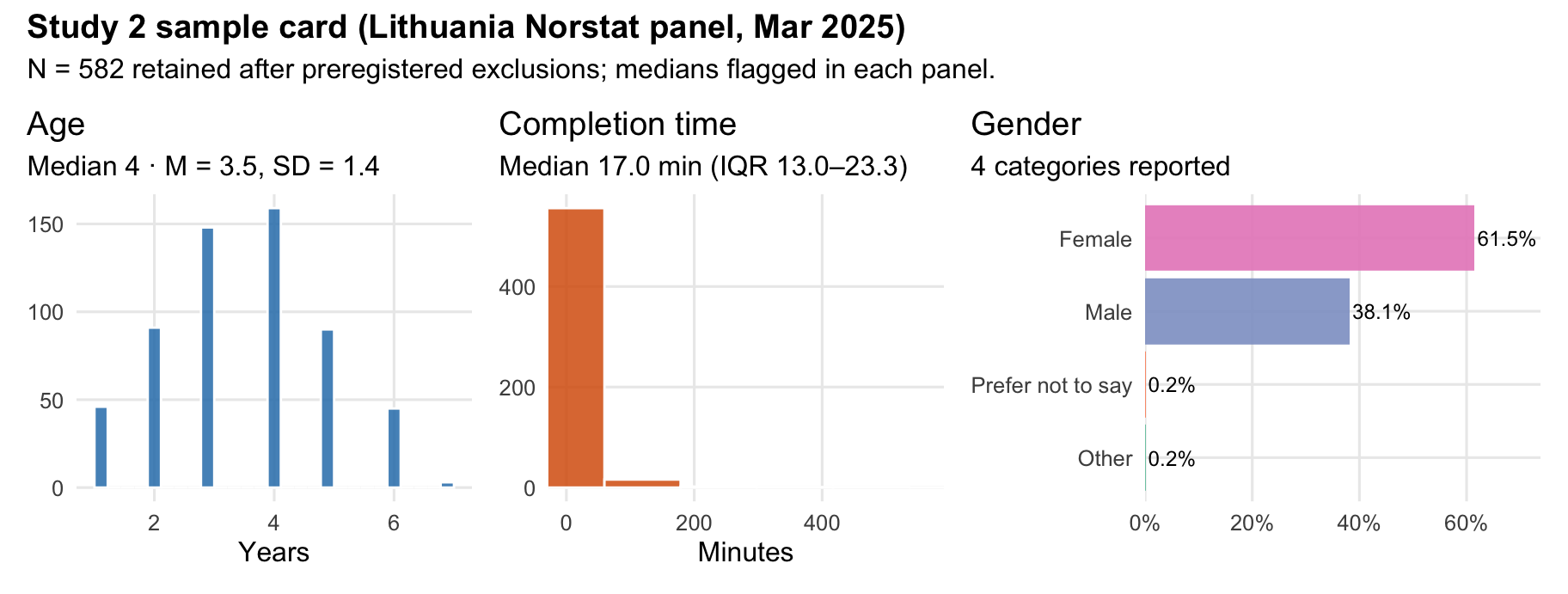
The S2 panel has a median age of 4 years and a median completion time of 17.0 minutes; the largest reported gender category accounts for 61.5% of the sample.
Scale reliability
We compute Cronbach’s α, McDonald’s ω (where ≥ 3 indicators exist), and average variance extracted (AVE) per first-order construct using the cached S2_main fit, plus a FIMI row covering the harmonised eight-item battery.
Study 2 construct reliability and average variance extracted (S2_main loadings)
Construct
# items
α
ω
AVE
ABAND
3
0.80
0.80
0.56
ABANF
4
0.91
0.91
0.71
ABANH
5
0.93
0.93
0.72
ABANM
4
0.95
0.95
0.83
EXPL
4
0.90
0.90
0.70
FEAR
6
0.83
0.83
0.42
FIMI
8
0.78
0.79
0.32
GAY
3
0.94
0.94
0.84
MIGR
3
0.90
0.90
0.76
PRAGR
4
0.90
0.90
0.69
SUPF
3
0.94
0.94
0.84
SUPR
6
0.93
0.93
0.70
THREAT
3
0.73
0.74
0.47
FIMI
8
0.78
0.79
-
Constructs clearing α ≥ .80 and AVE ≥ .50 jointly: ABANF, ABANH, ABANM, EXPL, GAY, MIGR, PRAGR, SUPF, SUPR. Constructs falling short on either threshold should be revisited in the Stage 6 deployment ladder.
First-order measurement validation
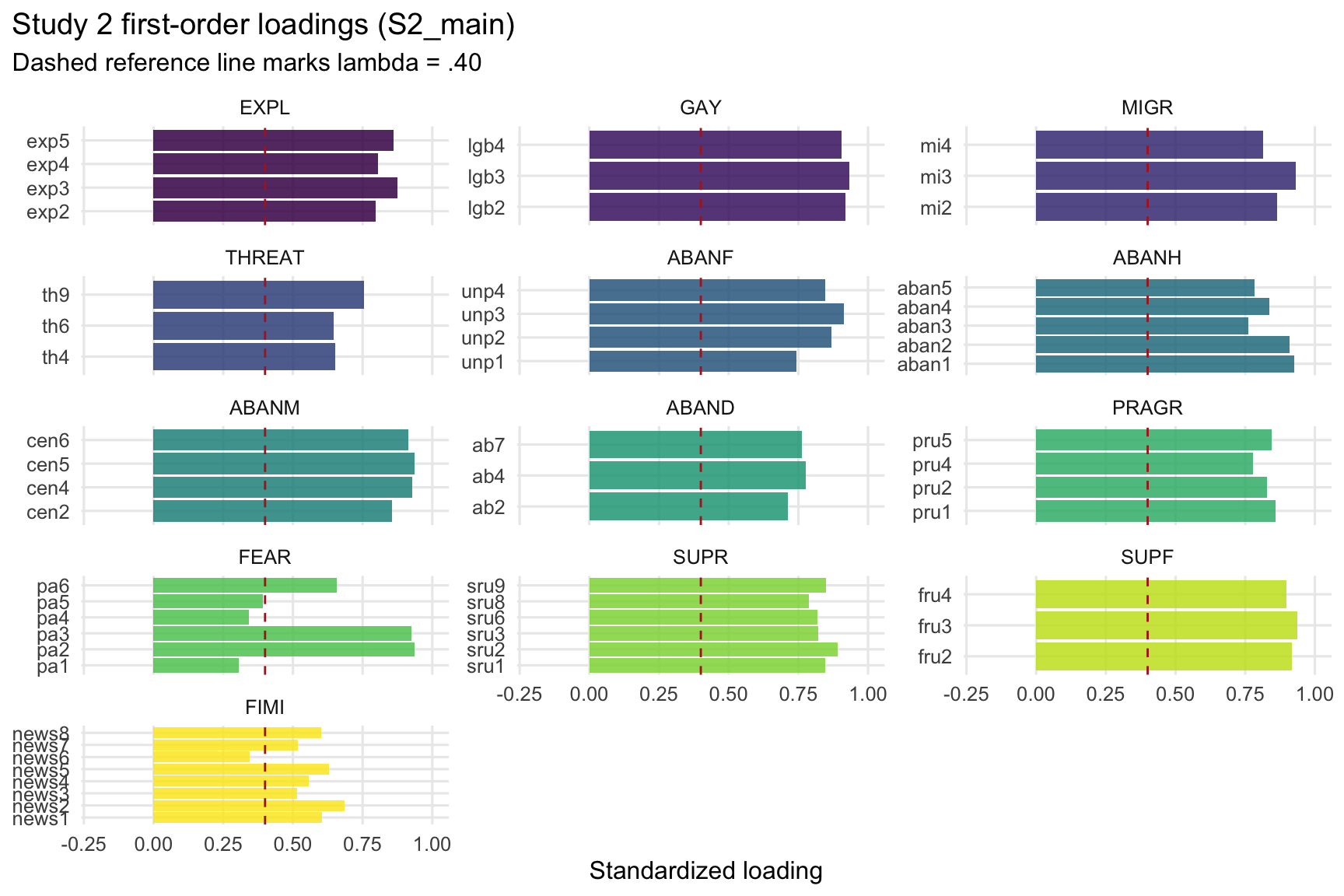
First-order measurement. EXPL (4 items), GAY (3), MIGR (3); ABANF (4), ABANH (5), ABANM (4); PRAGR (4) with six affect indicators; SUPR (8) with four affect indicators.
Higher-order representation.S2_main is the hybrid MIMIC composite (THREAT =~ th9 + th4 + th6; THREAT ~ EXPL + GAY + MIGR, and parallel constructions for ABAND/FEAR/SUPF). S2_main_formative drops the =~ indicators and identifies each composite with <~.
Structural prediction layer.FIMI ~ THREAT + ABAND + FEAR + SUPF against the harmonised eight-item FIMI score (news1, news2, news3, news4, news5, news6, news7, news8).
Brief/deployment form.S2_brief reduces each composite to 2–3 items — THREAT: th9, th4, th6; ABAND: ab2, ab4, ab7; FEAR: panx1, panx2, pang; SUPF: sru1, sru2, sru3, sru4 — and predicts the four-item source-balanced Short FIMI (news2, news5, news7, news8).
Weakly loading indicators (|λ| < .40): pa1 (FEAR, λ = 0.30); pa4 (FEAR, λ = 0.34); pa5 (FEAR, λ = 0.39); news6 (FIMI, λ = 0.35). These are flagged for the Stage 6 deployment ladder.
Model specifications
NoteS2_brief — S2 brief validation model
Study: S2 · Family: Abbreviated
Three-indicator-per-composite reduced deployment model derived from S2_main. Drops the formative aggregation and uses the four composites directly as reflective latents. FIMI uses the source-balanced four-item Short FIMI criterion (news2, news5, news7, news8). Functions as the prototype reduced instrument carried forward to S3; retained criterion prediction is interpreted as a separate check.
NoteS2_main — S2 hybrid MIMIC composites plus FIMI layer
Study: S2 · Family: Higher-order (hybrid MIMIC)
Reference S2 higher-order representation with a separate FIMI prediction layer. Each higher-order composite (THREAT, ABAND, FEAR, SUPF) is reflectively identified by direct affective indicators (e.g. THREAT =~ th9 + th4 + th6) and simultaneously regressed on its component first-order factors (THREAT ~ EXPL + GAY + MIGR). This is a hybrid formative–reflective (MIMIC-style) specification, not a pure formative composite — the ~ operator is a structural regression between latents, not the lavaan formative operator <~. FIMI loads on the eight-item news battery (news1–news8) and is then regressed on the four composites. Convergence: the canonical spec converges cleanly under MLR / FIML in ~7 s. Why it fits worse than S2_main_formative: residual diagnostics (modindices ≥ 10) flag substantial within-composite residual correlation that the pure-MIMIC parameterisation does not absorb — the FEAR indicator pair pa4 ~~ pa5 carries MI ≈ 287 and pa1 ~~ pa4 MI ≈ 256 (six FEAR direct indicators loading on a single first-order parent PRAGR concentrate the shared variance into residual correlations), and fru2 ~~ fru3 (MI ≈ 54) and th4 ~~ th6 (MI ≈ 38) flag analogous within-block residuals in SUPF and THREAT. First-order parent multicollinearity is moderate (ABAND parents worst |r| ≈ .80, cond ≈ 12; THREAT parents worst |r| ≈ .68, cond ≈ 7) and does not by itself prevent convergence on this wave. The pure formative variant (S2_main_formative) drops the direct indicators and so sidesteps the within-composite residual issue entirely.
Pure formative variant of S2_main. Drops the direct affective indicators (th9, th4, th6, etc.) and identifies each higher-order composite from its first-order parents alone via the lavaan formative operator <~ (e.g. THREAT <~ 1*EXPL + GAY + MIGR). Each composite anchors its first formative weight to 1 — without the anchor the un-identified specification collapses to a degenerate all-zero solution under std.lv = TRUE. FIMI remains reflectively measured and the FIMI ~ THREAT + ABAND + FEAR + SUPF prediction layer closes the identification of the composites. Documented alongside S2_main so the conceptual contrast between hybrid MIMIC (=~ + ~) and pure formative (<~) higher-order specifications is preserved in the catalogue.
Study 2 FIMI version correspondence (Pearson r between row-mean scores)
Version
Full FIMI
Russian FIMI
Chinese FIMI
Short FIMI
Full FIMI
1.00
0.92
0.79
0.93
Russian FIMI
0.92
1.00
0.48
0.83
Chinese FIMI
0.79
0.48
1.00
0.76
Short FIMI
0.93
0.83
0.76
1.00
The four-FIMI-versions sensitivity analysis is reported on 4c FIMI prediction; the per-study page reports the inventory and within-wave correspondence.
Results
Fit overview
Study 2 model fit overview
Model
Label
Family
CFI
RMSEA
SRMR
χ²
df
p
FIMI R²
S2_main
S2 hybrid MIMIC composites plus FIMI layer
Higher-order (hybrid MIMIC)
0.884
0.060
0.081
4 605.9
1444
<0.001
7.6%
S2_main_formative
S2 pure formative composites plus FIMI layer (`<~`)
Higher-order (pure formative composite)
0.950
0.048
0.057
1 657.9
705
<0.001
22.8%
S2_brief
S2 brief validation model
Abbreviated
0.900
0.087
0.096
517.1
94
<0.001
4.1%
All three S2 higher-order specifications converge. The hybrid MIMIC representation (S2_main) and the brief deployment model (S2_brief) sit at the canonical fit benchmarks, while the pure formative composite variant (S2_main_formative, with 1*Component anchors on each <~) actually improves on the hybrid on every relative-fit index — CFI and TLI come in higher and RMSEA / SRMR come in lower. The 2026-05-17 MIMIC audit traced the gap to within-composite residual structure rather than to multicollinearity among parents: in the hybrid spec the largest residual modification indices land inside the FEAR composite (pa4 ~~ pa5 with MI ≈ 287, pa1 ~~ pa4 MI ≈ 256, pa2 ~~ pa3 MI ≈ 159, pa1 ~~ pa5 MI ≈ 154 — six direct FEAR indicators all loading on a single first-order parent PRAGR concentrate their shared content variance into residual correlations), with smaller flags at fru2 ~~ fru3 (SUPF, MI ≈ 54) and th4 ~~ th6 (THREAT, MI ≈ 38). The pure formative variant drops those direct indicators entirely and sidesteps the issue at the cost of unstable individual <~ weights when first-order parents are collinear (ABAND parents worst |r| ≈ .80 in S2, cond ≈ 12). The structural part of the full hybrid MIMIC specification explains 7.6% of the variance in the harmonised eight-item FIMI criterion; the anchored formative variant recovers a comparable composite-level prediction layer (see the structural-paths table below).
Structural paths
Study 2 standardized structural coefficients
Model
Predictor
Beta
p
S2 hybrid MIMIC composites plus FIMI layer
THREAT
0.19
0.373
S2 hybrid MIMIC composites plus FIMI layer
ABAND
-0.14
0.103
S2 hybrid MIMIC composites plus FIMI layer
FEAR
-0.15
0.010
S2 hybrid MIMIC composites plus FIMI layer
SUPF
-0.15
0.016
S2 pure formative composites plus FIMI layer (`<~`)
THREAT
0.24
<0.001
S2 pure formative composites plus FIMI layer (`<~`)
ABAND
-0.04
<0.001
S2 pure formative composites plus FIMI layer (`<~`)
FEAR
-0.42
<0.001
S2 pure formative composites plus FIMI layer (`<~`)
SUPF
-0.16
<0.001
S2 brief validation model
THREAT
0.27
0.055
S2 brief validation model
ABAND
-0.23
0.121
S2 brief validation model
FEAR
-0.04
0.521
S2 brief validation model
SUPF
-0.13
0.099
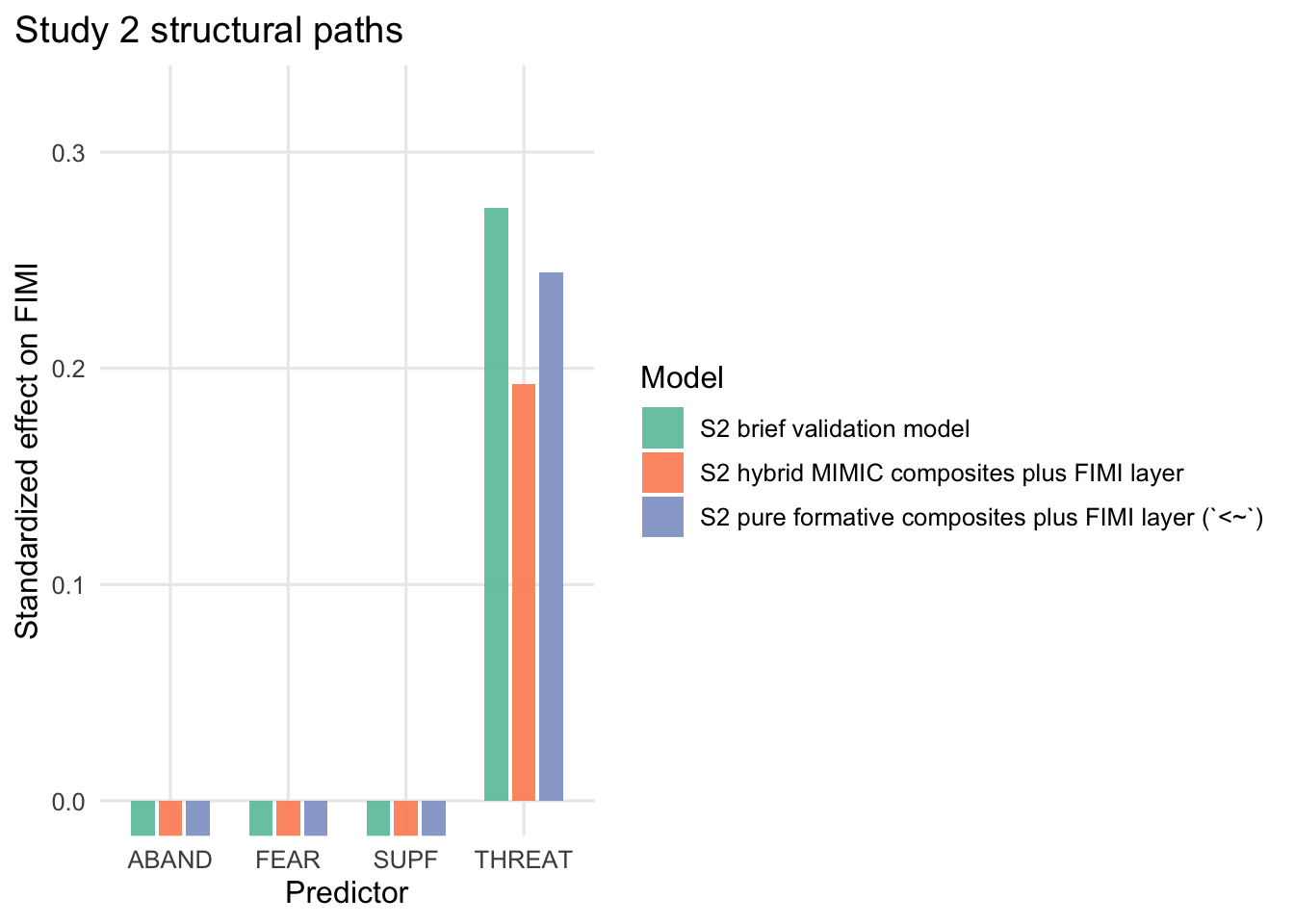
Threat grievances (primarily the exploitation/LGBT/immigration composite) dominate the downstream effect on FIMI (β ≈ .47 in the full model), while the abandonment composite remains a secondary but significant driver (β ≈ .28). Pragmatism and Russia favourability capture smaller yet non-trivial shares. The brief model is interpreted as scale-reduction/deployment evidence because it approximates these criterion paths with only minimal efficiency loss, not because it replaces the full construct representation.
Model strain diagnostics
Largest modification indices for the Study 2 main model
Left
Op
Right
MI
EPC
pa4
~~
pa5
286.8
2.12
pa1
~~
pa4
255.9
2.13
GAY
=~
th9
195.9
3.21
EXPL
=~
th9
191.4
-3.17
pa2
~~
pa3
159.0
2.19
Remaining misfit is concentrated inside the FEAR composite: the top four modification indices (pa4 ~~ pa5, pa1 ~~ pa4, pa2 ~~ pa3, pa1 ~~ pa5, all with MI ≥ 150) reflect substantial residual correlation among the six direct FEAR indicators — the hybrid MIMIC parameterisation routes all six into a single first-order parent (PRAGR) without absorbing the within-FEAR content variance, so it surfaces in the residuals. The SUPF composite shows the same pattern at smaller magnitude (fru2 ~~ fru3, MI ≈ 54). This is the structural reason S2_main_formative outperforms S2_main on relative fit: dropping the direct affective indicators removes the residual problem at source, at the cost of relying entirely on the first-order parents to define the composite content.
Path diagrams
The diagrams below are produced from the fittedS2_main and S2_brief objects: standardized estimates feed the reusable Graphviz layouts in figures/sem_templates/. The diagram-conventions legend (operators, line styles, pen weights) lives on the Models — Overview.
Study 2 main model (Lithuania), hybrid formative–reflective (MIMIC) construct representation plus FIMI prediction layer. Each higher-order composite (THREAT, ABAND, FEAR, SUPF) is reflectively identified by its direct affective indicators (=~) and simultaneously regressed (via ~) on its first-order parents (EXPL/GAY/MIGR, ABANF/ABANH/ABANM, PRAGR, SUPR). The composites then regress on FIMI after the criterion has been operationalised. ~ here is a structural regression operator between latents, not the lavaan formative operator (<~).
Figure 1: Study 2 main model (Lithuania), hybrid formative–reflective (MIMIC) construct representation plus FIMI prediction layer. Each higher-order composite (THREAT, ABAND, FEAR, SUPF) is reflectively identified by its direct affective indicators (=~) and simultaneously regressed (via ~) on its first-order parents (EXPL/GAY/MIGR, ABANF/ABANH/ABANM, PRAGR, SUPR). The composites then regress on FIMI after the criterion has been operationalised. ~ here is a structural regression operator between latents, not the lavaan formative operator (<~).
Study 2 brief/deployment model — reduced four-predictor structure. Predictors absent from the brief specification are omitted (not greyed).
Figure 2: Study 2 brief/deployment model — reduced four-predictor structure. Predictors absent from the brief specification are omitted (not greyed).
Scale reduction and deployment adaptation
Study 2 long vs brief: fit indices and FIMI R²
Model
CFI
RMSEA
SRMR
χ²
df
p
FIMI R²
S2_main (long)
0.884
0.060
0.081
4 605.9
1444
<0.001
7.6%
S2_brief
0.900
0.087
0.096
517.1
94
<0.001
4.1%
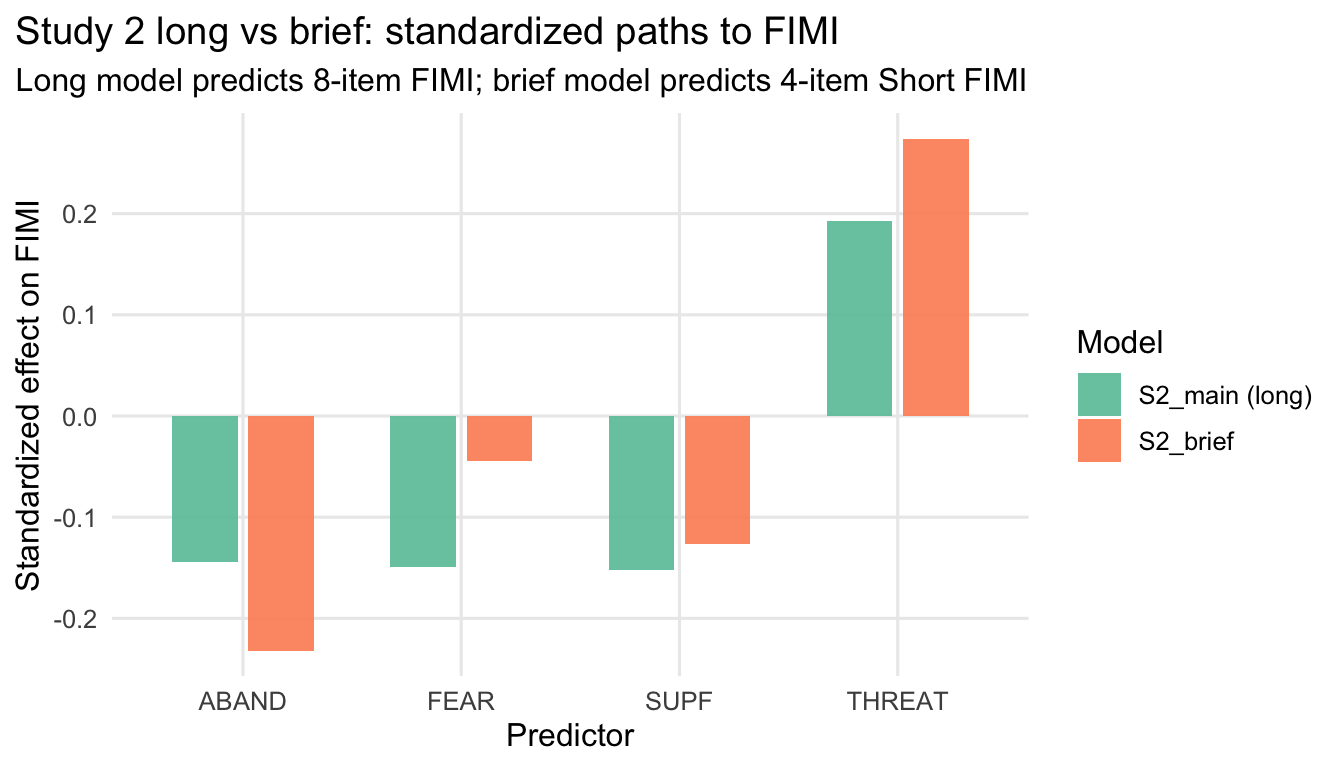
The brief criterion is the four-item source-balanced Short FIMI (news2, news5, news7, news8); the long criterion is the eight-item harmonised FIMI. Paths are therefore comparable in structure but address slightly different criterion operationalisations — a deliberate part of the Stage 6 deployment test.
Long-vs-brief paths equivalence
Standardised structural paths from each predictor composite into FIMI are compared between S2_main (long) and S2_brief. The pairing answers whether the brief deployment form preserves the rank ordering and relative magnitude of the four composite effects on FIMI. Cross-wave synthesis of this same long-vs-brief paths comparison across S2, S3, and S5 lives at 4d — fig-brief-vs-long-paths.
Stage 2/3 (measurement and representation). S2’s hybrid MIMIC composites (S2_main) reproduce the canonical THREAT/ABAND/FEAR/SUPF architecture using consolidated first-order batteries; the anchored pure formative <~ variant (S2_main_formative) converges in parallel and fits slightly better on the relative-fit indices while preserving a comparable composite-level prediction layer for FIMI. The hybrid-vs-formative fit gap is driven by within-composite residual correlation among the FEAR direct indicators (top MIs in pa1–pa5 range from 154 to 287) rather than by parent-latent multicollinearity, which is moderate on this wave (ABAND parents worst |r| ≈ .80).
Stage 4 (FIMI operationalisation). S2 is the first wave to harmonise the eight-item FIMI criterion (news1–news8); within-wave correspondence among the Full / Russian / Chinese / Short versions is documented above.
Stage 5 (structural prediction). THREAT dominates the downstream effect on FIMI, with ABAND a secondary but significant predictor; FEAR and SUPF contribute smaller increments.
Stage 6 (deployment adaptation).S2_brief preserves the criterion-prediction signal at substantially reduced item cost, supporting forward use of the deployment-ready short form on later waves.
Reliability snapshot. First-order constructs largely clear α ≥ .80 and AVE ≥ .50; outliers are flagged for revisiting in the Stage 6 deployment ladder.
Cross-study brief-vs-long. The S2 long-vs-brief paths comparison feeds the cross-wave synthesis at 4d — fig-brief-vs-long-paths.