-
Inputs: S1-S4 wrangled item-level files in
data/wrangled_data/, plus the canonical FIMI item identity map in R/roadmap_helpers.R::fimi_item_map() and the audit mapping files outputs/item_mapping_overview.csv / outputs/item_mapping_master_long.csv.
-
This page: FIMI DV operationalisation (Stage 4 owner page). Rebuilds the FIMI dependent-variable evidence end-to-end: S1 15-item pool to S2+ 8-item battery, S2/S3/S4 Full/Russian/Chinese/Short DV measurement checks, and the reproducible short-form selection across S2-S4.
-
Hands off to: 4c FIMI prediction for structural prediction using the resulting criterion definitions; 4d Deployment and invariance for predictor-scale deployment; 3d Study 4 for S4 country-level modelling.
Overview
This page rebuilds the FIMI dependent-variable (DV) operationalisation from the item level. The FIMI news battery is the criterion the DisInforMeter scale predicts; it is not part of the predictor scale. The working rule is:
-
Full FIMI is primary. It is the full administered news battery in each FIMI wave: 15 items in S1 and 8 items in S2/S3/S4.
-
Russian-origin and Chinese-origin FIMI are planned source-specific DVs. They test whether the criterion behaves the same when the news content comes from Russian versus Chinese sources.
-
Short FIMI is the source-balanced four-item DV. The canonical short criterion is the shortest source-balanced subset that preserves the Full FIMI signal across S2-S4.
The page has three deliverables: (a) an ex-post audit of how much of the S1 15-item criterion is retained by the S2+ 8-item battery, (b) measurement and invariance checks for Full/Russian/Chinese/Short FIMI in S2-S4, and (c) a reproducible short-scale search over all S2+ item subsets that documents the selected Short FIMI criterion.
Item identity and source composition
From S1 15 items to the S2+ 8-item battery
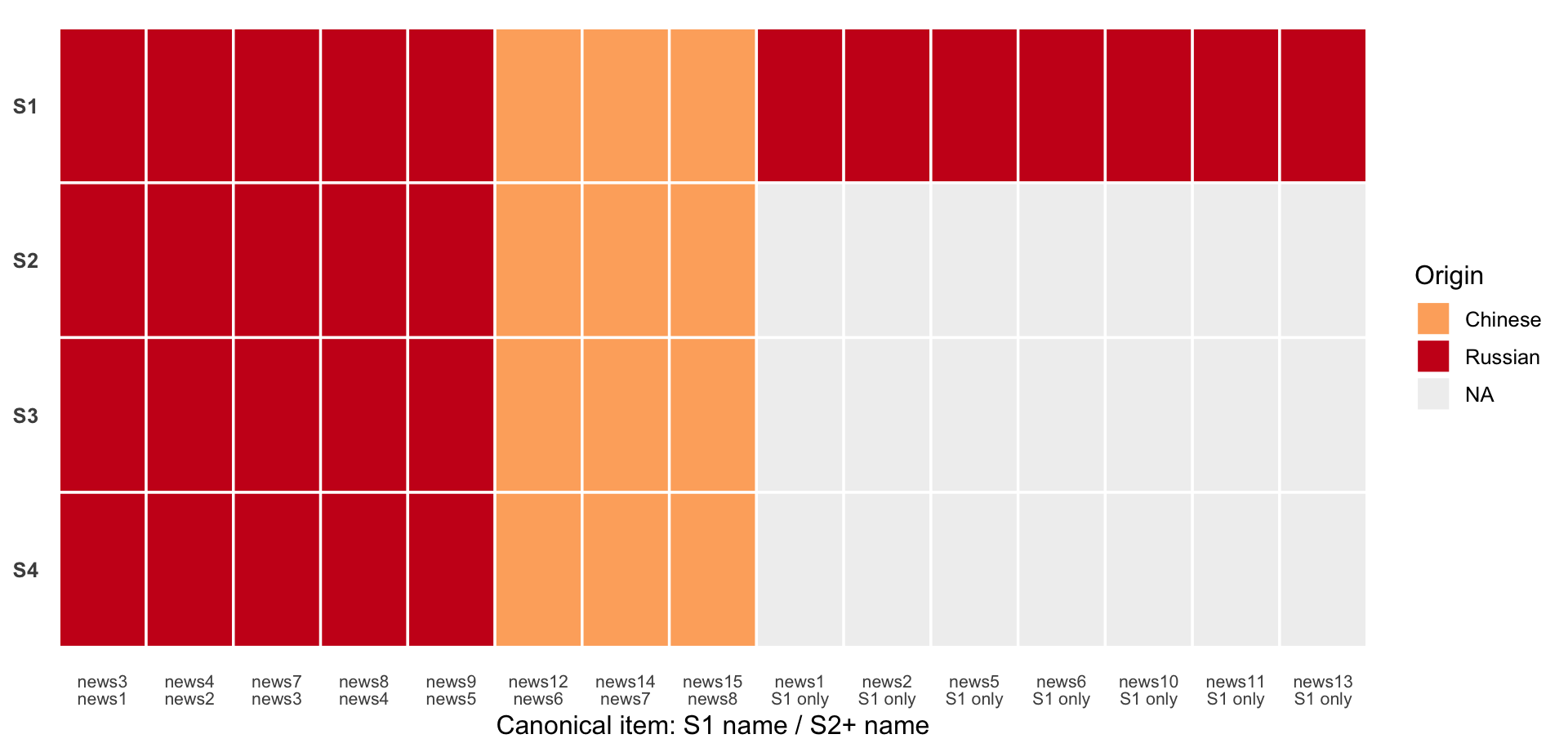
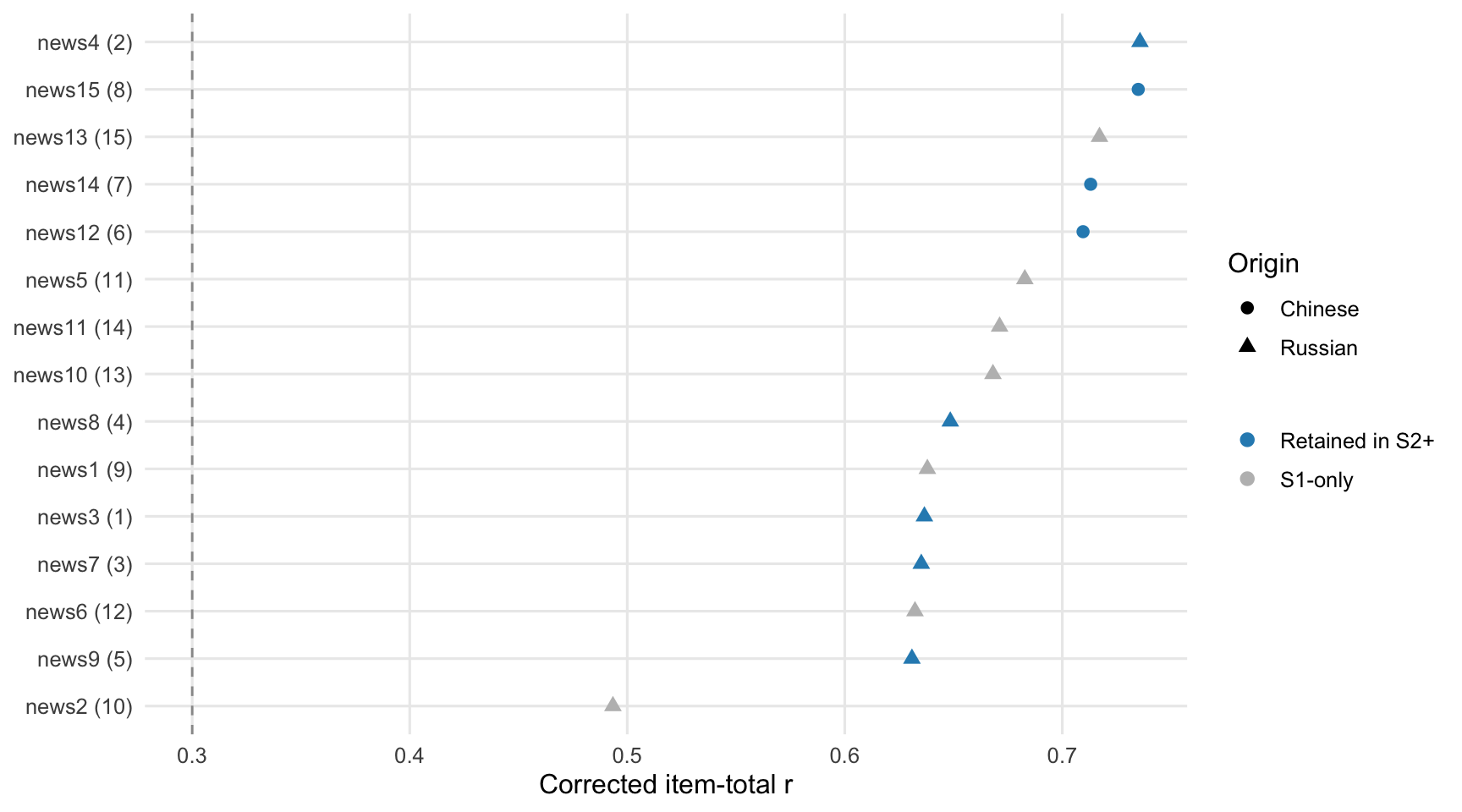
The S1 battery is the only wave that fielded all 15 FIMI items. The S2+ battery kept eight items: all three Chinese-origin items plus five Russian-origin items. The analyses below do not pretend to recover the historical fieldwork decision perfectly; they audit whether the retained eight items preserve the S1 full-score variance, whether the seven dropped items add distinctive psychometric information, and how the retained set ranks against all possible 8-item subsets.
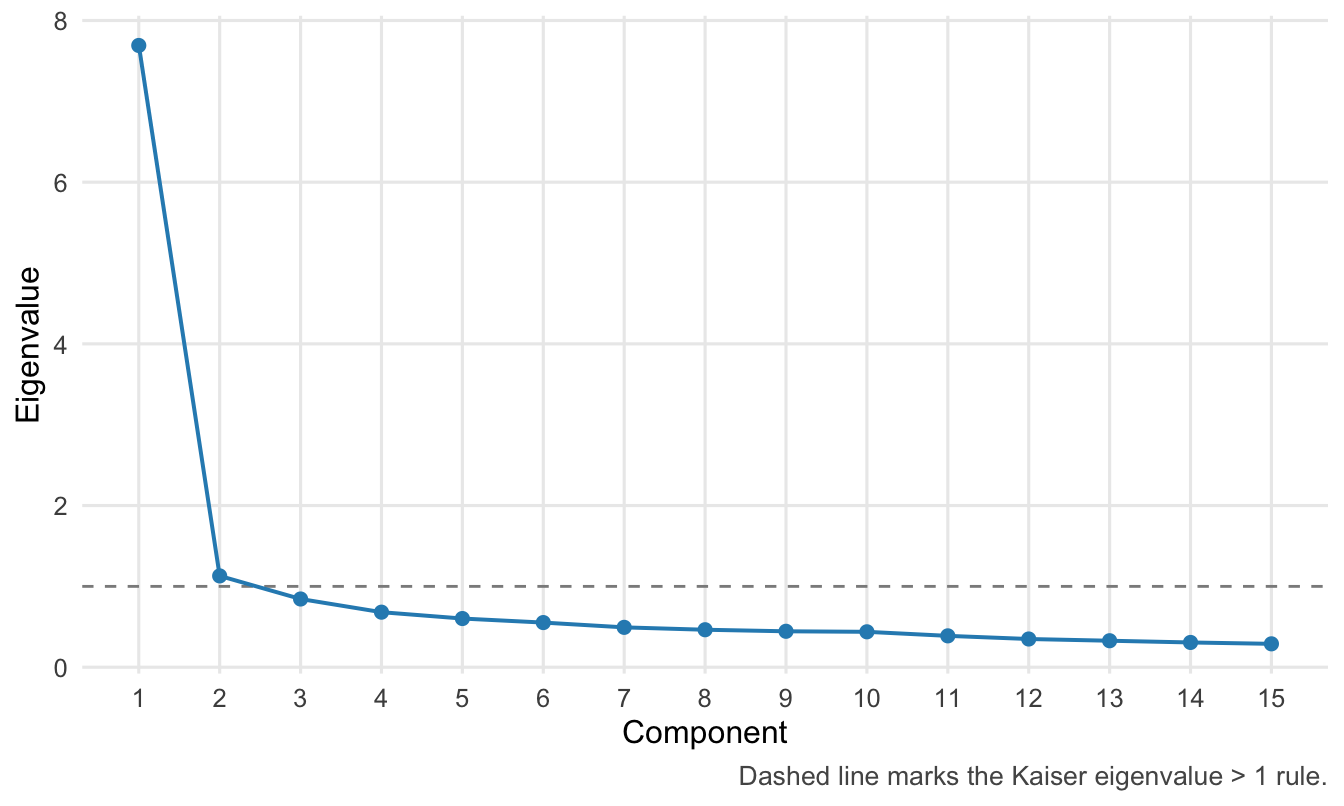
Parallel analysis suggests that the number of factors = 3 and the number of components = NA
The retained S2+ core correlates 0.969 with the S1 Full 15 score and ranks 4406 / 6435 among all possible 8-item subsets by this criterion. Its distinctive design feature is not raw maximisation of S1 internal consistency; it is source coverage: all three Chinese-origin items are retained while the Russian-origin set is compressed from twelve items to five.
Full, Russian, Chinese, and Short FIMI in S2/S3/S4
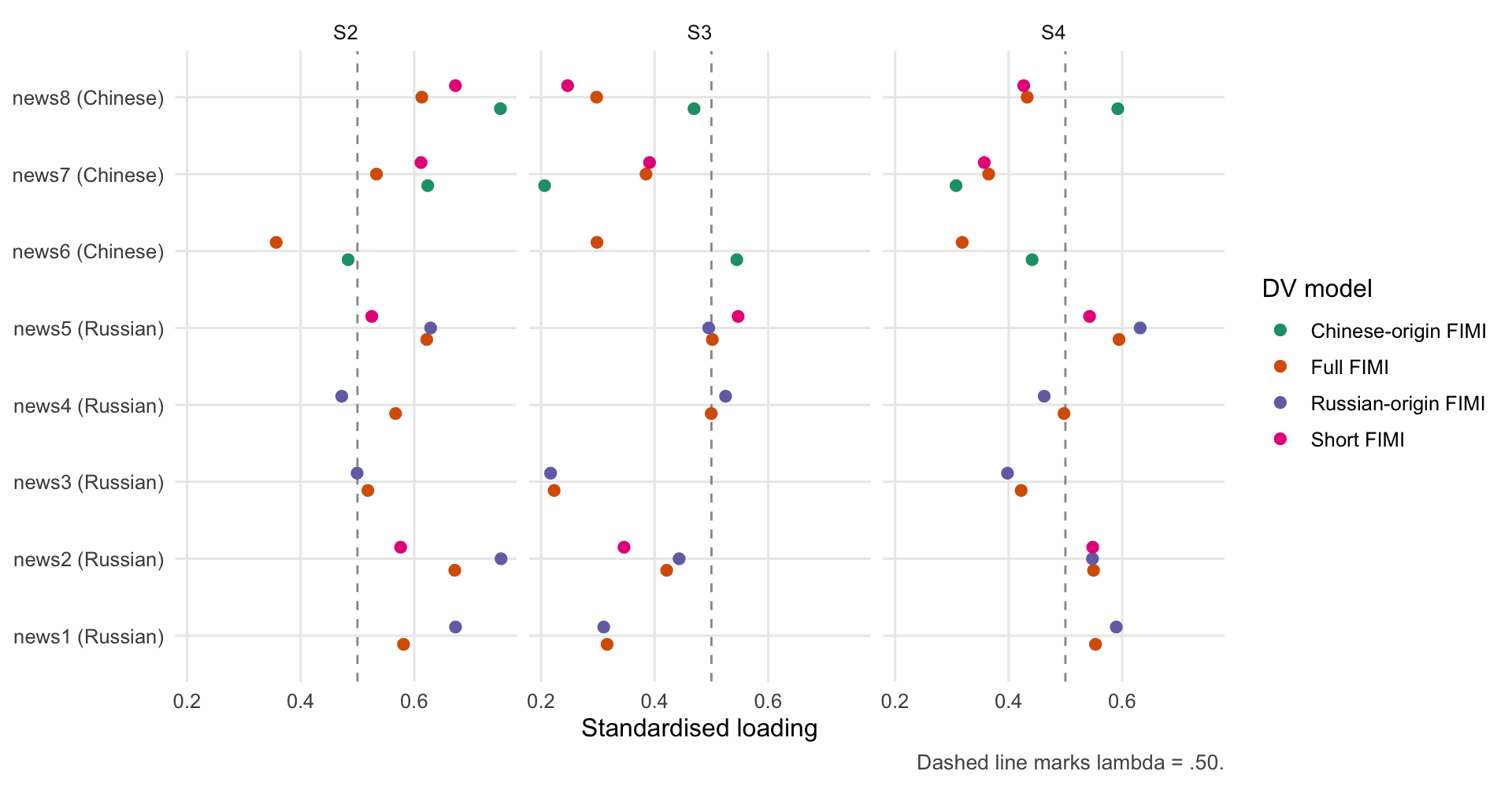
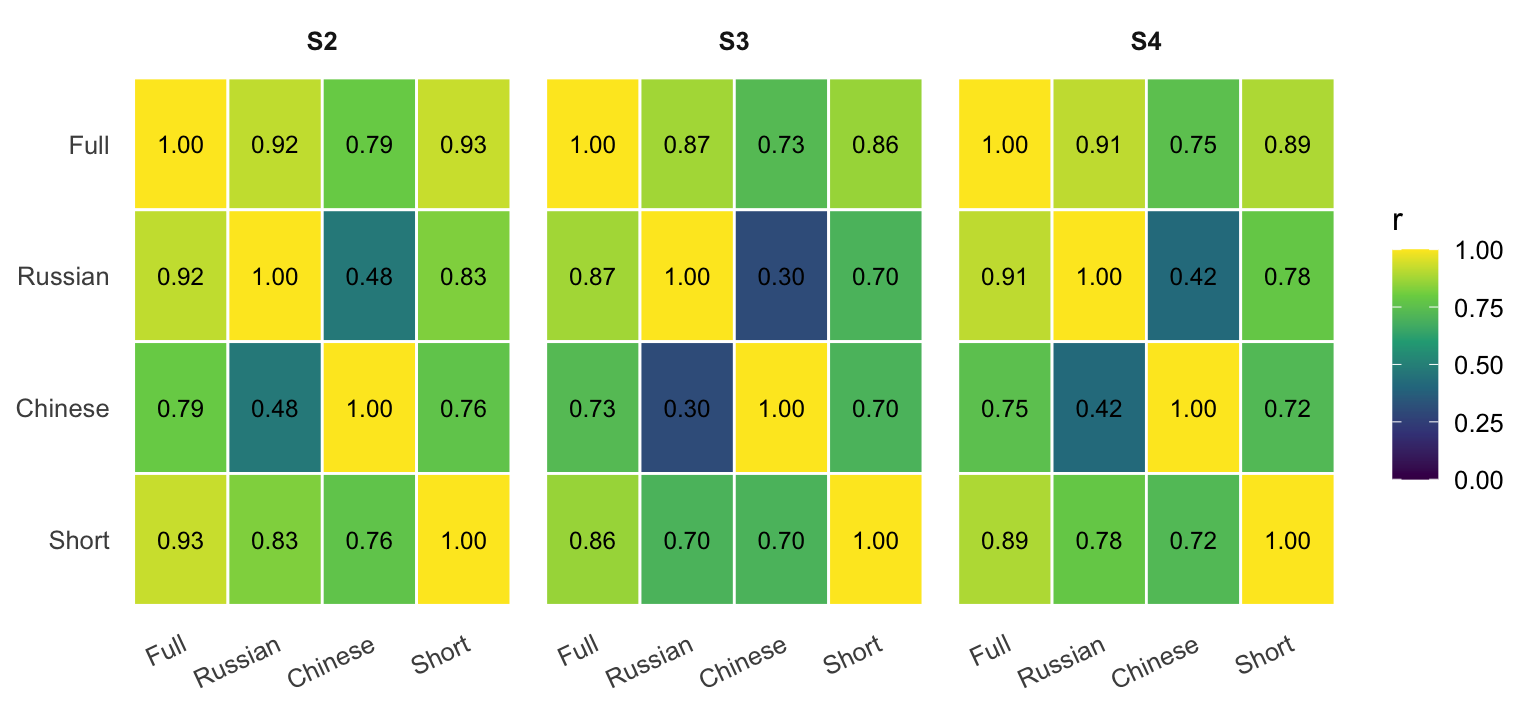
For S2, S3, and S4 the item names are aligned (news1-news8), so Full, Russian-origin, Chinese-origin, and the canonical Short FIMI can be evaluated under exactly the same item definitions. This section treats them as measurement models first and scores second.
Cross-study invariance for the FIMI DV
Selecting the canonical Short FIMI DV from S2-S4
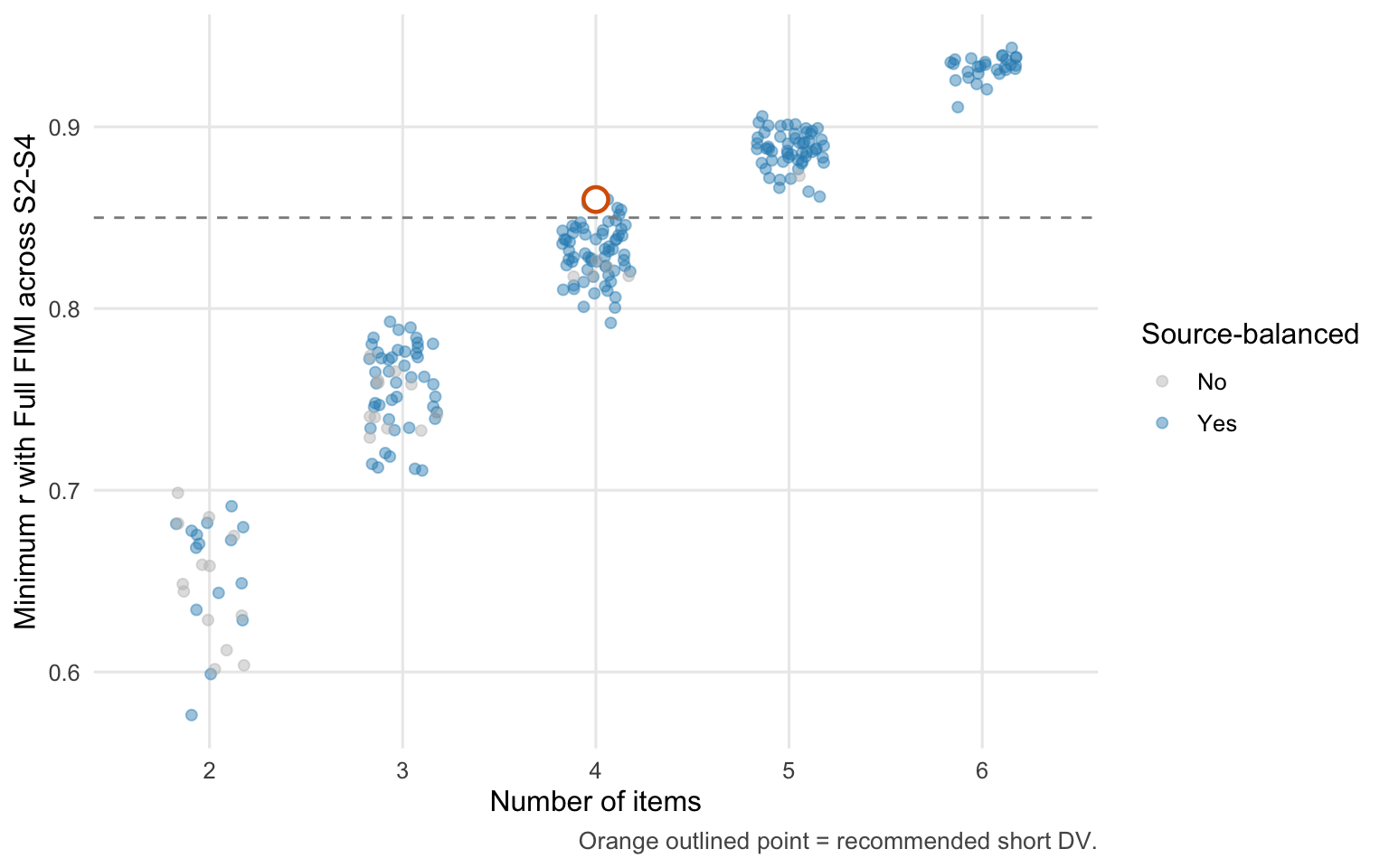
The short-form search below enumerates every 2-, 3-, 4-, 5-, and 6-item subset of the S2+ eight-item battery and scores each subset in S2, S3, and S4. The selection rule is deliberately explicit:
- The subset must include at least one Russian-origin and one Chinese-origin item.
- The subset should be as short as possible.
- Within that length, prefer high minimum correlation with Full FIMI across S2/S3/S4, then balanced correlation with both source-specific DVs, then internal consistency.
Because the Chinese-origin score is empirically less interchangeable with Full/Russian FIMI, the source-balance constraint is substantive, not cosmetic. An all-Russian short score can track Full FIMI well, but it cannot test whether Chinese-origin receptivity is preserved.
The canonical Short FIMI DV is news2,news5,news7,news8 (canonical IDs 2,5,7,8). It has 2 Russian-origin and 2 Chinese-origin items, a mean correlation of 0.892 with Full FIMI, and a worst-wave correlation of 0.860 across S2-S4.
Synthesis
The evidence supports three changes to the project convention.
-
Full FIMI remains the primary DV. It is the most information-rich criterion and the one all S1-S4 FIMI waves can define.
-
Russian-origin and Chinese-origin FIMI should be reported as planned source-specific DVs in S2-S4. Their score correlations are positive but not identical, and the Chinese-origin score is consistently the more distinctive criterion.
-
Short FIMI is the four-item source-balanced DV. The data-driven short DV above is the shortest source-balanced candidate that preserves the full-battery signal across S2-S4.
Downstream prediction pages should use: Full FIMI as the named primary criterion; Russian-origin and Chinese-origin FIMI for source-specific sensitivity; and the recommended source-balanced short DV when a short criterion is required.