3d. Study 4 — Cross-national (Dec 2025)

NoteWhere am I in the pipeline?
TipHeadline contribution

Study 4 (Multinational, 2025) contributes the following cross-study evidence:

  • Stage 3: the S4 deployed short instrument carries first-order construct measurement directly and does not field the first-order parent blocks (EXPL, GAY, MIGR, ABANF, ABANH, ABANM, PRAGR) that the S2 / S3 higher-order composites regress on; a hybrid MIMIC parameterisation (THREAT =~ direct indicators + THREAT ~ parent factors) is therefore structurally unavailable on this wave. The deployed CFA is the only higher-order representation S4 can field — see the note below the headline.
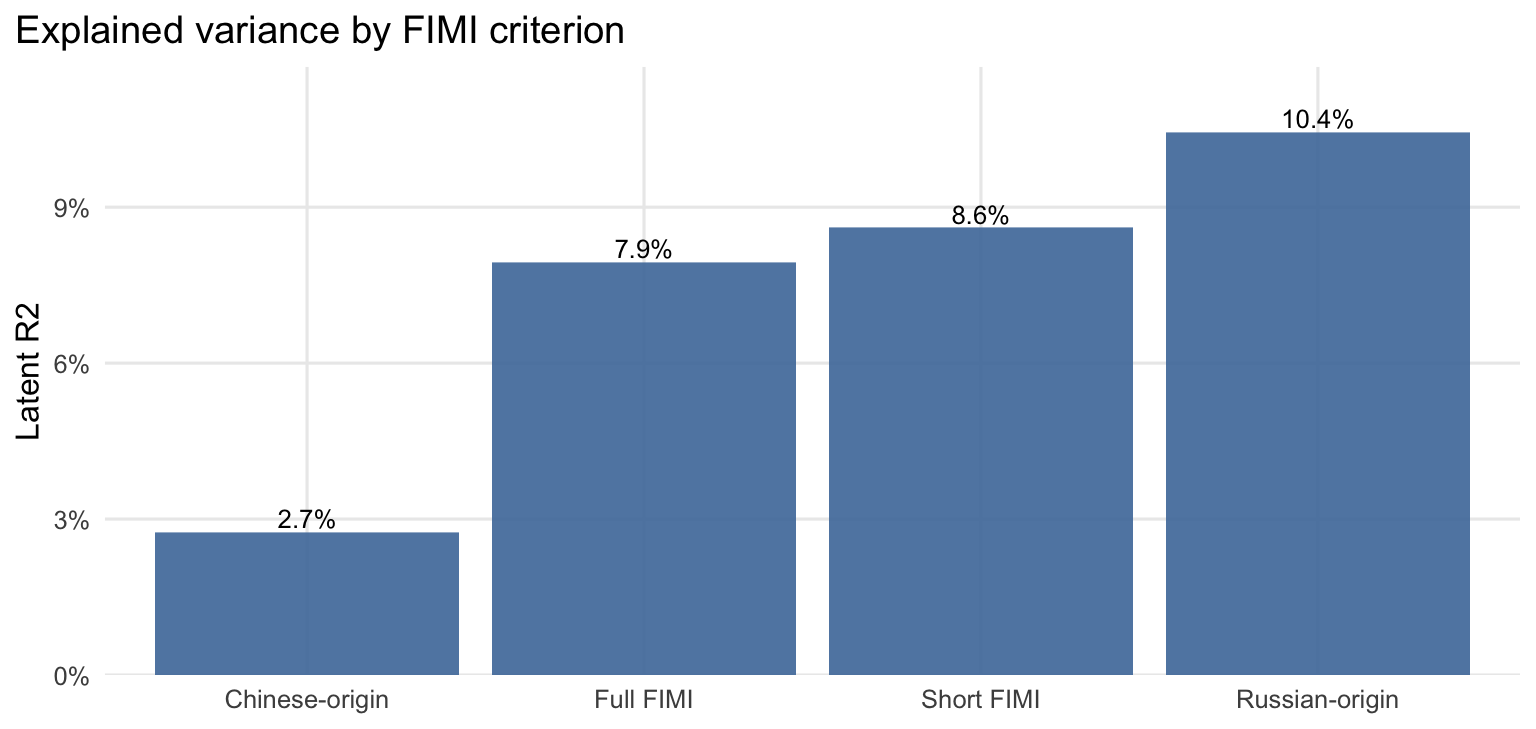
  • Stage 4/5: harmonised FIMI predicted across four criterion versions (full, Russian-source, Chinese-source, short) in pooled multinational data.
  • Stage 6: deployed short-form measurement and combined-item bridge for the multinational fielding.
  • Stage 7: configural/metric/scalar measurement invariance across the named country groups.
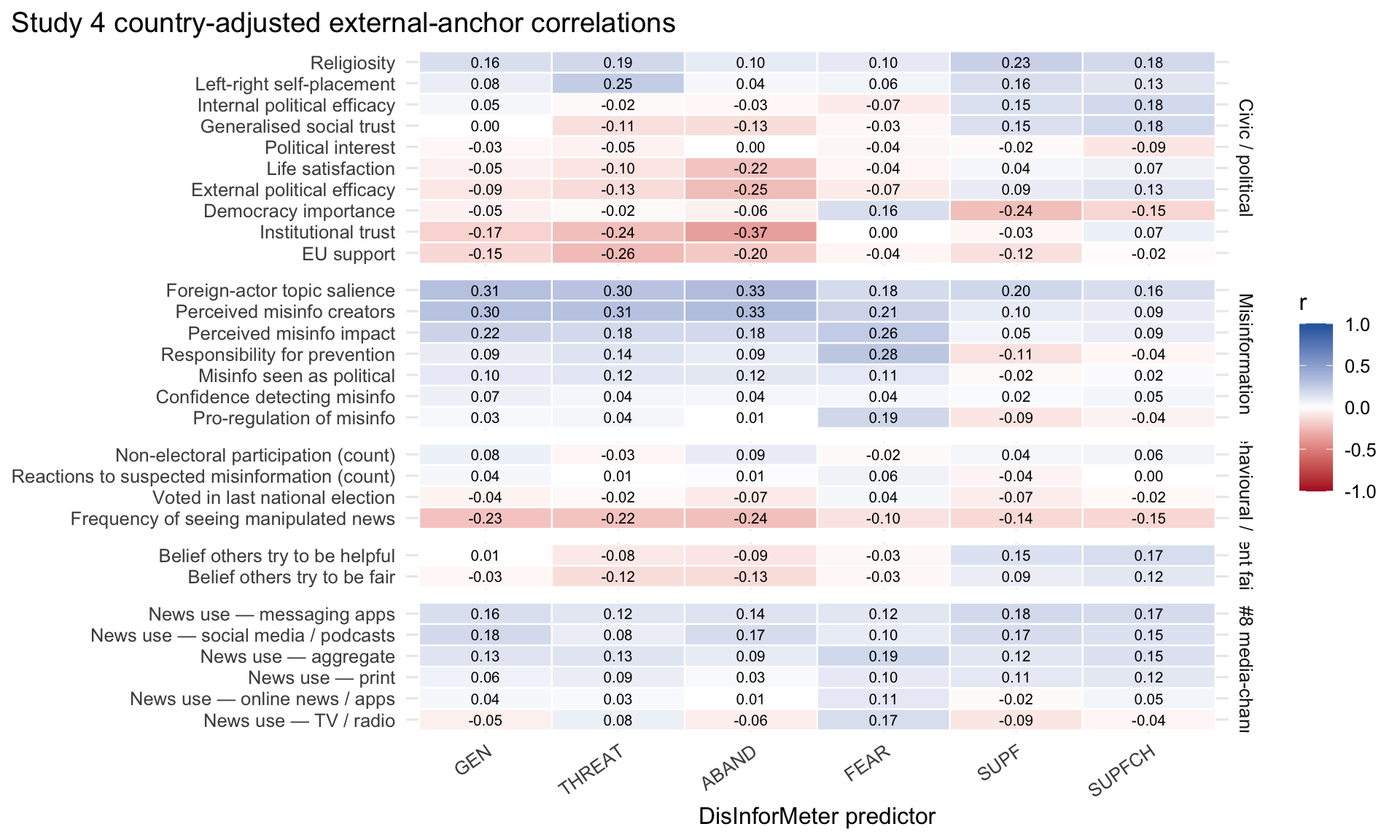
  • Stage 8: civic and misinformation anchor correlations; COND treatment effects are reported in the 4c appendix.

See also: 4c FIMI prediction · 4d Deployment and invariance · 4e Nomological network

S4 exclusion policy (preregistration point 6). The retained S4 sample is defined by a single enforced exclusion: the Q16 “Newspaper” attention check, inherited from the project team’s cleaned ID list (Study 4_DE-CONSPIRATOR Survey_cleaned.xlsx). Two further attention probes are computed and exposed as columns rather than enforced as exclusions: the embedded attention item (att_pass_embedded, derived from att == 4) and the explicit EU-referendum probe (att_pass_q29). A duration-based flag (fast_completion) marks the 1st-percentile fastest completers; it is not enforced at the data-prep step. Country quotas were enforced at sampling time, not at exclusion time, so no country-quota filter runs on the wrangled data. The attention-check sensitivity analyses below re-fit the headline models on the subsample that passes both attention probes and is not flagged as a fast completer. Canonical exclusion logic lives in the S4 block of 01-data-preparation.qmd.

Note

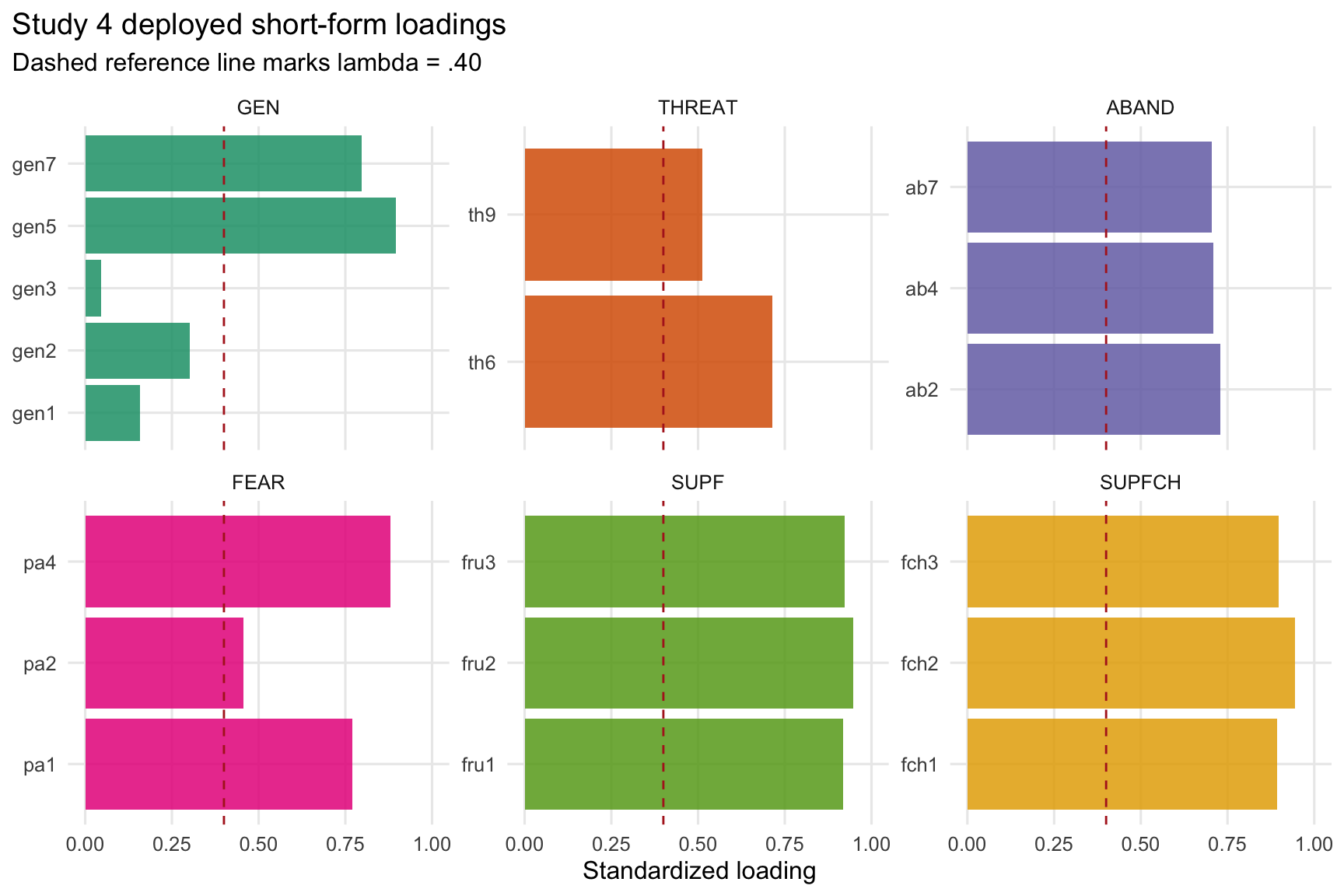
Higher-order representation on S4 (Stage 3). S4 does not field a hybrid MIMIC or pure formative variant of the higher-order constructs. The deployed S4 short instrument carries the first-order construct measurement directly — GEN, THREAT, ABAND, FEAR, SUPF, and SUPFCH are each identified by 2–5 reflective items (gen1–gen7, th6/th9, ab2/ab4/ab7, pa1/pa2/pa4, fru1/fru2/fru3, fch1/fch2/fch3) — and the wave does not field the first-order parent blocks (EXPL, GAY, MIGR; ABANF, ABANH, ABANM; PRAGR) that the S2 / S3 hybrid MIMIC composites regress on. A MIMIC parameterisation in the strict sense (THREAT =~ direct indicators and THREAT ~ parent factors) is therefore structurally unavailable on this wave: there are no parent factors to regress on. Note that on this wave SUPF / SUPFCH index affective admiration measured via the fru* / fch* items (S4 legacy: SUPR / SUPCH); the canonical S1 / S5 SUPR / SUPCH belief composites (sru* / ski* items) are not fielded here, which is why the renamed S4 labels avoid the S4←→S5 collision. The cross-study higher-order representation comparison on 4a accordingly treats S4 as a one-row entry, with the deployed reflective first-order CFA (S4_deploy_cfa) standing in for the higher-order representation family.

Overview

Study 4 is the multinational deployment test of the short DisInforMeter. The wave fielded the harmonised eight-item FIMI news battery, the compressed predictor battery, a six-arm COND experiment, and civic / political anchor measures across a large cross-national sample. This page focuses on the psychometric and criterion-validity questions: whether the deployed short form is usable in pooled multinational data, whether the measurement model survives country grouping, whether the predictors explain the harmonised FIMI criterion, and how the predictors relate to civic and misinformation anchors.

The COND treatment-effect models are deliberately kept in the 4c COND appendix. They use the same cleaned S4 outputs but answer a different experimental question.

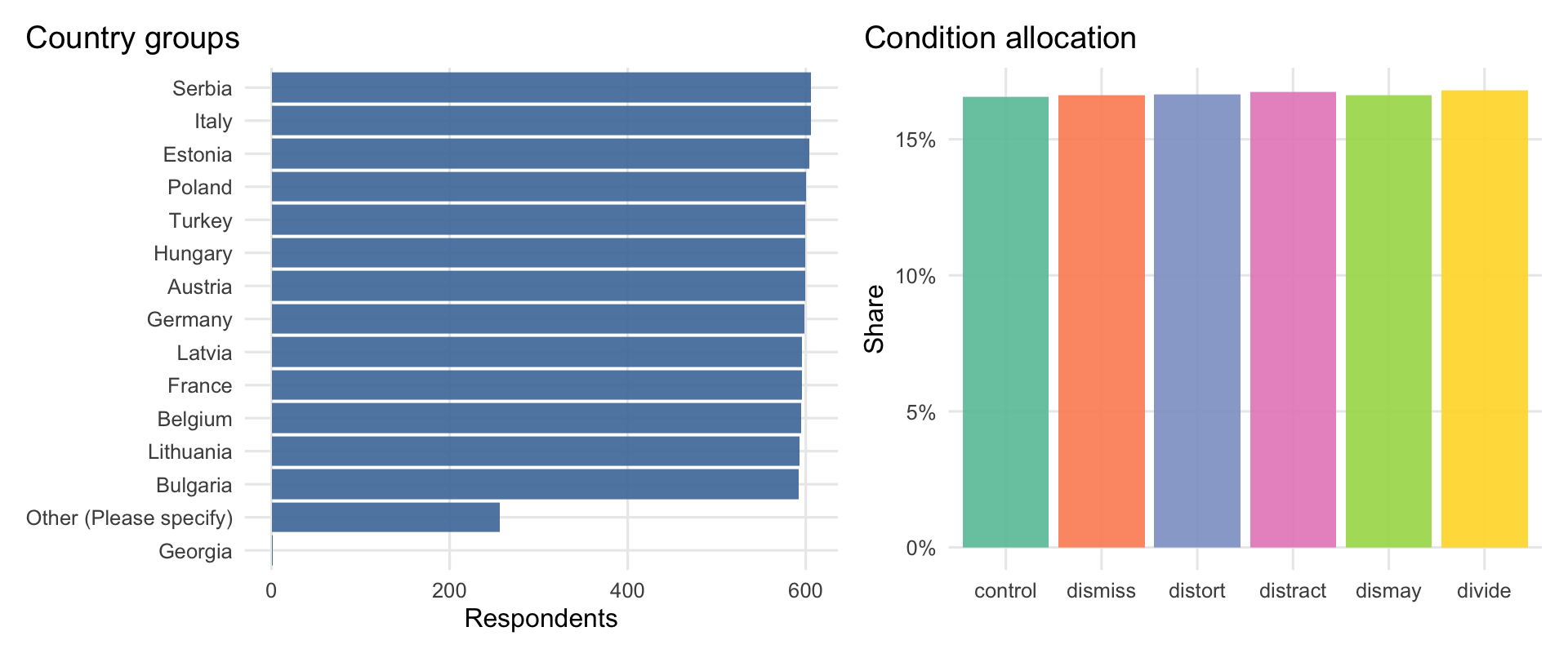
The retained S4 sample contains 8,040 respondents. The canonical country / country_fct fields currently remain the country-of-birth placeholder because the newly released participant-region file is incomplete for this retained sample. Pooled measurement and prediction models use all retained respondents, including Other (Please specify) and the single Georgia case. Grouped country models are therefore still birth-country-placeholder models and are restricted to adequately sized named groups: Italy, Serbia, Estonia, Poland, Austria, Hungary, Turkey, Germany, Latvia, France, Belgium, Lithuania, Bulgaria.

Sample profile

Study 4 retained respondents by country
Country n %
Italy 606 7.5%
Serbia 606 7.5%
Estonia 604 7.5%
Poland 600 7.5%
Austria 599 7.5%
Hungary 599 7.5%
Turkey 599 7.5%
Germany 598 7.4%
Latvia 596 7.4%
France 596 7.4%
Belgium 595 7.4%
Lithuania 593 7.4%
Bulgaria 592 7.4%
Other (Please specify) 256 3.2%
Georgia 1 0.0%
Study 4 condition allocation
Condition n %
control 1332 16.6%
dismiss 1336 16.6%
distort 1340 16.7%
distract 1345 16.7%
dismay 1337 16.6%
divide 1350 16.8%

Study 4 response-quality flags retained for sensitivity analyses
Total N Flag Share
8040 fast_completion 0.9%
8040 embedded_attention_pass 86.9%
8040 q29_attention_pass 100.0%

Deployed scale reliability

We compute Cronbach’s α, McDonald’s ω (where ≥ 3 indicators exist), and the average variance extracted (AVE) from the cached S4_deploy_cfa fit for every first-order construct in the deployed predictor model. AVE is undefined for the FIMI rows (these are observed sum/row-mean scores, not CFA-modeled latents on this page) and is reported as —.

Study 4 deployed predictor and FIMI reliability (AVE from `S4_deploy_cfa` standardized loadings; — for observed FIMI scores)
Scale # items alpha omega AVE
GEN 5 0.63 0.65 0.31
THREAT 2 0.53 - 0.39
ABAND 3 0.76 0.76 0.51
FEAR 3 0.71 0.76 0.53
SUPF 3 0.95 0.95 0.86
SUPFCH 3 0.94 0.94 0.83
FIMI_FULL 8 0.69 0.69 -
FIMI_RUSSIAN 5 0.65 0.66 -
FIMI_CHINESE 3 0.42 0.43 -
FIMI_SHORT 4 0.53 0.53 -

Item-pool dimensionality (EFA)

Preregistration point 5 commits to an exploratory factor analysis ahead of the confirmatory work. This section runs that EFA on the 19-item deployed predictor pool (GEN, THREAT, ABAND, FEAR, SUPF, SUPFCH). The eight FIMI news items are the criterion and are excluded from the predictor EFA. The canonical S1 + S4 Stage 1 dimensionality page now lives at 2b Item-pool dimensionality; this section is retained on 03d because the S4 EFA is also referenced from the S4 preregistration commitments and the deployed-CFA discussion below.

Sampling adequacy and sphericity for the S4 predictor pool
Statistic Value
Items 19
N (pairwise) 8,040
N (complete-case) 8,040
Overall KMO (MSA) 0.893
Bartlett chi-square 103 570.7
Bartlett df 171
Bartlett p <0.001
Item-level KMO measures of sampling adequacy
Construct Item MSA
ABAND ab2 0.903
ABAND ab4 0.876
ABAND ab7 0.915
FEAR pa1 0.765
FEAR pa2 0.929
FEAR pa4 0.756
GEN gen1 0.867
GEN gen2 0.881
GEN gen3 0.892
GEN gen5 0.892
GEN gen7 0.892
SUPF fru1 0.911
SUPF fru2 0.904
SUPF fru3 0.913
SUPFCH fch1 0.887
SUPFCH fch2 0.879
SUPFCH fch3 0.915
THREAT th6 0.941
THREAT th9 0.956

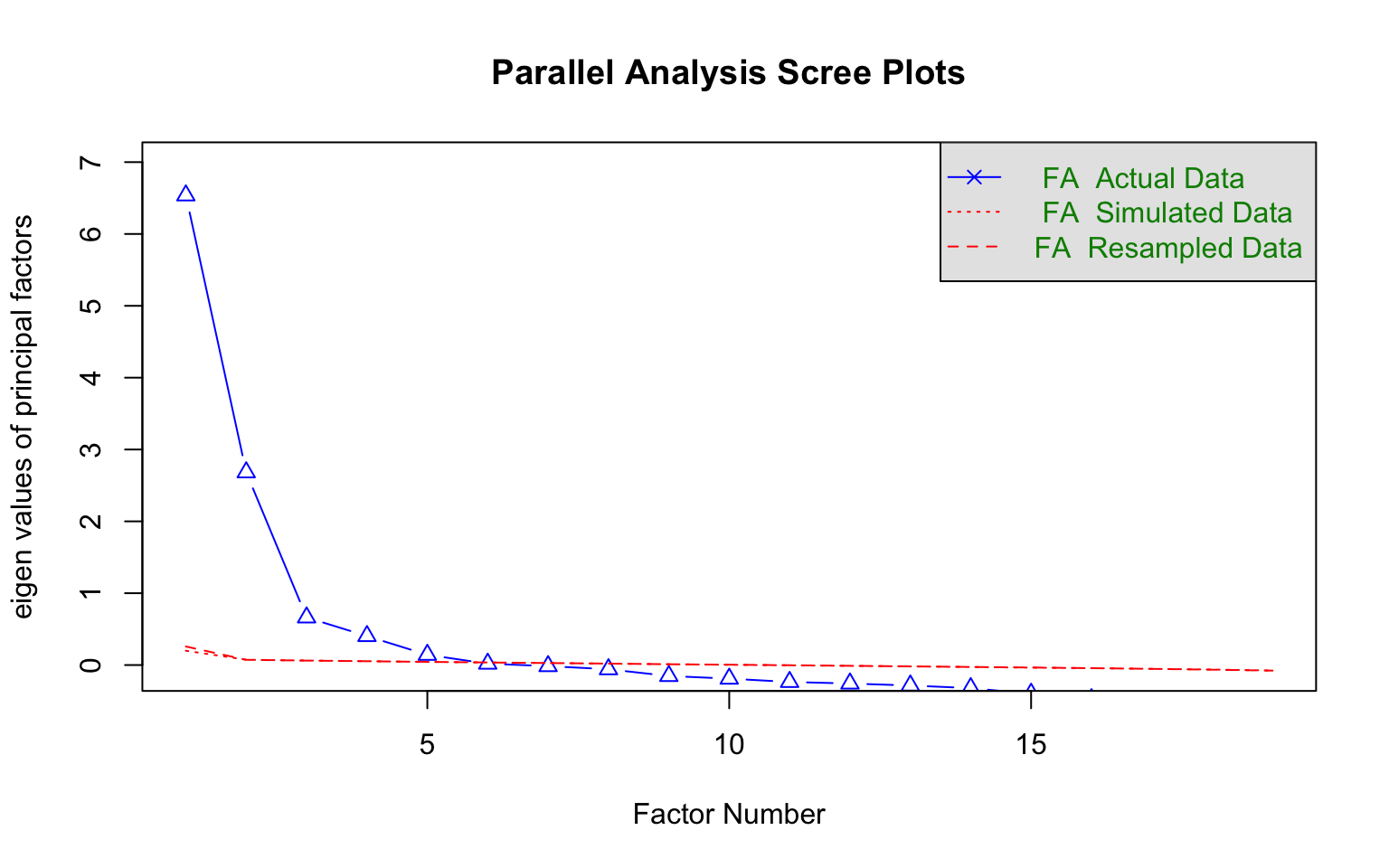
Parallel analysis and scree plot for the S4 predictor pool. The retained factor count is the number of empirical eigenvalues exceeding the 95th-percentile simulated eigenvalues.
Parallel analysis suggests that the number of factors =  5  and the number of components =  NA 
Velicer's MAP across candidate factor counts (smaller is better)
# factors MAP
1 0.0766
2 0.0361
3 0.0324
4 0.0346
5 0.0306
6 0.0370
7 0.0470
8 0.0575
Oblimin-rotated 6-factor ML solution; loadings with |λ|
Item Construct ML5 ML4 ML3 ML2 ML1 ML6
ab2 ABAND 0.70
ab4 ABAND 0.77
ab7 ABAND 0.68
pa1 FEAR 0.78
pa2 FEAR 0.39
pa4 FEAR 0.89
gen1 GEN 0.62
gen2 GEN 0.63
gen3 GEN 0.53
gen5 GEN 0.95
gen7 GEN 0.31 0.61
fru1 SUPF 0.79
fru2 SUPF 0.90
fru3 SUPF 0.84
fch1 SUPFCH 0.89
fch2 SUPFCH 0.55 0.31
fch3 SUPFCH 0.59
th6 THREAT 0.61
th9 THREAT 0.32
Variance accounted for by each oblimin-rotated factor
metric ML5 ML4 ML3 ML2 ML1 ML6
SS loadings 3.059 2.783 1.934 1.776 1.681 0.958
Proportion Var 0.161 0.146 0.102 0.093 0.088 0.050
Cumulative Var 0.161 0.307 0.409 0.503 0.591 0.642
Proportion Explained 0.251 0.228 0.159 0.146 0.138 0.079
Cumulative Proportion 0.251 0.479 0.638 0.784 0.921 1.000

Parallel analysis retains 5 factors. Velicer’s MAP minimises at 5 factors. The registered S4 deployed CFA (S4_deploy_cfa) specifies 6 first-order latents (GEN, THREAT, ABAND, FEAR, SUPF, SUPFCH). The EFA is reported with 6 factors so it is directly comparable to the registered solution; the parallel-analysis and MAP counts are noted for transparency. The factor solution is not used to re-specify the CFA.

Model specifications

Study: S4 · Family: Abbreviated

Multinational deployment measurement model for the S4 short DisInforMeter. It uses the actually fielded S4 indicators, including the compressed/combined deployment items and separate Russia (SUPF, fru*) and China (SUPFCH, fch*) affective-admiration factors. This model is the predictor-side baseline for country invariance before any FIMI prediction paths are interpreted.

Measurement-only specification (no structural regressions).

GEN    =~ gen1 + gen2 + gen3 + gen5 + gen7
  THREAT =~ th6 + th9
  ABAND  =~ ab2 + ab4 + ab7
  FEAR   =~ pa1 + pa2 + pa4
  SUPF   =~ fru1 + fru2 + fru3
  SUPFCH =~ fch1 + fch2 + fch3

Study: S4 · Family: Full SEM

Sensitivity model using the three Chinese-origin S2+ news items (news6-news8) as the FIMI criterion while keeping the S4 predictor measurement model fixed.

Structural paths

  • FIMI ~ GEN + THREAT + ABAND + FEAR + SUPF + SUPFCH
GEN    =~ gen1 + gen2 + gen3 + gen5 + gen7
  THREAT =~ th6 + th9
  ABAND  =~ ab2 + ab4 + ab7
  FEAR   =~ pa1 + pa2 + pa4
  SUPF   =~ fru1 + fru2 + fru3
  SUPFCH =~ fch1 + fch2 + fch3

  FIMI =~ news6 + news7 + news8
  FIMI ~ GEN + THREAT + ABAND + FEAR + SUPF + SUPFCH

Study: S4 · Family: Full SEM

Primary Study 4 structural-prediction model. The deployed predictor factors (GEN, THREAT, ABAND, FEAR, SUPF, SUPFCH) predict the harmonised eight-item S2+ FIMI criterion (news1-news8) in the full multinational sample.

Structural paths

  • FIMI ~ GEN + THREAT + ABAND + FEAR + SUPF + SUPFCH
GEN    =~ gen1 + gen2 + gen3 + gen5 + gen7
  THREAT =~ th6 + th9
  ABAND  =~ ab2 + ab4 + ab7
  FEAR   =~ pa1 + pa2 + pa4
  SUPF   =~ fru1 + fru2 + fru3
  SUPFCH =~ fch1 + fch2 + fch3

  FIMI =~ news1 + news2 + news3 + news4 + news5 + news6 + news7 + news8
  FIMI ~ GEN + THREAT + ABAND + FEAR + SUPF + SUPFCH

Study: S4 · Family: Full SEM

Sensitivity model using the five Russian-origin S2+ news items (news1-news5) as the FIMI criterion while keeping the S4 predictor measurement model fixed.

Structural paths

  • FIMI ~ GEN + THREAT + ABAND + FEAR + SUPF + SUPFCH
GEN    =~ gen1 + gen2 + gen3 + gen5 + gen7
  THREAT =~ th6 + th9
  ABAND  =~ ab2 + ab4 + ab7
  FEAR   =~ pa1 + pa2 + pa4
  SUPF   =~ fru1 + fru2 + fru3
  SUPFCH =~ fch1 + fch2 + fch3

  FIMI =~ news1 + news2 + news3 + news4 + news5
  FIMI ~ GEN + THREAT + ABAND + FEAR + SUPF + SUPFCH

Study: S4 · Family: Full SEM

Comparability model using the source-balanced four-item cross-wave Short FIMI criterion (news2, news5, news7, news8) while keeping the S4 predictor measurement model fixed.

Structural paths

  • FIMI ~ GEN + THREAT + ABAND + FEAR + SUPF + SUPFCH
GEN    =~ gen1 + gen2 + gen3 + gen5 + gen7
  THREAT =~ th6 + th9
  ABAND  =~ ab2 + ab4 + ab7
  FEAR   =~ pa1 + pa2 + pa4
  SUPF   =~ fru1 + fru2 + fru3
  SUPFCH =~ fch1 + fch2 + fch3

  FIMI =~ news2 + news5 + news7 + news8
  FIMI ~ GEN + THREAT + ABAND + FEAR + SUPF + SUPFCH

Pooled SEM estimation

Study 4 pooled model fit overview
Model Label Family CFI TLI RMSEA SRMR chi-square df p FIMI R2
S4_deploy_cfa S4 deployed short-form measurement CFA Abbreviated 0.828 0.785 0.127 0.133 17 976.9 137 <0.001 -
S4_pred_full S4 full FIMI prediction Full SEM 0.824 0.796 0.090 0.104 20 108.1 303 <0.001 7.9%
S4_pred_russian S4 Russian-origin FIMI prediction Full SEM 0.827 0.794 0.101 0.113 19 169.9 231 <0.001 10.4%
S4_pred_chinese S4 Chinese-origin FIMI prediction Full SEM 0.826 0.786 0.110 0.118 18 438.7 188 <0.001 2.7%
S4_pred_short S4 short FIMI prediction Full SEM 0.826 0.789 0.105 0.115 18 733.1 209 <0.001 8.6%

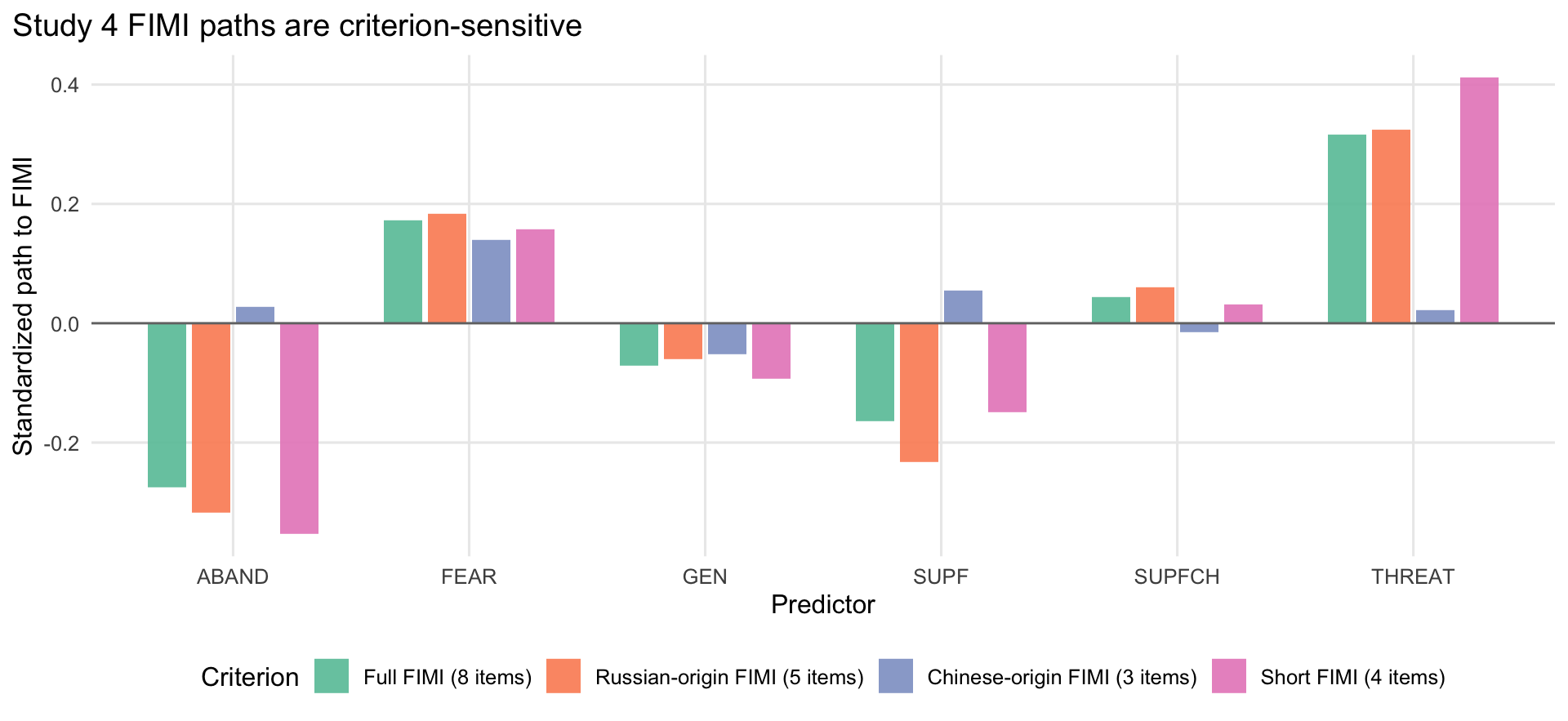
Study 4 standardized FIMI prediction paths by criterion operationalisation
Criterion Predictor beta p FIMI R2
Full FIMI (8 items) GEN -0.07 0.097 7.9%
Full FIMI (8 items) THREAT 0.32 0.050 7.9%
Full FIMI (8 items) ABAND -0.27 0.059 7.9%
Full FIMI (8 items) FEAR 0.17 <0.001 7.9%
Full FIMI (8 items) SUPF -0.16 <0.001 7.9%
Full FIMI (8 items) SUPFCH 0.04 0.075 7.9%
Russian-origin FIMI (5 items) GEN -0.06 0.159 10.4%
Russian-origin FIMI (5 items) THREAT 0.32 0.051 10.4%
Russian-origin FIMI (5 items) ABAND -0.32 0.035 10.4%
Russian-origin FIMI (5 items) FEAR 0.18 <0.001 10.4%
Russian-origin FIMI (5 items) SUPF -0.23 <0.001 10.4%
Russian-origin FIMI (5 items) SUPFCH 0.06 0.017 10.4%
Chinese-origin FIMI (3 items) GEN -0.05 0.327 2.7%
Chinese-origin FIMI (3 items) THREAT 0.02 0.903 2.7%
Chinese-origin FIMI (3 items) ABAND 0.03 0.869 2.7%
Chinese-origin FIMI (3 items) FEAR 0.14 <0.001 2.7%
Chinese-origin FIMI (3 items) SUPF 0.05 0.299 2.7%
Chinese-origin FIMI (3 items) SUPFCH -0.01 0.651 2.7%
Short FIMI (4 items) GEN -0.09 0.058 8.6%
Short FIMI (4 items) THREAT 0.41 0.033 8.6%
Short FIMI (4 items) ABAND -0.35 0.042 8.6%
Short FIMI (4 items) FEAR 0.16 <0.001 8.6%
Short FIMI (4 items) SUPF -0.15 0.002 8.6%
Short FIMI (4 items) SUPFCH 0.03 0.290 8.6%

Country measurement invariance

The invariance ladder uses the deployed predictor CFA (S4_deploy_cfa) and excludes only groups that are not interpretable as country-level samples for this purpose: Other (Please specify) and the Georgia singleton. These respondents remain in every pooled S4 model above.

Study 4 country invariance ladder for the deployed predictor CFA
Level CFI TLI RMSEA SRMR chi-square df p Delta CFI Delta RMSEA Delta pass
configural 0.807 0.760 0.133 0.138 20 765.3 1781 <0.001 yes
metric 0.798 0.768 0.131 0.149 21 902.0 1937 <0.001 -0.010 -0.002 yes
scalar 0.772 0.758 0.134 0.152 24 578.9 2093 <0.001 -0.026 0.003 no
Largest exploratory modification indices for the scalar country-invariance model
lhs op rhs mi epc
FEAR =~ gen3 243.9 1.11
THREAT =~ gen1 236.9 0.83
SUPF =~ pa2 229.4 1.78
FEAR =~ gen3 228.4 1.07
FEAR =~ gen3 224.5 1.13
ABAND =~ gen1 223.0 0.88
FEAR =~ gen3 222.0 1.18
FEAR =~ gen3 213.5 1.03
FEAR =~ gen3 205.5 1.01
ABAND =~ gen2 201.8 0.86
FEAR =~ gen3 200.2 1.03
FEAR =~ gen3 199.7 0.86

The strongest supported country-invariance level under the planned delta rules is metric. This is not treated as partial invariance: if the scalar step strains the data, the page reports that strain rather than freeing parameters automatically.

Language-group invariance ladder

Survey language is the closest minority-status proxy available in S4 (the wave does not field a dedicated minority-status item). Respondents who took the survey in a non-titular language of their country (for example Russian-language respondents in Latvia or Estonia) appear in the smaller language strata, so a configural-to-metric ladder on language is informative about whether the deployed predictor CFA travels across the language groups that carry the minority signal. The ladder is restricted to languages with N ≥ 200 to keep group-level estimation stable; smaller language strata remain in the pooled model but are not split out here.

Study 4 language-group invariance ladder for the deployed predictor CFA (languages with N >= 200: BG, DE, ET, FR, HU, IT, LT, LV, NL, PL, SR, TR)
Level CFI TLI RMSEA SRMR chi-square df p Delta CFI Delta RMSEA Delta pass
configural 0.807 0.759 0.133 0.138 20 470.5 1644 <0.001 yes
metric 0.796 0.765 0.131 0.149 21 689.4 1787 <0.001 -0.011 -0.002 no

The strongest supported language-invariance level under the planned delta rules is configural. The scalar step is intentionally omitted from this ladder: the small number of retained language strata makes a scalar test underpowered to distinguish genuine intercept differences from sampling noise, and the country ladder above already carries the scalar evidence. Cached fits for the configural and metric steps live under outputs/sem_fits/s4_S4_deploy_cfa_lang_*.rds.

Deployment adaptation and combined-item bridge

S4 compressed deployment items documented in the project roadmap
S4 item Construct Combines Rationale
pa2 FEAR (fear / anxiety) pa2 + pa3 Two near-identical worry items in S2/S3 were merged into a single anchor for the S4 short form.
pa4 FEAR (fear / anxiety) pa4 + pa5 Two anxiety-about-conflict items in S2/S3 were merged into a single anchor for the S4 short form.
gen3 GEN (general DisInforMeter) gen3 + gen4 Two overlapping general-receptivity items in S2/S3 were merged into one item for S4.
Bridge checks for S4 compressed deployment items in waves with split items
Study S4 item Construct Split items n r(split items) r(proxy,parent) r(proxy,FIMI) Note
S2 pa2 FEAR c("pa2", "pa3") NA - - - split items not available
S2 pa4 FEAR c("pa4", "pa5") NA - - - split items not available
S2 gen3 GEN c("gen3", "gen4") NA - - - split items not available
S3 pa2 FEAR c("pa2", "pa3") NA - - - split items not available
S3 pa4 FEAR c("pa4", "pa5") NA - - - split items not available
S3 gen3 GEN c("gen3", "gen4") NA - - - split items not available
S5 pa2 FEAR c("pa2", "pa3") NA - - - split items not available
S5 pa4 FEAR c("pa4", "pa5") NA - - - split items not available
S5 gen3 GEN c("gen3", "gen4") NA - - - split items not available

External-anchor probes

These are country-adjusted validity probes, not treatment-effect models. Each reported country-adjusted correlation residualises the predictor and anchor on country_fct before correlating the residuals. Pooled Pearson correlations are included for context.

The anchor catalogue covers five families: civic / political attitudes (scale_inst_trust, scale_eu_support, etc.), misinformation perceptions (scale_misinfo_*), preregistration point 8’s three behavioural / participation exploratory DVs (behavioural reactions to suspected misinformation, voting and non-electoral political participation, frequency of seeing online news the respondent believes is manipulated by foreign actors), the convergent fairness / helpfulness anchor, and the exploratory media-channel-use block. The latter three were added to honour AsPredicted #261660 point 8 and are flagged below as Prereg #8 … families so the heatmap groups them together.

Study 4 external-anchor correlations, country-adjusted primary estimates
Family Predictor Anchor n country-adjusted r FDR p pooled r
Civic / political ABAND Democracy importance 8040 -0.06 <0.001 -0.06
Civic / political ABAND EU support 8040 -0.20 <0.001 -0.20
Civic / political ABAND External political efficacy 8040 -0.25 <0.001 -0.28
Civic / political ABAND Generalised social trust 8040 -0.13 <0.001 -0.15
Civic / political ABAND Institutional trust 8040 -0.37 <0.001 -0.41
Civic / political ABAND Internal political efficacy 8040 -0.03 0.011 -0.01
Civic / political ABAND Left-right self-placement 8040 0.04 0.001 0.01
Civic / political ABAND Life satisfaction 8040 -0.22 <0.001 -0.25
Civic / political ABAND Political interest 8040 0.00 0.708 0.02
Civic / political ABAND Religiosity 8040 0.10 <0.001 0.16
Civic / political FEAR Democracy importance 8040 0.16 <0.001 0.15
Civic / political FEAR EU support 8040 -0.04 0.001 -0.04
Civic / political FEAR External political efficacy 8040 -0.07 <0.001 -0.07
Civic / political FEAR Generalised social trust 8040 -0.03 0.016 -0.03
Civic / political FEAR Institutional trust 8040 0.00 0.882 -0.01
Civic / political FEAR Internal political efficacy 8040 -0.07 <0.001 -0.07
Civic / political FEAR Left-right self-placement 8040 0.06 <0.001 0.05
Civic / political FEAR Life satisfaction 8040 -0.04 <0.001 -0.03
Civic / political FEAR Political interest 8040 -0.04 0.002 -0.03
Civic / political FEAR Religiosity 8040 0.10 <0.001 0.11
Civic / political GEN Democracy importance 8040 -0.05 <0.001 -0.06
Civic / political GEN EU support 8040 -0.15 <0.001 -0.15
Civic / political GEN External political efficacy 8040 -0.09 <0.001 -0.13
Civic / political GEN Generalised social trust 8040 0.00 0.885 -0.04
Civic / political GEN Institutional trust 8040 -0.17 <0.001 -0.23
Civic / political GEN Internal political efficacy 8040 0.05 <0.001 0.06
Civic / political GEN Left-right self-placement 8040 0.08 <0.001 0.06
Civic / political GEN Life satisfaction 8040 -0.05 <0.001 -0.08
Civic / political GEN Political interest 8040 -0.03 0.009 -0.02
Civic / political GEN Religiosity 8040 0.16 <0.001 0.22
Civic / political SUPF Democracy importance 8040 -0.24 <0.001 -0.25
Civic / political SUPF EU support 8040 -0.12 <0.001 -0.13
Civic / political SUPF External political efficacy 8040 0.09 <0.001 0.02
Civic / political SUPF Generalised social trust 8040 0.15 <0.001 0.09
Civic / political SUPF Institutional trust 8040 -0.03 0.003 -0.13
Civic / political SUPF Internal political efficacy 8040 0.15 <0.001 0.15
Civic / political SUPF Left-right self-placement 8040 0.16 <0.001 0.12
Civic / political SUPF Life satisfaction 8040 0.04 <0.001 -0.02
Civic / political SUPF Political interest 8040 -0.02 0.104 -0.01
Civic / political SUPF Religiosity 8040 0.23 <0.001 0.28
Civic / political SUPFCH Democracy importance 8040 -0.15 <0.001 -0.16
Civic / political SUPFCH EU support 8040 -0.02 0.168 -0.03
Civic / political SUPFCH External political efficacy 8040 0.13 <0.001 0.07
Civic / political SUPFCH Generalised social trust 8040 0.18 <0.001 0.14
Civic / political SUPFCH Institutional trust 8040 0.07 <0.001 -0.01
Civic / political SUPFCH Internal political efficacy 8040 0.18 <0.001 0.18
Civic / political SUPFCH Left-right self-placement 8040 0.13 <0.001 0.10
Civic / political SUPFCH Life satisfaction 8040 0.07 <0.001 0.01
Civic / political SUPFCH Political interest 8040 -0.09 <0.001 -0.08
Civic / political SUPFCH Religiosity 8040 0.18 <0.001 0.23
Civic / political THREAT Democracy importance 8040 -0.02 0.068 -0.02
Civic / political THREAT EU support 8040 -0.26 <0.001 -0.25
Civic / political THREAT External political efficacy 8040 -0.13 <0.001 -0.16
Civic / political THREAT Generalised social trust 8040 -0.11 <0.001 -0.13
Civic / political THREAT Institutional trust 8040 -0.24 <0.001 -0.27
Civic / political THREAT Internal political efficacy 8040 -0.02 0.090 -0.02
Civic / political THREAT Left-right self-placement 8040 0.25 <0.001 0.23
Civic / political THREAT Life satisfaction 8040 -0.10 <0.001 -0.11
Civic / political THREAT Political interest 8040 -0.05 <0.001 -0.03
Civic / political THREAT Religiosity 8040 0.19 <0.001 0.22
Misinformation ABAND Confidence detecting misinfo 8040 0.04 <0.001 0.04
Misinformation ABAND Foreign-actor topic salience 8040 0.33 <0.001 0.33
Misinformation ABAND Misinfo seen as political 8040 0.12 <0.001 0.12
Misinformation ABAND Perceived misinfo creators 8040 0.33 <0.001 0.33
Misinformation ABAND Perceived misinfo impact 8040 0.18 <0.001 0.18
Misinformation ABAND Pro-regulation of misinfo 8040 0.01 0.584 0.01
Misinformation ABAND Responsibility for prevention 8040 0.09 <0.001 0.09
Misinformation FEAR Confidence detecting misinfo 8040 0.04 <0.001 0.05
Misinformation FEAR Foreign-actor topic salience 8040 0.18 <0.001 0.18
Misinformation FEAR Misinfo seen as political 8040 0.11 <0.001 0.11
Misinformation FEAR Perceived misinfo creators 8040 0.21 <0.001 0.21
Misinformation FEAR Perceived misinfo impact 8040 0.26 <0.001 0.25
Misinformation FEAR Pro-regulation of misinfo 8040 0.19 <0.001 0.19
Misinformation FEAR Responsibility for prevention 8040 0.28 <0.001 0.28
Misinformation GEN Confidence detecting misinfo 8040 0.07 <0.001 0.07
Misinformation GEN Foreign-actor topic salience 8040 0.31 <0.001 0.31
Misinformation GEN Misinfo seen as political 8040 0.10 <0.001 0.10
Misinformation GEN Perceived misinfo creators 8040 0.30 <0.001 0.30
Misinformation GEN Perceived misinfo impact 8040 0.22 <0.001 0.20
Misinformation GEN Pro-regulation of misinfo 8040 0.03 0.003 0.04
Misinformation GEN Responsibility for prevention 8040 0.09 <0.001 0.09
Misinformation SUPF Confidence detecting misinfo 8040 0.02 0.030 0.02
Misinformation SUPF Foreign-actor topic salience 8040 0.20 <0.001 0.19
Misinformation SUPF Misinfo seen as political 8040 -0.02 0.062 -0.02
Misinformation SUPF Perceived misinfo creators 8040 0.10 <0.001 0.09
Misinformation SUPF Perceived misinfo impact 8040 0.05 <0.001 0.04
Misinformation SUPF Pro-regulation of misinfo 8040 -0.09 <0.001 -0.08
Misinformation SUPF Responsibility for prevention 8040 -0.11 <0.001 -0.11
Misinformation SUPFCH Confidence detecting misinfo 8040 0.05 <0.001 0.04
Misinformation SUPFCH Foreign-actor topic salience 8040 0.16 <0.001 0.16
Misinformation SUPFCH Misinfo seen as political 8040 0.02 0.165 0.02
Misinformation SUPFCH Perceived misinfo creators 8040 0.09 <0.001 0.09
Misinformation SUPFCH Perceived misinfo impact 8040 0.09 <0.001 0.08
Misinformation SUPFCH Pro-regulation of misinfo 8040 -0.04 <0.001 -0.04
Misinformation SUPFCH Responsibility for prevention 8040 -0.04 <0.001 -0.04
Misinformation THREAT Confidence detecting misinfo 8040 0.04 <0.001 0.05
Misinformation THREAT Foreign-actor topic salience 8040 0.30 <0.001 0.30
Misinformation THREAT Misinfo seen as political 8040 0.12 <0.001 0.13
Misinformation THREAT Perceived misinfo creators 8040 0.31 <0.001 0.32
Misinformation THREAT Perceived misinfo impact 8040 0.18 <0.001 0.19
Misinformation THREAT Pro-regulation of misinfo 8040 0.04 <0.001 0.05
Misinformation THREAT Responsibility for prevention 8040 0.14 <0.001 0.14
Prereg #8 behavioural / participation ABAND Frequency of seeing manipulated news 8040 -0.24 <0.001 -0.26
Prereg #8 behavioural / participation ABAND Non-electoral participation (count) 8040 0.09 <0.001 0.11
Prereg #8 behavioural / participation ABAND Reactions to suspected misinformation (count) 8040 0.01 0.299 0.02
Prereg #8 behavioural / participation ABAND Voted in last national election 7912 -0.07 <0.001 -0.08
Prereg #8 behavioural / participation FEAR Frequency of seeing manipulated news 8040 -0.10 <0.001 -0.10
Prereg #8 behavioural / participation FEAR Non-electoral participation (count) 8040 -0.02 0.082 -0.02
Prereg #8 behavioural / participation FEAR Reactions to suspected misinformation (count) 8040 0.06 <0.001 0.06
Prereg #8 behavioural / participation FEAR Voted in last national election 7912 0.04 0.002 0.03
Prereg #8 behavioural / participation GEN Frequency of seeing manipulated news 8040 -0.23 <0.001 -0.24
Prereg #8 behavioural / participation GEN Non-electoral participation (count) 8040 0.08 <0.001 0.09
Prereg #8 behavioural / participation GEN Reactions to suspected misinformation (count) 8040 0.04 0.002 0.04
Prereg #8 behavioural / participation GEN Voted in last national election 7912 -0.04 <0.001 -0.06
Prereg #8 behavioural / participation SUPF Frequency of seeing manipulated news 8040 -0.14 <0.001 -0.16
Prereg #8 behavioural / participation SUPF Non-electoral participation (count) 8040 0.04 <0.001 0.07
Prereg #8 behavioural / participation SUPF Reactions to suspected misinformation (count) 8040 -0.04 <0.001 -0.04
Prereg #8 behavioural / participation SUPF Voted in last national election 7912 -0.07 <0.001 -0.09
Prereg #8 behavioural / participation SUPFCH Frequency of seeing manipulated news 8040 -0.15 <0.001 -0.16
Prereg #8 behavioural / participation SUPFCH Non-electoral participation (count) 8040 0.06 <0.001 0.07
Prereg #8 behavioural / participation SUPFCH Reactions to suspected misinformation (count) 8040 0.00 0.916 0.00
Prereg #8 behavioural / participation SUPFCH Voted in last national election 7912 -0.02 0.043 -0.04
Prereg #8 behavioural / participation THREAT Frequency of seeing manipulated news 8040 -0.22 <0.001 -0.25
Prereg #8 behavioural / participation THREAT Non-electoral participation (count) 8040 -0.03 0.004 -0.02
Prereg #8 behavioural / participation THREAT Reactions to suspected misinformation (count) 8040 0.01 0.636 0.02
Prereg #8 behavioural / participation THREAT Voted in last national election 7912 -0.02 0.076 -0.02
Prereg #8 convergent fairness / helpfulness ABAND Belief others try to be fair 8040 -0.13 <0.001 -0.16
Prereg #8 convergent fairness / helpfulness ABAND Belief others try to be helpful 8040 -0.09 <0.001 -0.13
Prereg #8 convergent fairness / helpfulness FEAR Belief others try to be fair 8040 -0.03 0.010 -0.03
Prereg #8 convergent fairness / helpfulness FEAR Belief others try to be helpful 8040 -0.03 0.018 -0.03
Prereg #8 convergent fairness / helpfulness GEN Belief others try to be fair 8040 -0.03 0.011 -0.07
Prereg #8 convergent fairness / helpfulness GEN Belief others try to be helpful 8040 0.01 0.572 -0.04
Prereg #8 convergent fairness / helpfulness SUPF Belief others try to be fair 8040 0.09 <0.001 0.03
Prereg #8 convergent fairness / helpfulness SUPF Belief others try to be helpful 8040 0.15 <0.001 0.09
Prereg #8 convergent fairness / helpfulness SUPFCH Belief others try to be fair 8040 0.12 <0.001 0.07
Prereg #8 convergent fairness / helpfulness SUPFCH Belief others try to be helpful 8040 0.17 <0.001 0.12
Prereg #8 convergent fairness / helpfulness THREAT Belief others try to be fair 8040 -0.12 <0.001 -0.14
Prereg #8 convergent fairness / helpfulness THREAT Belief others try to be helpful 8040 -0.08 <0.001 -0.10
Prereg #8 media-channel use ABAND News use — TV / radio 8040 -0.06 <0.001 -0.05
Prereg #8 media-channel use ABAND News use — aggregate 8040 0.09 <0.001 0.13
Prereg #8 media-channel use ABAND News use — messaging apps 8040 0.14 <0.001 0.18
Prereg #8 media-channel use ABAND News use — online news / apps 8040 0.01 0.616 0.00
Prereg #8 media-channel use ABAND News use — print 8040 0.03 0.007 0.03
Prereg #8 media-channel use ABAND News use — social media / podcasts 8040 0.17 <0.001 0.22
Prereg #8 media-channel use FEAR News use — TV / radio 8040 0.17 <0.001 0.17
Prereg #8 media-channel use FEAR News use — aggregate 8040 0.19 <0.001 0.19
Prereg #8 media-channel use FEAR News use — messaging apps 8040 0.12 <0.001 0.13
Prereg #8 media-channel use FEAR News use — online news / apps 8040 0.11 <0.001 0.10
Prereg #8 media-channel use FEAR News use — print 8040 0.10 <0.001 0.10
Prereg #8 media-channel use FEAR News use — social media / podcasts 8040 0.10 <0.001 0.10
Prereg #8 media-channel use GEN News use — TV / radio 8040 -0.05 <0.001 -0.05
Prereg #8 media-channel use GEN News use — aggregate 8040 0.13 <0.001 0.14
Prereg #8 media-channel use GEN News use — messaging apps 8040 0.16 <0.001 0.18
Prereg #8 media-channel use GEN News use — online news / apps 8040 0.04 <0.001 0.03
Prereg #8 media-channel use GEN News use — print 8040 0.06 <0.001 0.05
Prereg #8 media-channel use GEN News use — social media / podcasts 8040 0.18 <0.001 0.22
Prereg #8 media-channel use SUPF News use — TV / radio 8040 -0.09 <0.001 -0.08
Prereg #8 media-channel use SUPF News use — aggregate 8040 0.12 <0.001 0.14
Prereg #8 media-channel use SUPF News use — messaging apps 8040 0.18 <0.001 0.20
Prereg #8 media-channel use SUPF News use — online news / apps 8040 -0.02 0.074 -0.03
Prereg #8 media-channel use SUPF News use — print 8040 0.11 <0.001 0.11
Prereg #8 media-channel use SUPF News use — social media / podcasts 8040 0.17 <0.001 0.21
Prereg #8 media-channel use SUPFCH News use — TV / radio 8040 -0.04 <0.001 -0.04
Prereg #8 media-channel use SUPFCH News use — aggregate 8040 0.15 <0.001 0.16
Prereg #8 media-channel use SUPFCH News use — messaging apps 8040 0.17 <0.001 0.20
Prereg #8 media-channel use SUPFCH News use — online news / apps 8040 0.05 <0.001 0.03
Prereg #8 media-channel use SUPFCH News use — print 8040 0.12 <0.001 0.11
Prereg #8 media-channel use SUPFCH News use — social media / podcasts 8040 0.15 <0.001 0.19
Prereg #8 media-channel use THREAT News use — TV / radio 8040 0.08 <0.001 0.08
Prereg #8 media-channel use THREAT News use — aggregate 8040 0.13 <0.001 0.14
Prereg #8 media-channel use THREAT News use — messaging apps 8040 0.12 <0.001 0.14
Prereg #8 media-channel use THREAT News use — online news / apps 8040 0.03 0.009 0.03
Prereg #8 media-channel use THREAT News use — print 8040 0.09 <0.001 0.08
Prereg #8 media-channel use THREAT News use — social media / podcasts 8040 0.08 <0.001 0.12

Per-country availability of the preregistered exploratory anchors

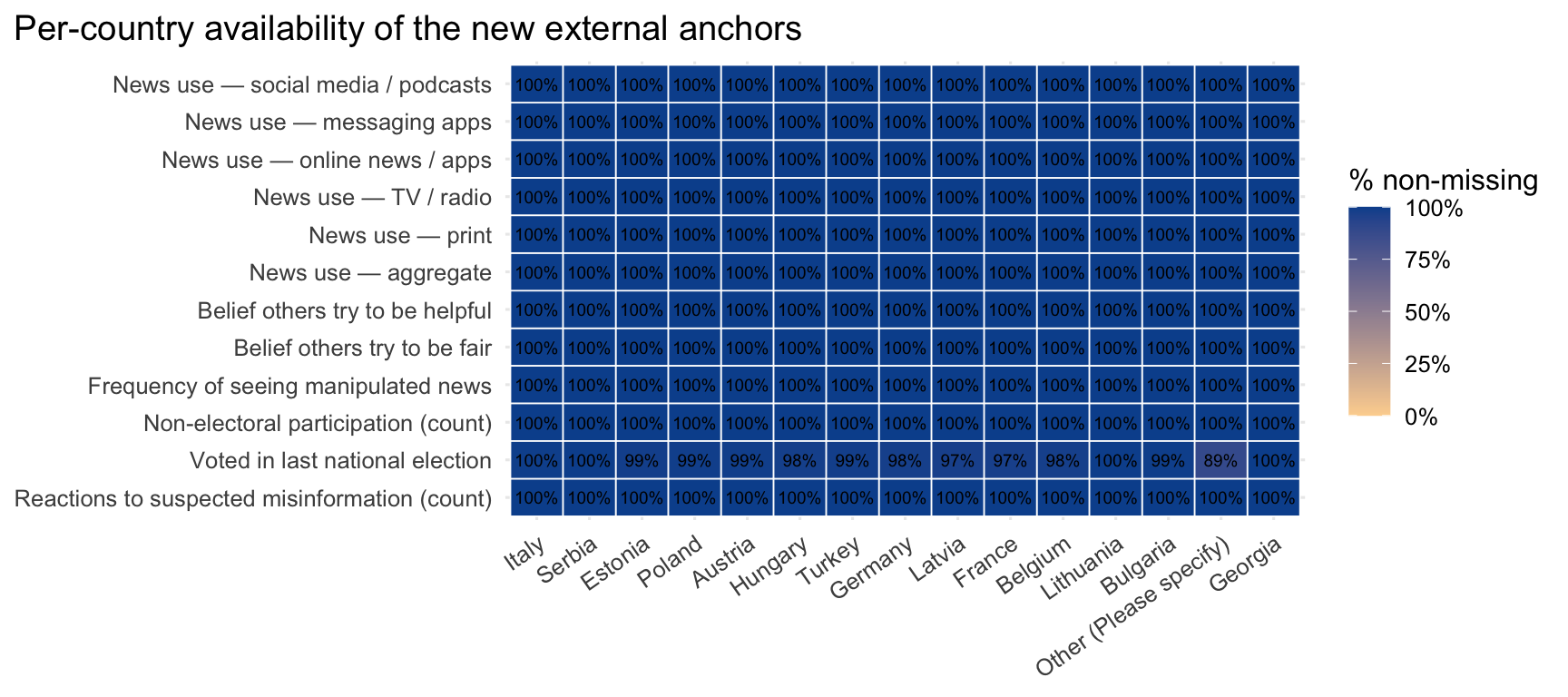
The three preregistered behavioural / participation DVs and the convergent / media-channel anchors were fielded identically in every country, but item-level non-response varies. The table below reports the proportion of respondents with a non-missing value per country for the new anchors so a reader can see whether any country’s contribution to those rows is meaningfully thin. The voting binary excludes the 128 respondents who chose “I don’t remember / Refused” (treated as missing) and the count-style behavioural / participation scales are zero-coded (no missing) by construction in 01-data-preparation.qmd.

All preregistered exploratory anchors have ≥ 80% non-missing coverage in every retained country.

Robustness and sensitivity

Preregistration point 6 commits to reporting the validation analyses with and without respondents who fail the attention checks. The headline S4 models (S4_deploy_cfa, S4_pred_full, S4_pred_russian, S4_pred_chinese, S4_pred_short) are re-fitted on the attentive subsample — respondents who pass both the embedded attention probe (att_pass_embedded) and the explicit Q29 probe (att_pass_q29) and who are not flagged as fast completers (fast_completion == FALSE). Refits are cached under outputs/sem_fits/s4_S4_*_attentive.rds.

Full-sample versus attentive-subsample (N = 3,309, 41.2% of retained) fit indices
Model CFI (full) CFI (attentive) ΔCFI RMSEA (full) RMSEA (attentive) ΔRMSEA SRMR (full) SRMR (attentive) ΔSRMR FIMI R² (full) FIMI R² (attentive) ΔR²
S4_deploy_cfa 0.828 0.799 -0.029 0.127 0.138 0.011 0.133 0.140 0.007 - - -
S4_pred_full 0.824 0.795 -0.030 0.090 0.097 0.007 0.104 0.108 0.003 7.9% 10.6% 2.7%
S4_pred_russian 0.827 0.799 -0.028 0.101 0.109 0.008 0.113 0.118 0.005 10.4% 12.4% 1.9%
S4_pred_chinese 0.826 0.796 -0.030 0.110 0.120 0.010 0.118 0.124 0.006 2.7% 2.9% 0.2%
S4_pred_short 0.826 0.798 -0.028 0.105 0.113 0.008 0.115 0.119 0.004 8.6% 11.3% 2.7%
Standardised FIMI prediction paths: full sample vs. attentive subsample
Criterion Predictor β (full) p (full) β (attentive) p (attentive) Δβ Sign flip
Full FIMI GEN -0.07 0.097 -0.09 0.123 -0.02 no
Full FIMI THREAT 0.32 0.050 0.35 0.120 0.03 no
Full FIMI ABAND -0.27 0.059 -0.40 0.058 -0.12 no
Full FIMI FEAR 0.17 <0.001 0.06 0.107 -0.11 no
Full FIMI SUPF -0.16 <0.001 -0.20 0.002 -0.04 no
Full FIMI SUPFCH 0.04 0.075 0.03 0.343 -0.01 no
Russian-origin GEN -0.06 0.159 -0.06 0.355 0.00 no
Russian-origin THREAT 0.32 0.051 0.36 0.113 0.04 no
Russian-origin ABAND -0.32 0.035 -0.43 0.048 -0.11 no
Russian-origin FEAR 0.18 <0.001 0.06 0.099 -0.12 no
Russian-origin SUPF -0.23 <0.001 -0.26 <0.001 -0.03 no
Russian-origin SUPFCH 0.06 0.017 0.05 0.186 -0.01 no
Chinese-origin GEN -0.05 0.327 -0.16 0.043 -0.11 no
Chinese-origin THREAT 0.02 0.903 0.09 0.694 0.07 no
Chinese-origin ABAND 0.03 0.869 -0.17 0.454 -0.19 yes
Chinese-origin FEAR 0.14 <0.001 0.04 0.394 -0.10 no
Chinese-origin SUPF 0.05 0.299 0.07 0.423 0.01 no
Chinese-origin SUPFCH -0.01 0.651 -0.01 0.794 0.00 no
Short FIMI GEN -0.09 0.058 -0.13 0.068 -0.04 no
Short FIMI THREAT 0.41 0.033 0.37 0.164 -0.05 no
Short FIMI ABAND -0.35 0.042 -0.41 0.094 -0.06 no
Short FIMI FEAR 0.16 <0.001 0.05 0.223 -0.11 no
Short FIMI SUPF -0.15 0.002 -0.17 0.019 -0.02 no
Short FIMI SUPFCH 0.03 0.290 0.03 0.477 0.00 no

Across the five refits, the largest absolute change in CFI was 0.030, the largest absolute change in RMSEA was 0.011, and the largest absolute change in any standardised FIMI prediction path was 0.19. Sign flips on FIMI prediction paths: yes. The headline conclusion does not change: the deployed predictor structure holds, and the criterion ordering across Full, Russian-origin, Chinese-origin, and Short FIMI is preserved on the attentive subsample.

Demographic subgroup robustness

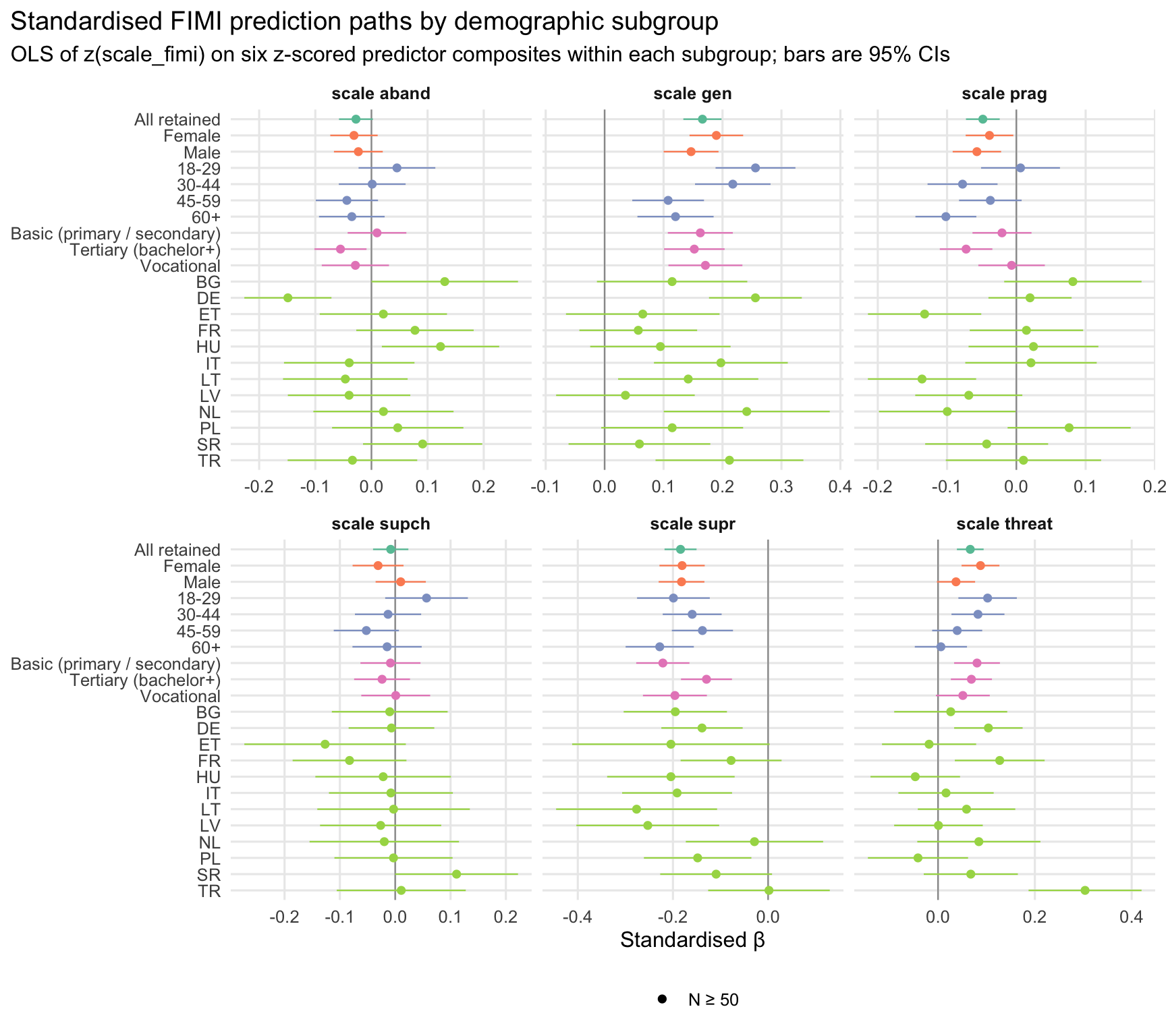
The preregistration commits to exploratory subgroup probes on the demographic variables collected for descriptive purposes (age, gender, education, minority status, languages spoken). The pooled S4_pred_full model would require twenty-plus refits if split by every subgroup, so the subgroup robustness check below uses the scale-composite OLS approximation: standardised regression of scale_fimi (Full FIMI composite) on the six z-scored predictor composites (scale_gen, scale_threat, scale_aband, scale_prag, scale_supr, scale_supch), refit within each pooled subgroup. The pooled benchmark on the full retained sample is reported alongside each subgroup so the magnitude of any shift can be read directly. Country is not split here because the country invariance ladder above already handles that grouping; subgroups are pre-pooled across all retained countries.

S4 does not field a dedicated minority-status item, so the language grouping below also doubles as a coarse minority-status proxy: respondents who took the survey in a non-titular language of their country (e.g., Russian-language respondents in Latvia or Estonia, French-language respondents in Belgium) appear in the smaller language strata flagged below.

Subgroup sample sizes and model R² for the scale-composite OLS approximation of S4_pred_full
Facet Subgroup N Model R²
Pooled (benchmark) All retained 8,040 2.9%
Gender Female 4,253 3.5%
Gender Male 3,773 2.5%
Age bracket 18-29 1,630 8.5%
Age bracket 30-44 2,271 3.8%
Age bracket 45-59 2,279 2.3%
Age bracket 60+ 1,860 5.1%
Education Basic (primary / secondary) 2,847 4.0%
Education Tertiary (bachelor+) 3,235 2.3%
Education Vocational 1,958 2.9%
Survey language BG 595 5.1%
Survey language DE 1,232 4.5%
Survey language ET 552 5.2%
Survey language FR 859 3.4%
Survey language HU 612 5.3%
Survey language IT 619 3.2%
Survey language LT 597 6.1%
Survey language LV 529 5.1%
Survey language NL 371 8.1%
Survey language PL 604 2.7%
Survey language SR 640 2.5%
Survey language TR 596 11.3%

All subgroups retain N ≥ 50; the forest plot above can be read at face value.

Across the well-powered (N ≥ 50) subgroups, the largest absolute shift in any standardised FIMI path relative to the pooled benchmark was 0.24 (scale_threat in Survey language — TR). Sign flips on substantively non-trivial paths (|β| > 0.05 in both samples): none. The headline conclusion holds: the pooled FIMI-prediction structure is largely stable across the demographic subgroups, with no predictor reversing direction in any well-powered cell.

Key takeaways

The cross-study Stage 1 dimensionality diagnostics for the S4 deployed predictor pool are mirrored on the canonical 2b Item-pool dimensionality page, which also reports the S1 broad-pool EFA.

The S4 page now moves the multinational wave from scaffold to live analysis. Pooled models use all retained respondents; country invariance is restricted only where country grouping is substantively interpretable. Full FIMI is the primary prediction criterion, and the Russian-origin, Chinese-origin, and short-FIMI variants show whether the structural pattern depends on the operationalisation of FIMI receptivity. The external-anchor table provides S4’s country-adjusted nomological evidence, while the COND experiment remains in the 4c COND appendix.

References