Overview
This page hosts Stage 1 — item-pool dimensionality for the DisInforMeter predictor batteries. Two waves carry the bulk of the dimensionality evidence: Study 1 fielded the broadest exploratory item pool, and Study 4 fielded the deployed multinational predictor pool (the version that downstream CFAs and structural models work from). The cross-study evidence on first-order structure consolidates on 4a Measurement architecture; per-study pages then estimate Stage 2 (first-order measurement) and Stages 3 / 5 / 6 / 7 / 8 against the structure documented here.
Per the eight-stage pipeline locked in R/roadmap_helpers.R::progress_matrix(), Stage 1 asks whether the empirical correlation structure can plausibly support the registered CFA partition. The diagnostics on this page are exploratory; they are reported alongside, not in place of, the registered CFA solutions. The CFA specifications in R/sem_specs.R are not re-specified on the basis of EFA findings — the EFA simply gives empirical context for how strongly the deployed partition is supported by the off-diagonal correlation structure.
Stage 1 in the pipeline
Stage 1 is exploratory dimensionality work on the predictor item pool. The FIMI criterion is excluded — Stage 4 (outcome operationalisation) treats FIMI separately on 03d and 4b. For each wave we report:
-
Sampling adequacy: overall KMO (
psych::KMO) and item-level MSA; Bartlett’s test of sphericity (psych::cortest.bartlett). Low MSA on any item is flagged; a Bartlett rejection is necessary (not sufficient) for EFA to be meaningful.
-
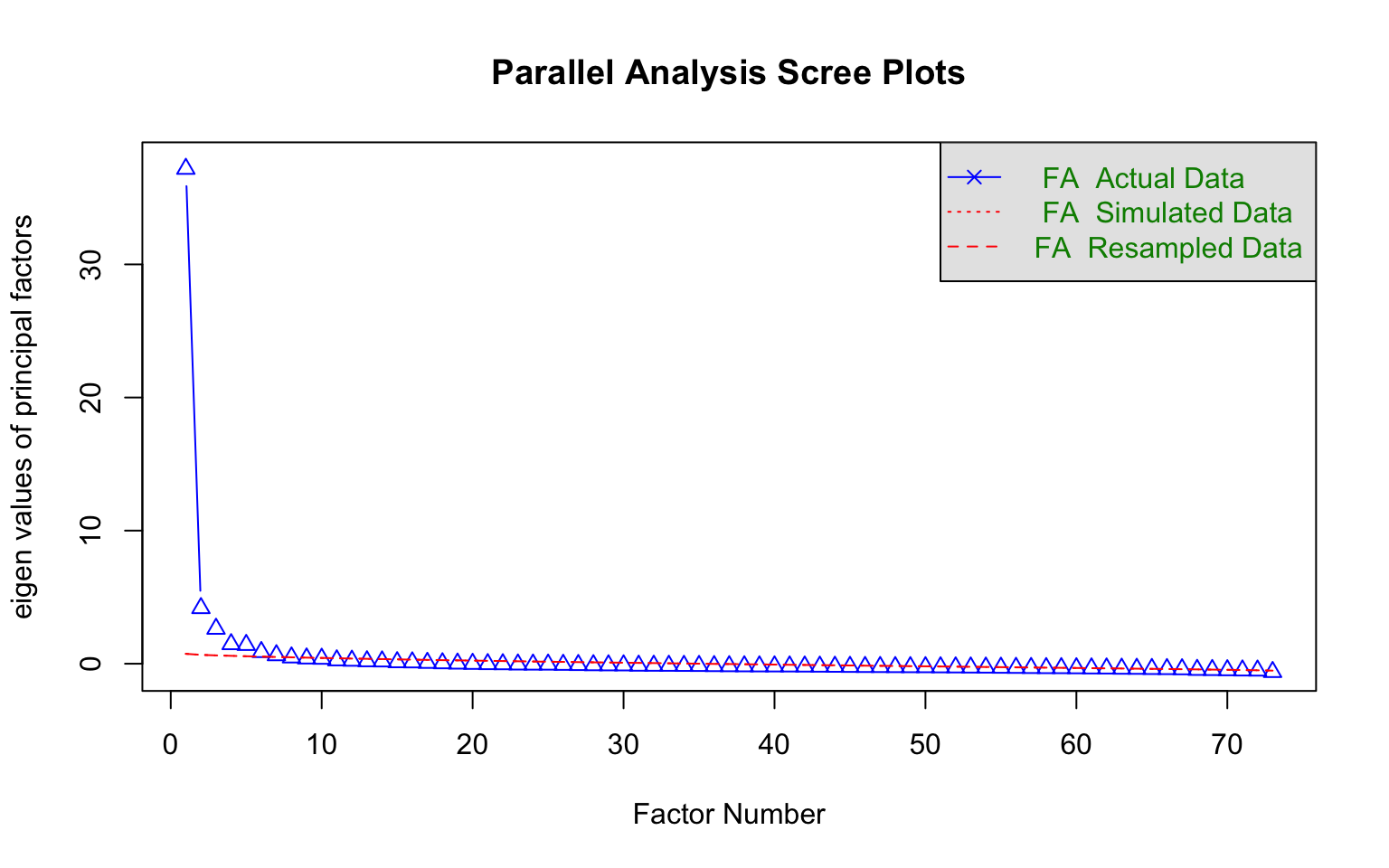
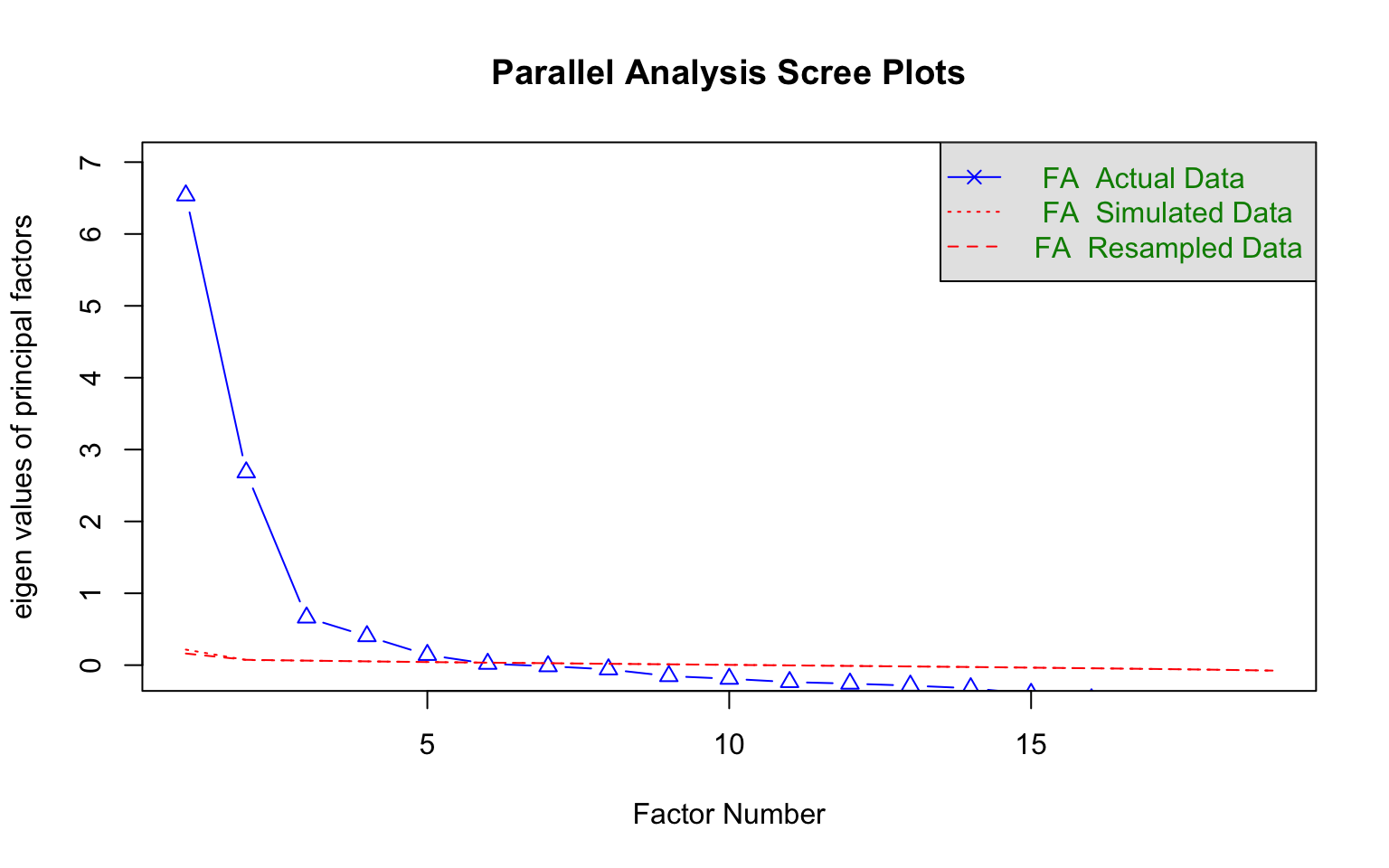
Factor-count diagnostics: parallel analysis with the 95th-percentile rule (
psych::fa.parallel, n.iter = 50) and Velicer’s MAP across 1–8 factors (psych::vss, fm = "ml", rotate = "oblimin").
-
Factor extraction: maximum-likelihood EFA with oblimin rotation (
psych::fa, fm = "ml") at the registered factor count. Loadings with |λ| < .30 are suppressed in the printed table to keep the structure readable. The full unsuppressed loading matrix is written to outputs/tables/.
The registered factor counts are taken directly from the lavaan specifications:
-
S1: the thirteen first-order latents in
S1_full (CET, EXPL, MOR, GAY, ABANF, MIGR, ABANH, KNOW, FREE, PRAGR, PRAGCH, SUPR, SUPCH; S1 legacy: USE/SAFE/LONE/ANXR/ANXK/SUPK). FIMI is the criterion and is excluded.
-
S4: the six first-order predictor latents in
S4_deploy_cfa (GEN, THREAT, ABAND, FEAR, SUPF, SUPFCH; S4 legacy: PRAG/SUPR/SUPCH — note that S4 SUPF / SUPFCH are affective admiration via the fru* / fch* items, not the S1/S5 belief composites). FIMI is the criterion and is excluded.
S1 item pool dimensionality
The Study 1 predictor item pool comprises 73 items across 13 first-order constructs (ABANF, ABANH, ABANM, CET, EXPL, GAY, KNOW, MIGR, MOR, PRAGCH, PRAGR, SUPCH, SUPR), drawn from the cached S1_full lavaan specification. FIMI news items are excluded.
S1 predictor pool: sampling adequacy and sphericity
| Items |
73 |
| N (pairwise) |
681 |
| N (complete-case) |
681 |
| Overall KMO (MSA) |
0.980 |
| Bartlett chi-square |
53 829.1 |
| Bartlett df |
2628 |
| Bartlett p |
<0.001 |
S1 item-level KMO measures of sampling adequacy
| ABANF |
unp1 |
0.984 |
| ABANF |
unp6 |
0.988 |
| ABANF |
unp7 |
0.986 |
| ABANF |
unp8 |
0.986 |
| ABANH |
aban1 |
0.976 |
| ABANH |
aban2 |
0.976 |
| ABANH |
aban3 |
0.987 |
| ABANH |
aban4 |
0.978 |
| ABANH |
aban5 |
0.977 |
| ABANM |
cen1 |
0.989 |
| ABANM |
cen2 |
0.972 |
| ABANM |
cen3 |
0.957 |
| ABANM |
cen4 |
0.986 |
| ABANM |
cen5 |
0.963 |
| CET |
poi3 |
0.989 |
| CET |
poi6 |
0.985 |
| CET |
poi7 |
0.985 |
| EXPL |
exp1 |
0.990 |
| EXPL |
exp2 |
0.986 |
| EXPL |
exp3 |
0.987 |
| EXPL |
exp4 |
0.987 |
| GAY |
lgb1 |
0.974 |
| GAY |
lgb2 |
0.968 |
| GAY |
lgb3 |
0.975 |
| GAY |
lgb4 |
0.976 |
| KNOW |
aban6 |
0.940 |
| KNOW |
aban7 |
0.924 |
| KNOW |
aban8 |
0.967 |
| MIGR |
unp3 |
0.962 |
| MIGR |
unp4 |
0.949 |
| MOR |
dec1 |
0.979 |
| MOR |
dec2 |
0.979 |
| MOR |
dec3 |
0.988 |
| MOR |
dec4 |
0.985 |
| MOR |
dec5 |
0.986 |
| PRAGCH |
pkin1 |
0.985 |
| PRAGCH |
pkin2 |
0.989 |
| PRAGCH |
pkin3 |
0.974 |
| PRAGCH |
pkin4 |
0.978 |
| PRAGCH |
pkin5 |
0.985 |
| PRAGCH |
pkin6 |
0.973 |
| PRAGR |
pru1 |
0.987 |
| PRAGR |
pru2 |
0.989 |
| PRAGR |
pru3 |
0.982 |
| PRAGR |
pru4 |
0.985 |
| PRAGR |
pru5 |
0.989 |
| PRAGR |
pru6 |
0.974 |
| SUPCH |
ski1 |
0.979 |
| SUPCH |
ski10 |
0.980 |
| SUPCH |
ski11 |
0.985 |
| SUPCH |
ski2 |
0.978 |
| SUPCH |
ski3 |
0.979 |
| SUPCH |
ski4 |
0.964 |
| SUPCH |
ski5 |
0.968 |
| SUPCH |
ski6 |
0.963 |
| SUPCH |
ski7 |
0.973 |
| SUPCH |
ski8 |
0.974 |
| SUPCH |
ski9 |
0.982 |
| SUPR |
sru1 |
0.979 |
| SUPR |
sru10 |
0.985 |
| SUPR |
sru11 |
0.981 |
| SUPR |
sru12 |
0.980 |
| SUPR |
sru13 |
0.981 |
| SUPR |
sru14 |
0.981 |
| SUPR |
sru15 |
0.984 |
| SUPR |
sru2 |
0.984 |
| SUPR |
sru3 |
0.984 |
| SUPR |
sru4 |
0.986 |
| SUPR |
sru5 |
0.975 |
| SUPR |
sru6 |
0.988 |
| SUPR |
sru7 |
0.985 |
| SUPR |
sru8 |
0.987 |
| SUPR |
sru9 |
0.985 |
Parallel analysis suggests that the number of factors = 7 and the number of components = NA
S1 Velicer's MAP across candidate factor counts (smaller is better)
| 1 |
0.0295 |
| 2 |
0.0179 |
| 3 |
0.0124 |
| 4 |
0.0115 |
| 5 |
0.0095 |
| 6 |
0.0087 |
| 7 |
0.0082 |
| 8 |
0.0081 |
S1 oblimin-rotated 13-factor ML solution; |λ|
| unp1 |
ABANF |
|
|
|
|
|
|
|
|
|
0.40 |
|
|
|
| unp6 |
ABANF |
|
|
0.36 |
|
|
|
|
|
|
|
|
|
|
| unp7 |
ABANF |
|
|
|
|
|
|
|
|
|
|
|
|
0.40 |
| unp8 |
ABANF |
|
|
|
|
|
|
|
|
|
|
|
|
|
| aban1 |
ABANH |
|
|
0.83 |
|
|
|
|
|
|
|
|
|
|
| aban2 |
ABANH |
|
|
0.84 |
|
|
|
|
|
|
|
|
|
|
| aban3 |
ABANH |
|
|
0.57 |
|
|
|
|
|
|
|
|
|
|
| aban4 |
ABANH |
|
|
0.71 |
|
|
|
|
|
|
|
|
|
|
| aban5 |
ABANH |
|
|
0.67 |
|
|
|
|
|
|
|
|
|
|
| cen1 |
ABANM |
|
|
0.31 |
|
|
|
|
|
|
|
|
|
|
| cen2 |
ABANM |
|
|
|
|
|
|
0.69 |
|
|
|
|
|
|
| cen3 |
ABANM |
|
|
|
|
|
|
0.90 |
|
|
|
|
|
|
| cen4 |
ABANM |
|
|
|
|
|
|
0.46 |
|
|
|
|
|
|
| cen5 |
ABANM |
|
|
|
|
|
|
0.86 |
|
|
|
|
|
|
| poi3 |
CET |
|
|
|
|
|
|
|
|
|
|
|
|
|
| poi6 |
CET |
|
|
|
|
0.52 |
|
|
|
|
|
|
|
|
| poi7 |
CET |
|
|
|
|
0.59 |
|
|
|
|
|
|
|
|
| exp1 |
EXPL |
|
|
|
|
0.57 |
|
|
|
|
|
|
|
|
| exp2 |
EXPL |
|
|
|
|
0.58 |
|
|
|
|
|
|
|
|
| exp3 |
EXPL |
|
|
|
|
0.44 |
|
|
|
|
|
|
|
|
| exp4 |
EXPL |
|
|
|
|
0.39 |
|
|
|
|
|
|
|
|
| lgb1 |
GAY |
|
|
|
|
|
0.66 |
|
|
|
|
|
|
|
| lgb2 |
GAY |
|
|
|
|
|
0.94 |
|
|
|
|
|
|
|
| lgb3 |
GAY |
|
|
|
|
|
0.82 |
|
|
|
|
|
|
|
| lgb4 |
GAY |
|
|
|
|
|
0.85 |
|
|
|
|
|
|
|
| aban6 |
KNOW |
|
|
|
|
|
|
|
|
0.88 |
|
|
|
|
| aban7 |
KNOW |
|
|
|
|
|
|
|
|
0.94 |
|
|
|
|
| aban8 |
KNOW |
|
|
|
|
|
|
0.39 |
|
0.31 |
|
|
|
|
| unp3 |
MIGR |
|
|
|
|
|
|
|
|
|
0.78 |
|
|
|
| unp4 |
MIGR |
|
|
|
|
|
|
|
|
|
0.72 |
|
|
|
| dec1 |
MOR |
|
|
|
0.82 |
|
|
|
|
|
|
|
|
|
| dec2 |
MOR |
|
|
|
0.79 |
|
|
|
|
|
|
|
|
|
| dec3 |
MOR |
|
|
|
0.62 |
|
|
|
|
|
|
|
|
|
| dec4 |
MOR |
|
|
|
0.52 |
|
|
|
|
|
|
|
|
|
| dec5 |
MOR |
|
|
|
0.42 |
|
|
|
|
|
|
|
|
|
| pkin1 |
PRAGCH |
|
|
|
|
|
|
|
0.53 |
|
|
|
|
|
| pkin2 |
PRAGCH |
|
|
|
|
|
|
|
0.35 |
|
|
|
|
|
| pkin3 |
PRAGCH |
|
|
|
|
|
|
|
0.64 |
|
|
|
|
|
| pkin4 |
PRAGCH |
|
|
|
|
|
|
|
0.62 |
|
|
|
|
|
| pkin5 |
PRAGCH |
|
|
|
|
|
|
|
0.41 |
|
|
|
|
|
| pkin6 |
PRAGCH |
|
|
|
|
|
|
|
|
|
|
0.61 |
|
|
| pru1 |
PRAGR |
|
|
|
|
|
|
|
|
|
|
|
0.40 |
|
| pru2 |
PRAGR |
|
|
|
|
|
|
|
|
|
|
|
0.43 |
|
| pru3 |
PRAGR |
|
|
|
|
|
|
|
|
|
|
|
0.50 |
|
| pru4 |
PRAGR |
|
|
|
|
|
|
|
|
|
|
|
0.50 |
|
| pru5 |
PRAGR |
0.46 |
|
|
|
|
|
|
|
|
|
|
|
|
| pru6 |
PRAGR |
|
|
|
|
|
|
|
|
|
|
0.60 |
|
|
| ski1 |
SUPCH |
0.40 |
0.30 |
|
|
|
|
|
|
|
|
|
|
|
| ski10 |
SUPCH |
|
0.66 |
|
|
|
|
|
|
|
|
|
|
|
| ski11 |
SUPCH |
|
0.49 |
|
|
|
|
|
|
|
|
|
|
|
| ski2 |
SUPCH |
|
0.53 |
|
|
|
|
|
|
|
|
|
|
|
| ski3 |
SUPCH |
|
0.53 |
|
|
|
|
|
|
|
|
|
|
|
| ski4 |
SUPCH |
|
0.73 |
|
|
|
|
|
|
|
|
|
|
|
| ski5 |
SUPCH |
|
0.82 |
|
|
|
|
|
|
|
|
|
|
|
| ski6 |
SUPCH |
|
0.78 |
|
|
|
|
|
|
|
|
|
|
|
| ski7 |
SUPCH |
|
0.68 |
|
|
|
|
|
|
|
|
|
|
|
| ski8 |
SUPCH |
|
0.56 |
|
|
|
|
|
|
|
|
|
|
|
| ski9 |
SUPCH |
|
0.70 |
|
|
|
|
|
|
|
|
|
|
|
| sru1 |
SUPR |
0.69 |
|
|
|
|
|
|
|
|
|
|
|
|
| sru10 |
SUPR |
0.68 |
|
|
|
|
|
|
|
|
|
|
|
|
| sru11 |
SUPR |
0.67 |
|
|
|
|
|
|
|
|
|
|
|
|
| sru12 |
SUPR |
0.38 |
|
|
|
|
|
|
|
|
|
|
|
|
| sru13 |
SUPR |
0.65 |
|
|
|
|
|
|
|
|
|
|
|
|
| sru14 |
SUPR |
0.59 |
|
|
|
|
|
|
|
|
|
|
|
|
| sru15 |
SUPR |
0.62 |
|
|
|
|
|
|
|
|
|
|
|
|
| sru2 |
SUPR |
0.66 |
|
|
|
|
|
|
|
|
|
|
|
|
| sru3 |
SUPR |
0.71 |
|
|
|
|
|
|
|
|
|
|
|
|
| sru4 |
SUPR |
0.62 |
|
|
|
|
|
|
|
|
|
|
|
|
| sru5 |
SUPR |
|
0.36 |
|
|
|
|
|
|
|
|
|
|
|
| sru6 |
SUPR |
0.66 |
|
|
|
|
|
|
|
|
|
|
|
|
| sru7 |
SUPR |
0.64 |
|
|
|
|
|
|
|
|
|
|
|
|
| sru8 |
SUPR |
0.42 |
|
|
|
|
|
|
|
|
|
|
|
|
| sru9 |
SUPR |
0.62 |
|
|
|
|
|
|
|
|
|
|
|
|
S1 variance accounted for by each oblimin-rotated factor
| SS loadings |
9.437 |
6.479 |
5.280 |
4.949 |
4.534 |
4.457 |
4.087 |
2.998 |
2.775 |
2.731 |
2.450 |
2.303 |
1.242 |
| Proportion Var |
0.129 |
0.089 |
0.072 |
0.068 |
0.062 |
0.061 |
0.056 |
0.041 |
0.038 |
0.037 |
0.034 |
0.032 |
0.017 |
| Cumulative Var |
0.129 |
0.218 |
0.290 |
0.358 |
0.420 |
0.481 |
0.537 |
0.578 |
0.616 |
0.654 |
0.687 |
0.719 |
0.736 |
| Proportion Explained |
0.176 |
0.121 |
0.098 |
0.092 |
0.084 |
0.083 |
0.076 |
0.056 |
0.052 |
0.051 |
0.046 |
0.043 |
0.023 |
| Cumulative Proportion |
0.176 |
0.296 |
0.395 |
0.487 |
0.571 |
0.654 |
0.730 |
0.786 |
0.838 |
0.888 |
0.934 |
0.977 |
1.000 |
Parallel analysis retains 7 factors. Velicer’s MAP minimises at 8 factors. The registered S1 first-order partition (S1_full) specifies 13 latents. The EFA is reported at 13 factors to keep the comparison aligned with the registered specification; the parallel-analysis and MAP counts are noted for transparency and are not used to re-specify the CFA.
S4 item pool dimensionality
The Study 4 deployed predictor pool comprises 19 items across 6 first-order constructs (GEN, THREAT, ABAND, FEAR, SUPF, SUPFCH; S4 legacy: PRAG/SUPR/SUPCH), drawn from the registered S4_deploy_cfa specification. FIMI news items are excluded.
S4 deployed predictor pool: sampling adequacy and sphericity
| Items |
19 |
| N (pairwise) |
8,040 |
| N (complete-case) |
8,040 |
| Overall KMO (MSA) |
0.893 |
| Bartlett chi-square |
103 570.7 |
| Bartlett df |
171 |
| Bartlett p |
<0.001 |
S4 item-level KMO measures of sampling adequacy
| ABAND |
ab2 |
0.903 |
| ABAND |
ab4 |
0.876 |
| ABAND |
ab7 |
0.915 |
| FEAR |
pa1 |
0.765 |
| FEAR |
pa2 |
0.929 |
| FEAR |
pa4 |
0.756 |
| GEN |
gen1 |
0.867 |
| GEN |
gen2 |
0.881 |
| GEN |
gen3 |
0.892 |
| GEN |
gen5 |
0.892 |
| GEN |
gen7 |
0.892 |
| SUPF |
fru1 |
0.911 |
| SUPF |
fru2 |
0.904 |
| SUPF |
fru3 |
0.913 |
| SUPFCH |
fch1 |
0.887 |
| SUPFCH |
fch2 |
0.879 |
| SUPFCH |
fch3 |
0.915 |
| THREAT |
th6 |
0.941 |
| THREAT |
th9 |
0.956 |
Parallel analysis suggests that the number of factors = 5 and the number of components = NA
S4 Velicer's MAP across candidate factor counts (smaller is better)
| 1 |
0.0766 |
| 2 |
0.0361 |
| 3 |
0.0324 |
| 4 |
0.0346 |
| 5 |
0.0306 |
| 6 |
0.0370 |
| 7 |
0.0470 |
| 8 |
0.0575 |
S4 oblimin-rotated 6-factor ML solution; |λ|
| ab2 |
ABAND |
0.70 |
|
|
|
|
|
| ab4 |
ABAND |
0.77 |
|
|
|
|
|
| ab7 |
ABAND |
0.68 |
|
|
|
|
|
| pa1 |
FEAR |
|
|
0.78 |
|
|
|
| pa2 |
FEAR |
|
|
0.39 |
|
|
|
| pa4 |
FEAR |
|
|
0.89 |
|
|
|
| gen1 |
GEN |
0.62 |
|
|
|
|
|
| gen2 |
GEN |
0.63 |
|
|
|
|
|
| gen3 |
GEN |
|
|
0.53 |
|
|
|
| gen5 |
GEN |
|
|
|
|
0.95 |
|
| gen7 |
GEN |
|
|
|
0.31 |
0.61 |
|
| fru1 |
SUPF |
|
0.79 |
|
|
|
|
| fru2 |
SUPF |
|
0.90 |
|
|
|
|
| fru3 |
SUPF |
|
0.84 |
|
|
|
|
| fch1 |
SUPFCH |
|
|
|
0.89 |
|
|
| fch2 |
SUPFCH |
|
|
|
0.55 |
|
0.31 |
| fch3 |
SUPFCH |
|
|
|
|
|
0.59 |
| th6 |
THREAT |
0.61 |
|
|
|
|
|
| th9 |
THREAT |
0.32 |
|
|
|
|
|
S4 variance accounted for by each oblimin-rotated factor
| SS loadings |
3.059 |
2.783 |
1.934 |
1.776 |
1.681 |
0.958 |
| Proportion Var |
0.161 |
0.146 |
0.102 |
0.093 |
0.088 |
0.050 |
| Cumulative Var |
0.161 |
0.307 |
0.409 |
0.503 |
0.591 |
0.642 |
| Proportion Explained |
0.251 |
0.228 |
0.159 |
0.146 |
0.138 |
0.079 |
| Cumulative Proportion |
0.251 |
0.479 |
0.638 |
0.784 |
0.921 |
1.000 |
Parallel analysis retains 5 factors. Velicer’s MAP minimises at 5 factors. The registered S4_deploy_cfa specifies 6 first-order latents (GEN, THREAT, ABAND, FEAR, SUPF, SUPFCH). The EFA is reported at 6 factors so it is directly comparable to the registered solution; the parallel-analysis and MAP counts are noted for transparency. The EFA is not used to re-specify the CFA.
How dimensionality decisions flow into Stage 2 / 3
Stage 1 dimensionality on this page feeds two downstream stages.
-
Stage 2 — first-order measurement validation estimates the registered first-order CFAs on each wave. For S1 this happens on 03a Study 1 (block CFAs and
S1_full); for S4 on 03d Study 4 (S4_deploy_cfa). Cross-wave first-order synthesis lives on 4a Measurement architecture.
-
Stage 3 — higher-order construct representation sits on top of the validated first-order partition. For S1 the higher-order representation choice is explored on 03a (reflective second-order, pure formative
<~, hybrid MIMIC, two-step rescue). S4 inherits the S2 / S3 representation; see the inheritance note on 03d and the cross-study comparison on 4a.
The EFA results here are reported for transparency and to surface any item-level MSA or empirical-eigenvalue surprises ahead of the registered CFA estimation. They are not used to re-specify R/sem_specs.R.