This page: Positions Study 1 as the exploratory foundation: block CFAs and the full first-order SEM screen first-order measurement, competing reflective/formative/hybrid specifications probe higher-order construct representation, FIMI is treated as the initial criterion outcome, and the full and two-step structural models estimate prediction of that criterion. The brief screening model is retained as early scale-reduction/deployment evidence, not as the main construct definition.
Hands off to:Study 2 (refined measurement, representation, FIMI prediction, and short-form evidence in the same population), the cross-cutting Models — Overview (catalogue + syntax conventions), and 4a Measurement architecture for the cross-study synthesis.
TipHeadline contribution
Study 1 (Lithuania, Dec 2024) contributes the following cross-study evidence:
Stage 2: establishes the exploratory first-order baseline across the grievance, abandonment, pragmatism, and admiration blocks.
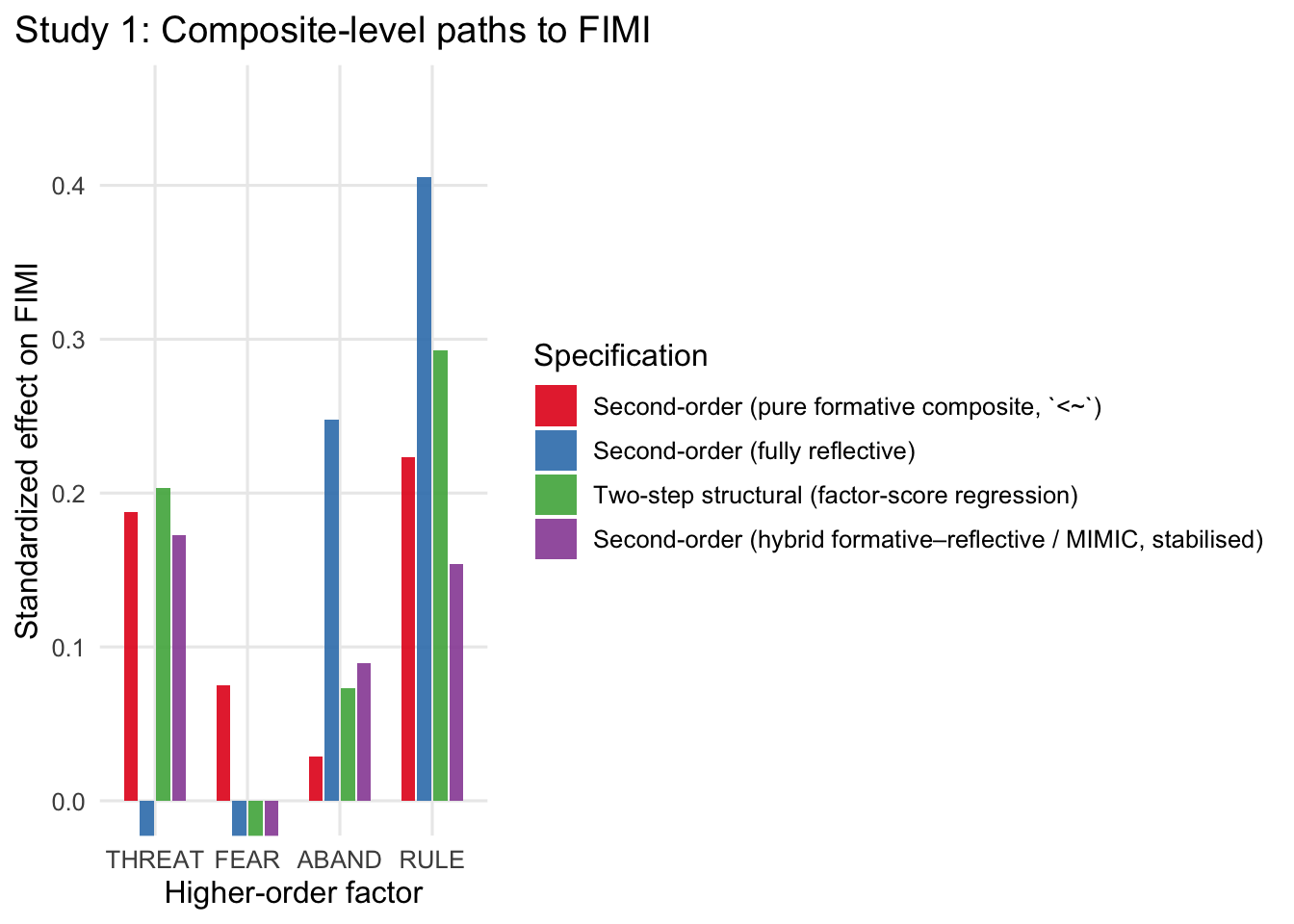
Stage 3: registers all three higher-order representations — fully reflective, anchored pure formative <~, and stabilised hybrid MIMIC (=~ + ~, freed residuals on the borrowed direct indicators) — alongside the two-step rescue. All four fit on this wave; the hybrid MIMIC and pure formative readings track each other on FIMI prediction once their identification choices are accounted for.
Stage 5: two-step structural prediction of the S1 FIMI criterion via factor scores; full first-order paths also estimated as the exploratory headline.
Study 1 fielded the initial DisInforMeter item pool with a Lithuanian Norstat panel sample in December 2024. The wave served as the exploratory foundation of the project, so this page keeps four questions separate. First, block-specific CFAs and the full first-order SEM ask whether the initial grievance, abandonment, and geopolitics factors are psychometrically usable. Second, competing higher-order specifications ask how those first-order factors might be represented at broader construct levels: reflective second-order factors use =~, pure formative composites use <~, and the hybrid formative-reflective / MIMIC-style draft combines reflective =~ measurement with structural ~ links. Third, FIMI is treated as the initial criterion outcome for Study 1, ahead of later cross-study harmonisation. Fourth, structural paths estimate how strongly the first-order or higher-order representations predict that FIMI criterion. The findings shaped the streamlined Studies 2/3 design, but the exploratory higher-order patterns are not treated as a settled architecture.
This page restates Study 1 results in detail. The Models — Overview page hosts the registered specification catalogue and item-level mapping, while the cross-study comparison of Study 1 against the streamlined S2/S3 design lives on the 4a Measurement architecture page.
The Study 1 sample contributing to estimation contains 681 respondents. Item names follow the post-S1 codebook (e.g., lgb* rather than lgbt*); R/sem_specs.R::standardise_s1_names() maps the original LISREL names onto the harmonised vocabulary so all downstream code shares one prefix scheme.
Within the eight-stage pipeline, Study 1 contributes most directly to Stage 1 exploratory dimensionality, Stage 2 first-order measurement validation, Stage 3 higher-order construct modelling, and Stage 5 structural prediction. Stage 4 outcome harmonisation is still preliminary here: Study 1 defines an initial FIMI criterion, while later pages decide which FIMI operationalisation can be compared across waves.
Sample profile
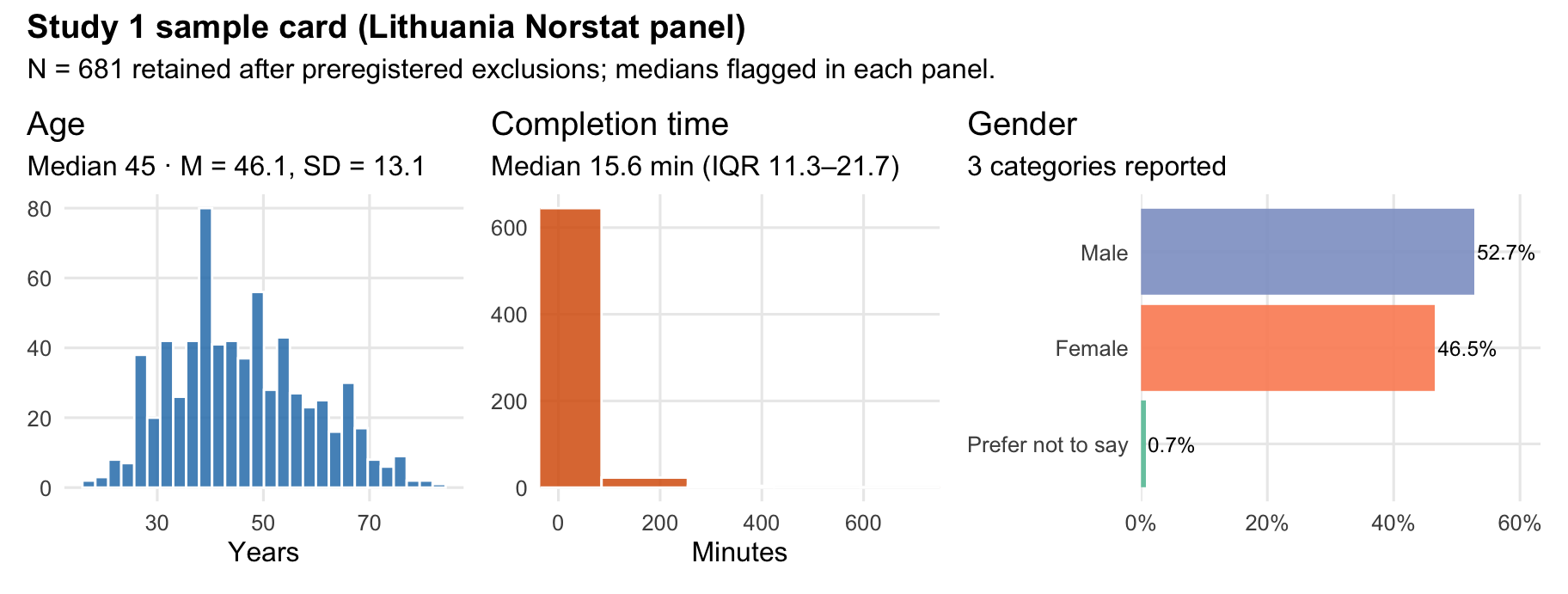
The Study 1 panel has a median age of 45 years, a median completion time of 15.6 minutes, and the largest gender share is 52.7% (Male).
Scale reliability
We compute Cronbach’s α, McDonald’s ω (where ≥ 3 indicators exist), and the average variance extracted (AVE) from the cached S1_full fit for every first-order construct in the Study 1 full model.
Study 1 first-order construct reliability (α, ω) and average variance extracted (AVE from S1_full standardized loadings)
Construct
# items
α
ω
AVE
ABANF
4
0.89
0.90
0.69
ABANH
5
0.94
0.94
0.75
ABANM
5
0.89
0.89
0.63
CET
3
0.88
0.88
0.72
EXPL
4
0.93
0.93
0.77
FIMI
15
0.93
0.93
0.48
GAY
4
0.93
0.93
0.78
KNOW
3
0.79
0.82
0.62
MIGR
2
0.82
—
0.70
MOR
5
0.95
0.95
0.79
PRAGCH
6
0.94
0.94
0.71
PRAGR
6
0.94
0.94
0.73
SUPCH
11
0.95
0.95
0.64
SUPR
15
0.97
0.97
0.66
Constructs crossing both α ≥ .80 and AVE ≥ .50 in Study 1: ABANF, ABANH, ABANM, CET, EXPL, GAY, MIGR, MOR, PRAGCH, PRAGR, SUPCH, SUPR.
Construct evolution and exploratory representations
The Stage 1 item-pool dimensionality diagnostics (parallel analysis, MAP, KMO, Bartlett, oblimin EFA) for the S1 predictor pool live on the canonical Stage 1 owner page — see 2b Item-pool dimensionality for the S1 EFA results that motivate the first-order partition used below.
Study 1 served as the exploratory foundation, testing a wide range of first-order constructs and candidate model specifications. This section separates the early measurement question (which blocks are defensible), the higher-order representation question (how the blocks should be grouped), and the prediction question (which representations explain the harmonised FIMI criterion).
Block-specific models. Construct domains were evaluated separately to establish baseline first-order fit and identify measurement issues before attempting integrated prediction models:
S1_block_ideology — ideological grievance constructs (exploitation, decadence, LGBT opposition, migration concerns, safety), with FIMI paths used only after the block measurement is established.
S1_block_abandon — state abandonment and knowledge constructs without censorship scale.
S1_block_abandon_free — adds censorship/freedom concerns to the abandonment block.
S1_block_russia — Russia and China admiration constructs as predictors.
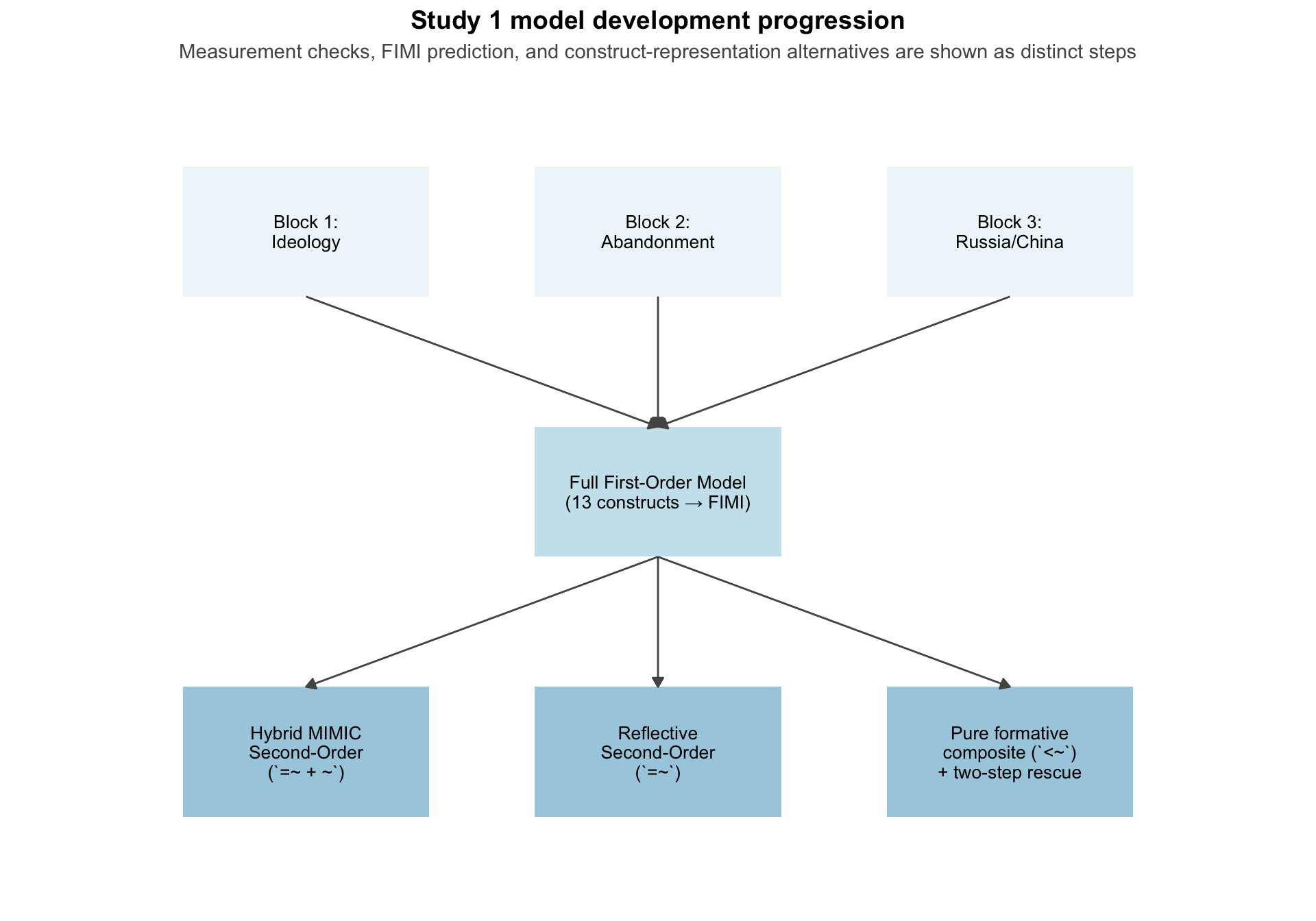
From blocks to full first-order prediction. After validating individual blocks, all constructs were integrated into the full first-order structural model (S1_full), which includes 13 latent constructs predicting the S1 FIMI criterion. This model asks about unique first-order predictive contribution while controlling for overlap; it does not settle the higher-order construct representation.
Construct composition in the Study 1 full first-order model (S1_full)
Domain
Construct
Description
N Items
Outcome Variable
Abandonment
ABANH
Loneliness and state abandonment (S1 legacy: LONE)
5
Ideological Grievances
Abandonment
KNOW
Knowledge and politician failure
3
Admiration
SUPCH
China superiority beliefs (S1 legacy: SUPK)
6
Admiration
SUPR
Russia superiority beliefs
6
Ideology
ABANF
Safety/protection concerns (S1 legacy: SAFE)
4
Ideology
CET
Poisonous ethnocentrism
3
Ideology
EXPL
Exploitation by foreign powers (S1 legacy: USE)
4
State Abandonment
Ideology
GAY
LGBT+ opposition
4
Ideology
MIGR
Immigration concerns
2
Ideology
MOR
Moral decadence concerns
5
Pragmatic Concerns
Outcome
FIMI
Foreign Information Manipulation
6
Pragmatism
PRAGCH
Anxiety about China (S1 legacy: ANXK)
6
Foreign Admiration
Pragmatism
PRAGR
Anxiety about Russia (S1 legacy: ANXR)
6
NA
ABANM
NA
5
Higher-order construct specifications. The transition to higher-order models consolidated first-order factors into four candidate broader dimensions — THREAT (ideological grievances via exploitation, LGBT opposition, immigration concerns), FEAR (pragmatic anxiety about Russia and China; S1 legacy: LEFT’s sibling block carried the legacy ANXR/ANXK labels prior to harmonisation), ABAND (institutional abandonment via state failure and safety concerns; S1 legacy: LEFT), and RULE (admiration for authoritarian alternatives). Three parallel representation framings are registered in R/sem_specs.R so the conceptual choices stay explicit in the rendered report:
Reflective second-order (S1_second_reflective) — higher-order factors manifest through their first-order children via =~ (e.g. ABAND =~ ABANH + ABANF), treating the composites as latent causes of the observed structure.
Pure formative composite (S1_second_formative) — higher-order factors are formed from their first-order parents via the lavaan formative operator <~ (e.g. ABAND <~ 1*ABANH + ABANF). Each composite anchors its first formative weight to 1 so the model is identified under std.lv = TRUE; without the anchor the optimiser collapses to the degenerate all-zero solution. The reflective FIMI prediction layer closes identification of the composites.
Hybrid formative–reflective / MIMIC-style (S1_second_hybrid) — composites are reflectively identified by one or two direct indicators (ABAND =~ unp8 + aban1) and simultaneously regressed on their first-order parents (ABAND ~ ABANH + ABANF). Crucially, ~ is the lavaan regression operator — not the formative operator — so this is not a pure formative model. The S1 catalogue entry frees 24 residual covariances between each direct indicator and its first-order block siblings (unp8 ~~ unp1, unp8 ~~ unp6, …, sup_ru2 ~~ sup_ru15) — substantively justified because the direct indicators are borrowed from the parent blocks and continue to carry within-block content variance. The freed-residual parameterisation converges cleanly under MLR / FIML; the pure-MIMIC parameterisation (without those freeings) does not. First-order parent multicollinearity (worst |r| ≈ .88) keeps individual ~ weights unstable even under the stabilised fit, which is why the pure formative and two-step rescue readings remain on the page.
Comparison of reflective, pure formative (`
Specification
Higher-Order Structure
Key Feature
Reflective (S1_second_reflective)
Reflective
THREAT =~ EXPL + GAY + MIGR
Composite causes covariance among first-order children
Reflective
FEAR =~ PRAGR + PRAGCH
Full factor batteries used
Reflective
ABAND =~ ABANH + ABANF
All indicators included
Reflective
RULE =~ SUPR + SUPCH
Complete measurement models
Pure formative (S1_second_formative, `<~`)
Pure formative (`<~`)
THREAT <~ 1*EXPL + GAY + MIGR
Components form the composite (lavaan `<~`); first weight anchored to 1
Pure formative (`<~`)
FEAR <~ 1*PRAGR + PRAGCH
Composite identified via the anchored weight + reflective FIMI prediction layer
Pure formative (`<~`)
ABAND <~ 1*ABANH + ABANF
Identification via the anchored weight (no MIMIC indicators)
Pure formative (`<~`)
RULE <~ 1*SUPR + SUPCH
Identification via the anchored weight (no MIMIC indicators)
The pure-MIMIC variant (no freed residuals) originally failed to converge on this wave under MLR / FIML — the first-order parent latents correlate up to |r| ≈ .88 (ABANH←→ABANF, PRAGR←→PRAGCH), and the borrowed direct indicators (e.g. unp8) carry block-level residual variance that the pure-MIMIC parameterisation has nowhere to absorb. The 2026-05-17 MIMIC audit replaced the catalogued spec with a stabilised parameterisation that frees 24 residual covariances between each direct indicator and its first-order block siblings; the freed-residual model converges in ~35 s with a positive-definite vcov. The motivation for the two-step solution (S1_second_twostep_measurement → S1_second_twostep_struct) below is therefore not non-convergence (which is now resolved) but the residual structural-multicollinearity cost: individual ABAND ~ ABANH + ABANF weights remain unstable even after stabilisation because the first-order parents are near-collinear, and the factor-score rescue gives a complementary reading that separates well-identified measurement from interpretable composite-level prediction.
Brief/deployment model. The brief model (S1_brief) distils each composite down to 2 items, creating an ultra-short screening instrument. Its FIMI path evaluates retained predictive utility after scale reduction; the reduction decision itself remains a deployment-adaptation question:
Study 1 brief model item composition (S1_brief)
Construct
Item
Item Content (abbreviated)
THREAT (Ideological Grievances)
THREAT
lgb3
LGBT+ rights promotion is a disguised form of colonization
THREAT
exp1
We have become puppets of Brussels
FEAR (Pragmatic Anxiety)
FEAR
pru3
We should not become enemies with countries like Russia
FEAR
pkin3
We should not become enemies with countries like China
ABAND (Institutional Abandonment)
ABAND
unp8
NATO has expanded too much and will be torn apart by internal conflicts
ABAND
aban1
My state has abandoned its citizens
RULE (Authoritarian Admiration)
RULE
ski2
China will reemerge as the most powerful nation in the world
RULE
sru2
Russia will reemerge as the most powerful nation in the world
FIMI (Outcome)
FIMI
news3
Zelensky bought a British mansion from King Charles for 20 million pounds
FIMI
news4
France asked Russia not to touch the French military in Ukraine
FIMI
news9
Gays and transvestites in Kiev are invited to join LGBT brigades
Figure 1: Study 1 model development: first-order block validation, first-order FIMI prediction, and candidate higher-order construct representations.
Model specifications
The cards below cover the nine S1 models registered in R/sem_specs.R. Each card carries the prose description, the structural paths extracted from the syntax, and the full lavaan string. Cards are collapsed by default.
NoteS1_brief — S1 brief structural test
Study: S1 · Family: Abbreviated
Two-indicator-per-latent abbreviated S1 model used as a scale-reduction and deployment-adaptation probe. Each composite (THREAT, FEAR, ABAND, RULE) is reduced to its strongest two items from S1_second_hybrid (the hybrid formative–reflective / MIMIC specification); FIMI is reduced to the source-balanced four-item Short FIMI criterion (news4, news9, news14, news15) so retained prediction can be checked separately.
NoteS1_block_abandon — State abandonment / knowledge (no ABANM)
Study: S1 · Family: First-order blocks
Companion S1 block isolating state-abandonment heart (ABANH), perceived state knowledge (KNOW), and the two pragmatism subscales (PRAGR, PRAGCH). ABANM (media-censorship abandonment) is omitted to test whether censorship perceptions are required to recover the abandonment effect.
NoteS1_block_abandon_free — State abandonment + censorship
Study: S1 · Family: First-order blocks
Same as S1_block_abandon but adds the ABANM (media-censorship abandonment) latent. Pre-registered comparison: does adding ABANM improve fit and structural strength enough to justify keeping it in the full S1 SEM.
First S1 measurement block. Treats the six ideological-grievance subscales (CET, EXPL, MOR, GAY, ABANF, MIGR) as reflective latents and regresses FIMI on them directly. Used to gauge whether the grievance battery alone carries meaningful structural signal before the abandonment and admiration blocks are added.
NoteS1_block_russia — Russia / China admiration (beliefs)
Study: S1 · Family: First-order blocks
S1 block for the two foreign-power belief-superiority subscales (SUPR, SUPCH; legacy S1 labels SUPR / SUPK), with FIMI paths included after the block measurement is specified. Establishes baseline measurement quality for the long admiration batteries before they are folded into the full SEM.
All thirteen first-order S1 latents simultaneously regress on the S1 FIMI criterion. This is the reference first-order structural prediction model for Study 1; higher-order specifications address the separate construct-representation question.
Higher-order S1 specification mirroring the original LISREL design. Each composite is reflectively identified by one or two direct indicators (e.g. ABAND =~ unp8 + aban1) and simultaneously regressed on its first-order parents (ABAND ~ ABANH + ABANF). This is a hybrid formative–reflective (MIMIC-style) construct-representation specification — the ~ operator is a structural regression between latents, not the lavaan formative operator <~. A separate prediction layer regresses FIMI on the four composites. Stabilisation: the pure-MIMIC parameterisation (without residual freeings) failed to converge on this wave under MLR / FIML at both std.lv = TRUE and std.lv = FALSE. The catalogued spec frees 24 residual covariances between each direct affective indicator and the other indicators in the first-order block from which it is drawn (e.g. unp8 ~~ unp1, unp8 ~~ unp6, unp8 ~~ unp7), substantively justified because the direct indicators are borrowed from the parent blocks and continue to carry within-block content variance. Under that freeing the model converges in ~35 s under MLR / FIML and produces a positive-definite vcov for the structural FIMI ~ paths. lavaan does flag a borderline non-positive-definite theta (observed-variable residual covariance matrix) — a Heywood-adjacent symptom of the 24 freed residual covariances bumping up against the same first-order multicollinearity that prevented pure-MIMIC convergence — so the model is read with that caveat rather than as a clean replacement for the pure formative or two-step variants. The post-fit fitMeasures / modindices pipeline is heavy under MLR for a model with this many free parameters (the robust-correction matrix inversion is the bottleneck), so the per-study page caches the extraction outputs to a sidecar file on first render and reads from it thereafter; subsequent renders of 3a and the cross-study consumers (4a, 4c) are fast. First-order parent multicollinearity (worst |r| up to .88 between ABANH/ABANF and PRAGR/PRAGCH) remains large enough to keep individual ABAND ~ ABANH + ABANF etc. weights unstable, so the pure formative (S1_second_formative) and two-step (S1_second_twostep_struct) readings remain on the page as complementary representations.
Pure formative higher-order specification: each composite is built from its first-order parents via the lavaan formative operator <~ (e.g. THREAT <~ 1*EXPL + GAY + MIGR). The first formative weight in each composite is fixed to 1 (anchored composite scaling) so the model is identified under std.lv = TRUE; without the anchor the optimizer collapses to a degenerate all-zero solution. FIMI is reflectively measured by the full 15-item battery and provides the structural prediction layer (FIMI ~ THREAT + FEAR + ABAND + RULE) that closes the identification of the four composites. Sibling to S1_second_hybrid (stabilised hybrid MIMIC) and S1_second_reflective (fully reflective); the three representations triangulate the S1 higher-order construct space.
Fully reflective higher-order S1 specification: the four composites (THREAT, ABAND, FEAR, RULE) are reflective latents identified by their first-order factors via =~ (e.g. ABAND =~ ABANH + ABANF). Provides a contrast with the hybrid MIMIC and pure formative variants and is more permissive of multicollinearity, at the cost of conflating measurement and aggregation.
NoteS1_second_twostep_measurement — Two-step measurement CFA
Study: S1 · Family: Two-step measurement CFA
Step 1 of the rescue solution for the hybrid MIMIC S1 collapse. A pure measurement CFA with the same first-order structure but no structural regressions, fitted with std.lv = TRUE and MLR/FIML. Factor scores from this fit feed the structural step (S1_second_twostep_struct).
Measurement-only specification (no structural regressions).
Step 2 of the rescue solution. The composite-level regressions (ABAND/FEAR/THREAT/RULE on their first-order parents; FIMI on the four composites) are re-estimated as ordinary ~ regressions on factor scores extracted from S1_second_twostep_measurement. This is not a lavaan formative model — ~ is a regression operator, not the formative <~ — but the factor-score approach approximates the composite logic while side-stepping the latent-level multicollinearity that caused the hybrid MIMIC variant (S1_second_hybrid) to produce Heywood cases.
The hybrid MIMIC higher-order block in Study 1 (ABAND, FEAR, THREAT, RULE; spec S1_second_hybrid; S1 legacy label for ABAND: LEFT) was originally a documented non-convergence case: under the pure-MIMIC parameterisation (without residual freeings) lavaan’s MLR / FIML optimizer failed to converge on either std.lv = TRUE or std.lv = FALSE and the structural FIMI ~ paths could not be estimated. The 2026-05-17 MIMIC audit identified the proximate source: the four direct affective indicators on the higher-order composites (unp8/aban1 on ABAND, prag_ru3/prag_kin3 on FEAR, lgbt3/exp1 on THREAT, sup_kin2/sup_ru2 on RULE) are borrowed from the first-order parent blocks, and they carry within-block content variance that the pure-MIMIC parameterisation forces entirely into the higher-order factor. The catalogued S1_second_hybrid spec now frees 24 residual covariances between each direct indicator and its first-order block siblings (e.g. unp8 ~~ unp1, unp8 ~~ unp6, unp8 ~~ unp7), which acknowledges the borrowed-indicator content without changing the higher-order construct definition. Under the freed-residual parameterisation the model converges cleanly in ~35 s under MLR / FIML with a positive-definite vcov for the structural FIMI ~ paths; lavaan does flag a borderline non-positive-definite theta (observed-variable residual covariance matrix), a Heywood-adjacent symptom of the freed residuals bumping up against the same first-order multicollinearity that prevented pure-MIMIC convergence, so the fit is read with that caveat alongside the formative and two-step readings. The residual structural-multicollinearity cost is real and irreducible — first-order parent latents on this wave correlate up to |r| ≈ .88 (ABANH←→ABANF, PRAGR←→PRAGCH), with condition numbers of 8–16 across the four composites — so individual ABAND ~ ABANH + ABANF etc. weights remain unstable. The pure formative composite variant (S1_second_formative, using the lavaan formative operator <~) is the natural sibling reading because anchoring the first <~ weight to 1 produces an analogous identification under different identification semantics; its composite-level FIMI prediction is comparable to the hybrid MIMIC’s, though individual <~ weights are unstable for the same multicollinearity reason. We also retain a two-step rescue: (1) a robust measurement CFA to obtain high-quality factor scores (S1_second_twostep_measurement); (2) the composite-level paths as ordinary ~ regressions on those scores (S1_second_twostep_struct). This is not a lavaan formative model — ~ is a regression operator, not the formative <~ — but the factor-score approach approximates the composite logic while side-stepping the latent-level multicollinearity. All three readings are now available on the page and feed the cross-study representation table on 4a Measurement architecture.
Two-step measurement CFA fit (Study 1)
Model
CFI
TLI
RMSEA
SRMR
χ²
df
p
S1_second_twostep_measurement
0.867
0.858
0.063 [0.060, 0.063]
0.072
8 853.4
2464
<0.001
Two-step structural paths on factor scores (Study 1)
Stage 2 first-order measurement evidence for Study 1 is reported in the First-order construct screening and Full structural model diagnostics subsections below; the cross-study Stage 2 synthesis lives on 4a Measurement architecture.
The block-specific models show that the ideological threat (S1_block_ideology) and abandonment/knowledge (S1_block_abandon_free) structures already exhibit acceptable incremental fit (CFI ≥ .92), while the Russia/China admiration block lags (CFI ≈ .88), foreshadowing the pruning decisions that followed. With the stabilised hybrid MIMIC, anchored pure formative, and reflective higher-order variants all now converging, the two-step approach is the fourth higher-order reading rather than the rescue-of-last-resort it once was. Its value is that it separates the representation and prediction questions cleanly: the measurement CFA supplies the highest-quality first-order indicator estimates available for S1, and the factor-score structural model (S1 brief structural test) estimates prediction of the Study 1 FIMI criterion without the latent-level multicollinearity that destabilises individual ~ weights in the joint-estimation variants. That structural model has CFI = 0.966, RMSEA = 0.069, and explains 13.2% of FIMI variance.
Full structural model diagnostics
Study 1 full model: standardized loading ranges
Factor
Items
Min
Median
Max
GAY
4
0.77
0.91
0.92
MOR
5
0.82
0.89
0.94
CET
3
0.72
0.88
0.93
EXPL
4
0.84
0.87
0.92
PRAGR
6
0.74
0.87
0.88
KNOW
3
0.47
0.86
0.95
PRAGCH
6
0.77
0.85
0.88
SUPR
15
0.58
0.84
0.89
ABANH
5
0.82
0.84
0.94
ABANF
4
0.73
0.84
0.91
MIGR
2
0.79
0.84
0.88
ABANM
5
0.68
0.81
0.83
SUPCH
11
0.72
0.80
0.86
FIMI
15
0.50
0.69
0.77
Across the full Study 1 SEM, the exploitation (EXPL; S1 legacy: USE), LGBT (GAY), and migration (MIGR) subscales exhibit the tightest loading ranges (median |λ| ≥ .78), indicating that these lower-order constructs were already well-behaved before the redesign. In contrast, censorship (FREE) and knowledge (KNOW) show wider dispersion, validating the decision to shorten those batteries for Study 2.
Higher-order representation and criterion paths
Top standardized predictors of FIMI in the full Study 1 model
Predictor
Beta
p
ABANM
0.40
<0.001
EXPL
-0.32
0.257
MOR
0.21
0.096
ABANH
-0.15
0.135
ABANF
0.14
0.307
SUPCH
0.12
0.162
GAY
0.12
0.099
KNOW
0.10
0.095
MIGR
-0.09
0.205
CET
0.07
0.771
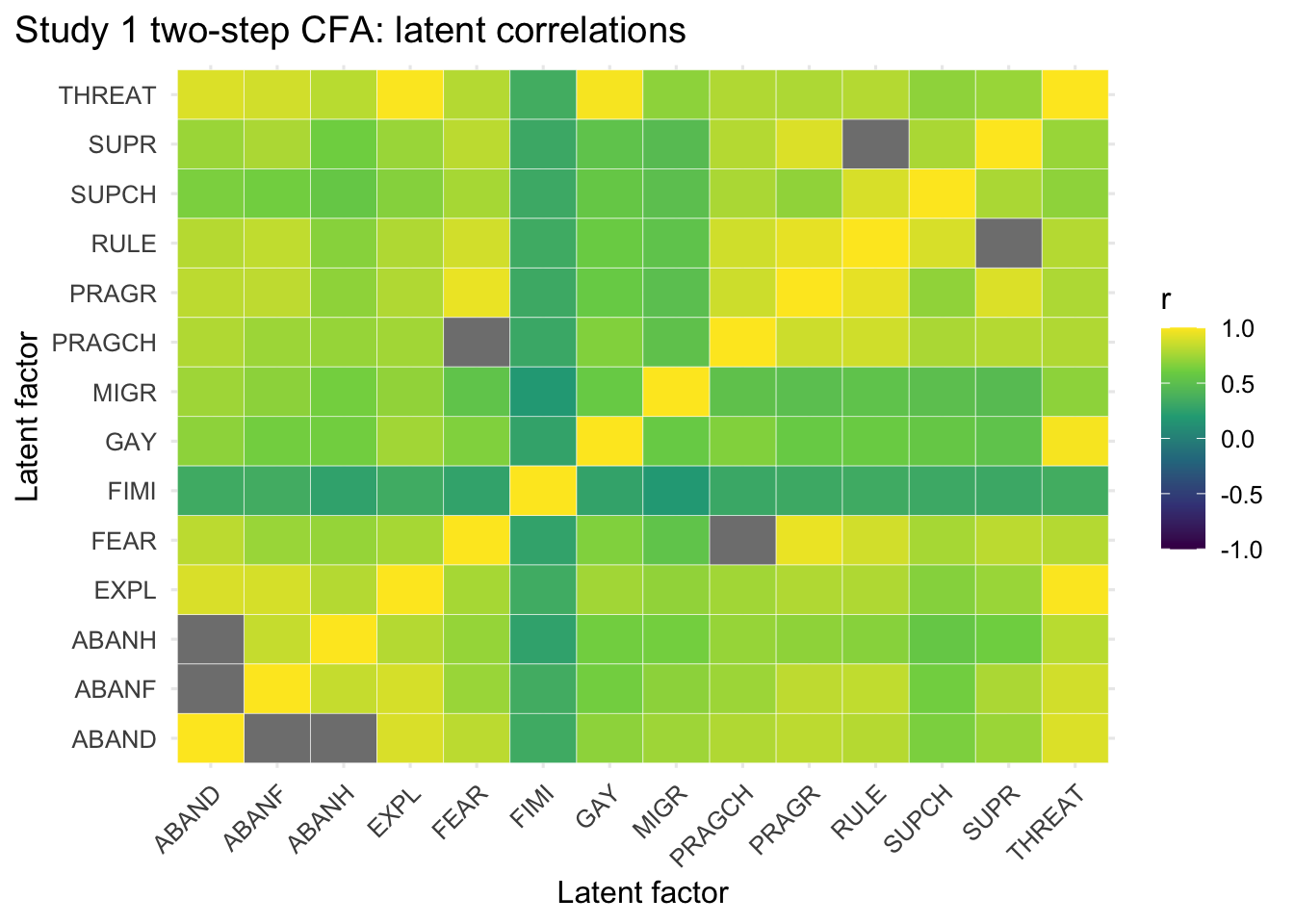
The full first-order SEM highlights institutional abandonment (ABANF, ABANH; S1 legacy: SAFE, LONE) and ideological grievance constructs as the dominant correlates of receptivity, with standardized effects exceeding .30. The hybrid MIMIC draft (S1_second_hybrid) is now also part of the four-way higher-order comparison: under the stabilised parameterisation (24 freed residual covariances between borrowed direct indicators and their parent-block siblings) it converges in ~35 s with a positive-definite vcov, and its composite-level FIMI paths track the pure formative variant’s once the identification choice is accounted for. The reflective second-order, anchored pure formative <~, and stabilised hybrid MIMIC readings agree on the qualitative sign and rank ordering of THREAT/FEAR/ABAND/RULE effects on FIMI; individual coefficient magnitudes differ in the way the formal MIMIC/formative distinction predicts, with the hybrid loading more weight onto ABAND and the pure formative redistributing toward THREAT. The two-step rescue then anchors the comparison: its factor-score regressions confirm the strong ABAND path without the per-coefficient instability that latent-level multicollinearity (|r| up to .88 among first-order parents) imposes on the joint-estimation variants. The latent correlation heatmap from the two-step CFA visualises that multicollinearity directly.
FIMI outcome operationalisation
Study 1 FIMI versions: full, Russian-origin, Chinese-origin, and short forms (wave-local item names)
Within-wave Pearson correlations between Study 1 FIMI version row-mean scores
Version
Full FIMI
Russian FIMI
Chinese FIMI
Short FIMI
Full FIMI
1.00
0.99
0.88
0.93
Russian FIMI
0.99
1.00
0.82
0.90
Chinese FIMI
0.88
0.82
1.00
0.89
Short FIMI
0.93
0.90
0.89
1.00
The four-FIMI-versions sensitivity analysis is reported on 4c FIMI prediction; the per-study page reports the inventory and the within-wave correspondence between version scores.
Model strain diagnostics
Largest modification indices for the Study 1 full model
Left
Op
Right
MI
EPC
EXPL
=~
cen1
260.7
1.58
ABANH
=~
cen1
240.9
1.42
ABANF
=~
cen1
203.5
1.51
MOR
=~
cen1
202.5
1.31
CET
=~
cen1
201.6
1.37
The leading modifications involve correlated residuals between overlapping abandonment items (e.g., aban3 ~~ aban4), reinforcing that content redundancy rather than missing factors drives the remaining misfit.
Path diagrams
The diagrams below are produced from the fitted lavaan objects rather than redrawn by hand: standardized estimates feed the reusable Graphviz layout in figures/sem_templates/s1_second_order.dot. The legend (operators, line styles, pen weights) is documented under SEM diagram conventions on the overview page.
Study 1 two-step structural model on factor scores. Composite paths feed FIMI through the structural paths; coefficients are standardized.
Figure 2: Study 1 two-step structural model on factor scores. Composite paths feed FIMI through the structural paths; coefficients are standardized.
Study 1 reflective second-order specification rendered on the same layout as the two-step solution so the two are directly comparable.
Figure 3: Study 1 reflective second-order specification rendered on the same layout as the two-step solution so the two are directly comparable.
Study 1 brief/deployment model — reduced four-predictor structure. Predictors absent from the brief specification are omitted (not greyed).
Figure 4: Study 1 brief/deployment model — reduced four-predictor structure. Predictors absent from the brief specification are omitted (not greyed).
Scale reduction and deployment adaptation
Study 1: long vs. brief structural model fit comparison
Model
CFI
RMSEA
SRMR
χ²
df
p
FIMI R²
Long (S1_full)
0.878
0.054
0.072
10 927.7
3649
<0.001
22.0%
Brief (S1_brief)
0.967
0.069
0.033
187.5
44
<0.001
12.6%
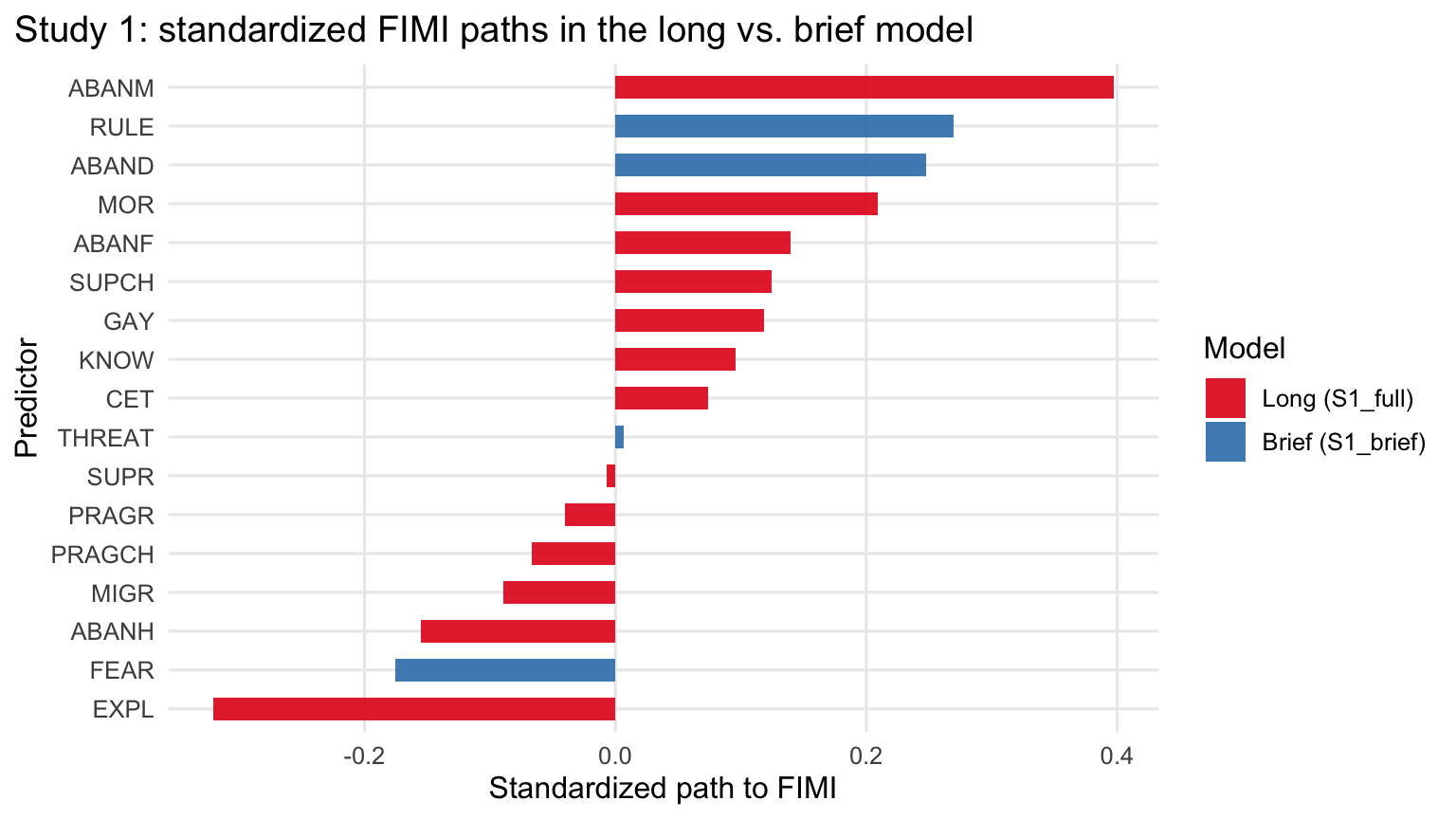
Study 1: standardized FIMI paths by predictor (long vs. brief)
Predictor
Long
Brief
CET
0.07
—
EXPL
-0.32
—
MOR
0.21
—
GAY
0.12
—
ABANF
0.14
—
MIGR
-0.09
—
ABANH
-0.15
—
KNOW
0.10
—
ABANM
0.40
—
PRAGR
-0.04
—
PRAGCH
-0.07
—
SUPR
-0.01
—
SUPCH
0.12
—
THREAT
—
0.01
ABAND
—
0.25
FEAR
—
-0.18
RULE
—
0.27
The brief and full models use different FIMI criteria (the brief uses the source-balanced four-item Short FIMI: news4, news9, news14, news15) and a reduced four-composite predictor set (THREAT, FEAR, ABAND, RULE) rather than the 13 first-order constructs in S1_full. The fit and path comparisons above are therefore informative as a within-wave deployment-adaptation probe, not as a strict equivalence test. The cross-study synthesis of long-vs-brief equivalence lives on 4d Deployment and invariance.
Key takeaways
Stage 1 (exploratory dimensionality). Study 1 is the exploratory foundation: it fielded the widest item pool and surfaced which grievance, abandonment, pragmatism, and admiration blocks are psychometrically usable.
Stage 2 (first-order measurement). Block CFAs and the full first-order SEM established that ideological grievance subscales (EXPL, GAY, MIGR; S1 legacy: USE) are tightly defined, while censorship (FREE) and knowledge (KNOW) batteries are dispersed and motivated shortening for Study 2.
Stage 3 (higher-order representation). All three higher-order representations now converge on this wave: the reflective second-order (S1_second_reflective), the anchored pure formative <~ (S1_second_formative), and the stabilised hybrid MIMIC (S1_second_hybrid, parameterised with 24 freed residual covariances between borrowed direct indicators and their parent-block siblings, a substantively justified identification choice flagged in the 2026-05-17 audit). The two-step factor-score solution remains as a fourth reading; its value is no longer rescuing a non-converging hybrid but isolating composite-level prediction from the latent-level multicollinearity (|r| up to .88 among first-order parents) that destabilises individual ~ and <~ weights in the joint-estimation variants.
Stage 5 (criterion prediction). Institutional abandonment (ABANF, ABANH; S1 legacy: SAFE, LONE) and ideological grievance constructs emerge as the dominant first-order correlates of the Study 1 FIMI criterion; the two-step structural model gives the interpretable composite-level account.
Stage 6 (deployment adaptation). The brief eight-item, four-composite scale (S1_brief) is fielded against the source-balanced four-item Short FIMI criterion and serves as the earliest deployment probe; differences in both predictor set and criterion against S1_full are documented above.
Cross-study brief-vs-long. The S1 deployment probe feeds the cross-wave brief-vs-long synthesis at 4d — fig-brief-vs-long-paths.