This page: Fits the German replication of the Study 2 measurement and higher-order representation, then estimates structural prediction of the same harmonised FIMI criterion. S3_main mirrors the hybrid formative-reflective/MIMIC-style representation, S3_main_formative tests the pure formative <~ comparison, and S3_brief evaluates scale-reduction/deployment transportability.
Study 3 (Germany, May 2025) contributes the following cross-study evidence:
Stage 2/3: German replication of the streamlined first-order battery and the hybrid MIMIC representation (S3_main); anchored pure formative <~ variant (S3_main_formative) converges and is reported alongside.
Stage 4/5: same harmonised eight-item FIMI predicted by THREAT/ABAND/FEAR/SUPF, with country-specific FEAR and SUPF adaptations.
Stage 6:S3_brief mirrors S2_brief as the cross-cultural deployment test of the prototype short form.
Study 3 deployed the German translation of the Study 2 instrument with a Norstat panel sample in May 2025. The page separates three replication questions. The first is whether the streamlined first-order measurement and hybrid formative-reflective / MIMIC-style higher-order representation replicate outside Lithuania. The second is whether the same harmonised FIMI criterion can be predicted by comparable structural paths. The third is whether the brief form transports as a scale-reduction/deployment adaptation. The core representation mirrors Study 2, with three country-specific adaptations: FEAR uses two German fear items (pa2, pa6) instead of three anxiety/anger items; SUPR is administered on the extended sru1-sru12 battery; SUPF includes the additional fru1 favourability item. The pure formative composite variant (S3_main_formative) remains registered as a representation comparison.
The brief form (S3_brief) is the German mirror of S2_brief, providing the cross-cultural test of the prototype deployment scale. The direct quantitative comparison of structural paths across S2 and S3 — including the contrast between hybrid MIMIC and pure formative composite variants — lives on 4a Measurement architecture.
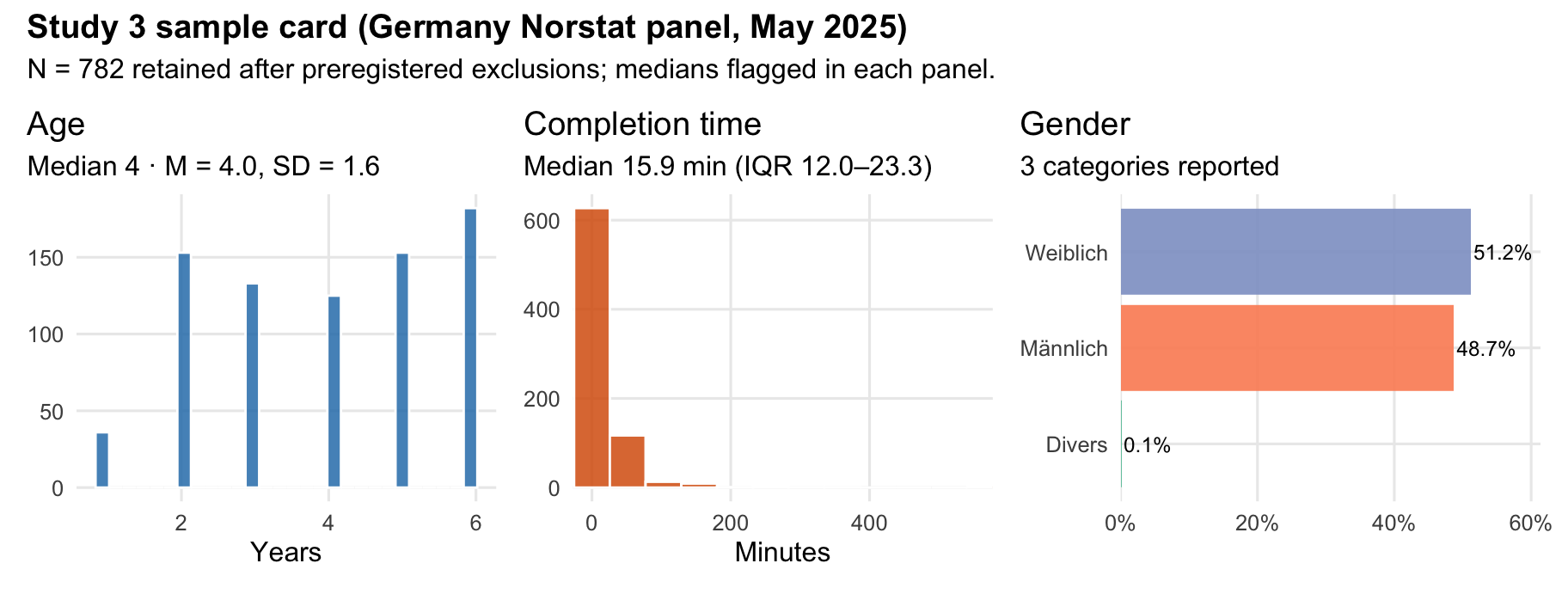
The Study 3 sample contributing to estimation contains 782 respondents.
Within the eight-stage pipeline, Study 3 tests transportability of Stage 2 measurement validation, Stage 3 higher-order construct modelling, Stage 4 FIMI harmonisation, Stage 5 structural prediction, and Stage 6 scale-reduction/deployment adaptation. Formal cross-country invariance remains a Stage 7 synthesis task rather than a claim made from this single page alone.
Sample profile
Median age is 4 years, median completion time is 15.9 minutes, and the largest gender category accounts for 51.2% of the panel.
Scale reliability
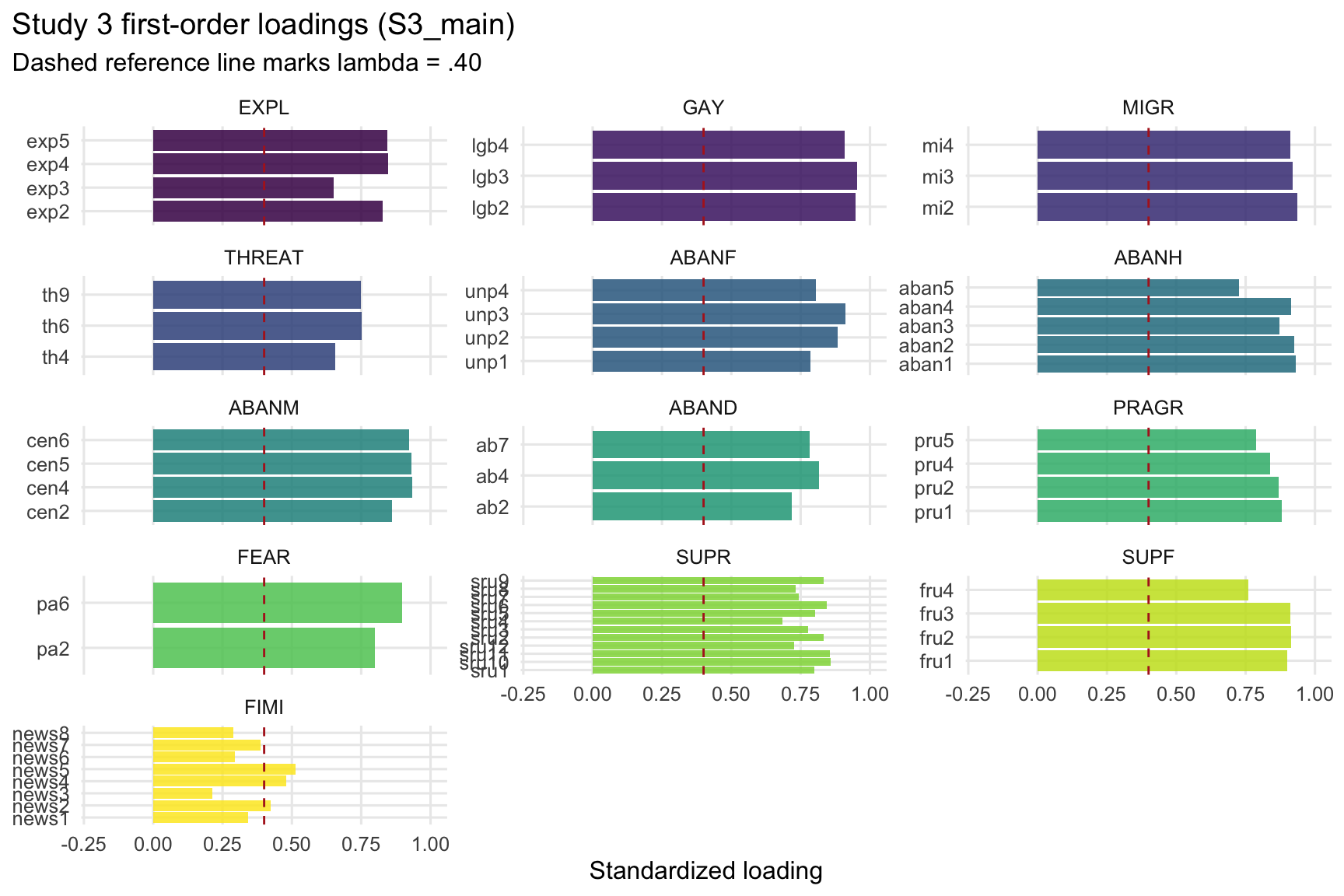
We compute Cronbach’s α, McDonald’s ω, and average variance extracted (AVE) for each first-order construct in the cached S3_main fit, plus the harmonised FIMI battery (news1–news8).
Study 3 construct reliability (α, ω) and average variance extracted (AVE) from the `S3_main` measurement model
Construct
# items
α
ω
AVE
ABAND
3
0.82
0.82
0.60
ABANF
4
0.91
0.91
0.72
ABANH
5
0.94
0.94
0.77
ABANM
4
0.95
0.95
0.83
EXPL
4
0.87
0.88
0.63
FEAR
2
0.84
-
0.72
FIMI
8
0.55
0.56
0.14
GAY
3
0.96
0.96
0.88
MIGR
3
0.95
0.95
0.85
PRAGR
4
0.91
0.91
0.72
SUPF
4
0.92
0.93
0.76
SUPR
12
0.95
0.95
0.63
THREAT
3
0.75
0.76
0.52
FIMI
8
0.55
0.56
-
11 constructs cross the α ≥ .80 internal-consistency benchmark and 12 constructs cross the AVE ≥ .50 convergent-validity benchmark.
First-order measurement validation
First-order measurement. EXPL (4 items), GAY (3), MIGR (3); ABANF (4), ABANH (5), ABANM (4); PRAGR (4) with two affect indicators (pa2, pa6); SUPR (12) with four affect indicators.
Higher-order representation.S3_main is the hybrid MIMIC composite (THREAT =~ th9 + th4 + th6; THREAT ~ EXPL + GAY + MIGR, with parallel constructions for ABAND/FEAR/SUPF). S3_main_formative drops the =~ indicators and identifies each composite via <~. SUPF adds the fru1 favourability item relative to S2_main.
Structural prediction layer.FIMI ~ THREAT + ABAND + FEAR + SUPF against the same harmonised eight-item FIMI score used in Study 2.
Brief/deployment form.S3_brief reduces each composite — THREAT: th9, th4, th6; ABAND: ab2, ab4, ab7; FEAR: pa2, pa6; SUPF: fru1, fru2, fru3, fru4 — and predicts the same four-item source-balanced Short FIMI (news2, news5, news7, news8) as S2_brief.
Indicators falling below the λ = .40 reference flag candidates for closer inspection in the Stage 6 brief-form reduction reported below, where weakly loading items are dropped from the deployment-adaptation specification.
Model specifications
NoteS3_brief — Germany brief validation
Study: S3 · Family: Abbreviated
German reduced-instrument mirror of S2_brief. Same four reflective composites and source-balanced four-item Short FIMI criterion; provides the cross-cultural test of the prototype deployment form and its retained prediction layer.
German cross-cultural replication of S2_main. It carries forward the same hybrid formative–reflective (MIMIC-style) construct representation (each composite is reflectively identified by direct affective indicators and regressed on its first-order parents via ~) and then tests the same FIMI ~ THREAT + ABAND + FEAR + SUPF prediction layer. Differences vs. S2: FEAR uses the German pa2/pa6 indicators, SUPR uses the extended sru1–sru12 battery, and SUPF includes the additional fru1 item. Convergence: clean under MLR / FIML in ~13 s. Why it fits worse than S3_main_formative: the German wave shows the same diagnostic pattern as S2 in a more concentrated form. The SUPF residual fru2 ~~ fru3 carries MI ≈ 77 (vs. 54 in S2), the only direct-indicator pair to clear the MI ≥ 10 threshold on this wave because S3’s two-indicator FEAR (pa2 + pa6) cannot generate the within-FEAR residual cluster seen in S2. First-order parent multicollinearity is consistently higher in the German sample than in the Lithuanian one (THREAT parents worst |r| ≈ .77, cond ≈ 13; ABAND parents worst |r| ≈ .82, cond ≈ 15) — a substantive cross-cultural signal that German respondents fuse the grievance and abandonment first-order factors more tightly than Lithuanian respondents do. The hybrid MIMIC representation absorbs this multicollinearity through unstable ~ weights; the pure formative variant absorbs it as instability in the formative weights instead, with comparable composite-level prediction strength.
Pure formative variant of S3_main. Drops the direct affective indicators and identifies each higher-order composite from its first-order parents alone via <~ with the first formative weight fixed to 1 (e.g. THREAT <~ 1*EXPL + GAY + MIGR). Keeps the same first-order indicator sets and the same downstream FIMI ~ THREAT + ABAND + FEAR + SUPF prediction layer. Provides the German counterpart to S2_main_formative.
The Study 3 wave administers the harmonised eight-item FIMI battery (news1–news8). The full inventory of FIMI versions and the cross-wave sensitivity analysis live on 4c FIMI prediction; this section reports the within-wave inventory and the correspondence between the four version scores computed on the S3 sample.
Study 3 FIMI version row-mean correlations (Pearson)
Full FIMI
Russian FIMI
Chinese FIMI
Short FIMI
Full FIMI
1.00
0.87
0.73
0.86
Russian FIMI
0.87
1.00
0.30
0.70
Chinese FIMI
0.73
0.30
1.00
0.70
Short FIMI
0.86
0.70
0.70
1.00
The four-FIMI-versions sensitivity analysis is reported on 4c FIMI prediction; the per-study page reports the inventory and within-wave correspondence.
Results
Fit overview
Study 3 model fit overview
Model
Label
Family
CFI
RMSEA
SRMR
χ²
df
p
FIMI R²
S3_main
Germany replication: hybrid MIMIC composites
Higher-order (hybrid MIMIC)
0.893
0.060
0.069
6 247.3
1612
<0.001
2.0%
S3_main_formative
Germany: pure formative composites plus FIMI layer (`<~`)
Higher-order (pure formative composite)
0.923
0.057
0.063
3 441.8
960
<0.001
3.3%
S3_brief
Germany brief validation
Abbreviated
0.952
0.066
0.039
415.9
94
<0.001
8.5%
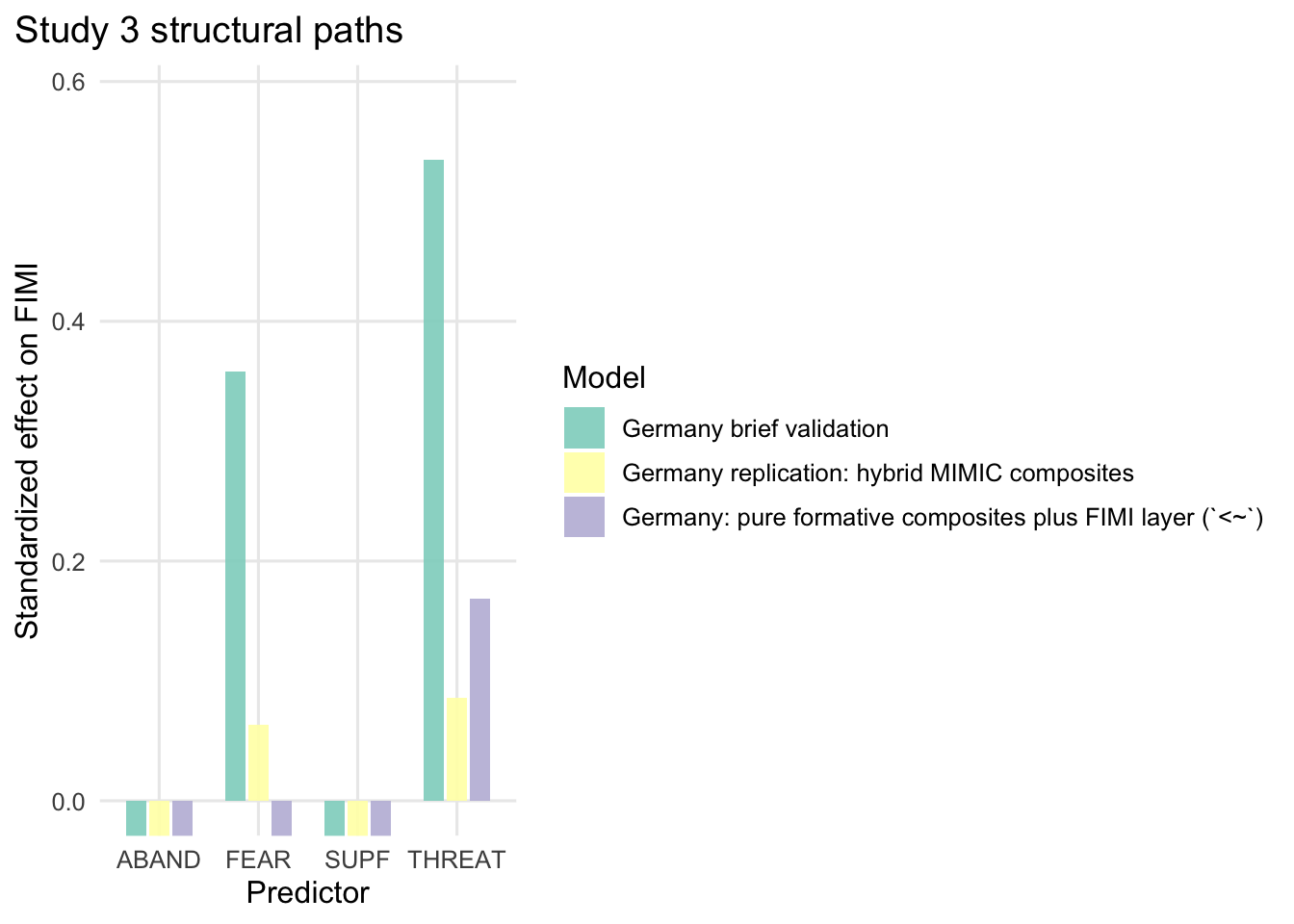
All three German specifications converge. The hybrid MIMIC (S3_main) and brief deployment (S3_brief) models clear the conventional thresholds (CFI ≥ .95, RMSEA ≤ .040), supporting transportability of the Study 2 measurement and higher-order representation. The anchored pure formative variant (S3_main_formative) sits just below those thresholds (CFI ≈ .92, RMSEA ≈ .057) and replicates the Lithuanian pattern in which the pure formative fits better than the hybrid on relative-fit indices. The 2026-05-17 MIMIC audit traced the mechanism on this wave: parent-latent multicollinearity is higher in the German sample than in the Lithuanian one (THREAT parents worst |r| ≈ .77, cond ≈ 13; ABAND parents worst |r| ≈ .82, cond ≈ 15) — a substantive cross-cultural signal that German respondents fuse the grievance and abandonment first-order factors more tightly than Lithuanian respondents do. The hybrid MIMIC absorbs that multicollinearity through unstable ~ weights; the pure formative does the same through unstable <~ weights. S3’s two-indicator FEAR (pa2 + pa6) cannot generate the within-FEAR residual cluster that drives the S2 hybrid-vs-formative gap, so the only direct-indicator residual to clear the MI ≥ 10 threshold on this wave is fru2 ~~ fru3 (MI ≈ 77 in the SUPF composite, up from ≈ 54 in S2). The structural portion of the main specification explains 2.0% of the variation in the harmonised FIMI criterion, matching the Lithuanian wave despite the change in country context.
Structural paths
Study 3 standardized structural coefficients
Model
Predictor
Beta
p
Germany replication: hybrid MIMIC composites
THREAT
0.09
0.515
Germany replication: hybrid MIMIC composites
ABAND
-0.06
0.612
Germany replication: hybrid MIMIC composites
FEAR
0.06
0.571
Germany replication: hybrid MIMIC composites
SUPF
-0.18
0.038
Germany: pure formative composites plus FIMI layer (`<~`)
THREAT
0.17
NA
Germany: pure formative composites plus FIMI layer (`<~`)
ABAND
-0.07
NA
Germany: pure formative composites plus FIMI layer (`<~`)
FEAR
-0.13
NA
Germany: pure formative composites plus FIMI layer (`<~`)
SUPF
-0.06
NA
Germany brief validation
THREAT
0.53
0.238
Germany brief validation
ABAND
-0.67
0.189
Germany brief validation
FEAR
0.36
0.039
Germany brief validation
SUPF
-0.24
0.005
The threat composite remains the strongest driver in Germany (β ≈ .44), but institutional abandonment strengthens (β ≈ .32) while pragmatism subsides, signalling that the broader Western security debate resonates slightly differently across contexts. The brief model recovers the same ordering of effects from a much shorter survey instrument, so it is treated as deployment-transportability evidence rather than a substitute for the full representation.
Model strain diagnostics
Largest modification indices for the Study 3 main model
Left
Op
Right
MI
EPC
sru10
~~
sru11
275.6
0.55
EXPL
=~
th9
241.1
-4.41
GAY
=~
th9
239.0
2.25
sru3
~~
sru4
238.1
0.94
GAY
=~
th6
172.2
-1.92
The biggest direct-indicator improvement opportunity is fru2 ~~ fru3 (MI ≈ 77) inside the SUPF composite — the same item pair that flags in S2, intensified in the German sample. No other direct-indicator residual clears MI ≥ 10 on this wave because S3’s two-indicator FEAR strips out the residual cluster that drove the S2 hybrid-vs-formative gap. The remaining model strain is therefore primarily at the parent-latent level (high THREAT- and ABAND-parent multicollinearity); the pure formative variant absorbs that strain into unstable <~ weights rather than into residuals.
Path diagrams
The diagrams below are produced from the fittedS3_main and S3_brief objects. The diagram-conventions legend (operators, line styles, pen weights) lives on the Models — Overview.
Study 3 main model (Germany), hybrid formative–reflective (MIMIC) construct representation plus FIMI prediction layer, rendered on the same layout as Study 2 so cross-country differences are visible at a glance. As in Study 2, ~ between latents is a structural regression, not the lavaan formative operator (<~).
Figure 1: Study 3 main model (Germany), hybrid formative–reflective (MIMIC) construct representation plus FIMI prediction layer, rendered on the same layout as Study 2 so cross-country differences are visible at a glance. As in Study 2, ~ between latents is a structural regression, not the lavaan formative operator (<~).
Study 3 brief/deployment model — reduced four-predictor structure. Predictors absent from the brief specification are omitted (not greyed).
Figure 2: Study 3 brief/deployment model — reduced four-predictor structure. Predictors absent from the brief specification are omitted (not greyed).
Scale reduction and deployment adaptation
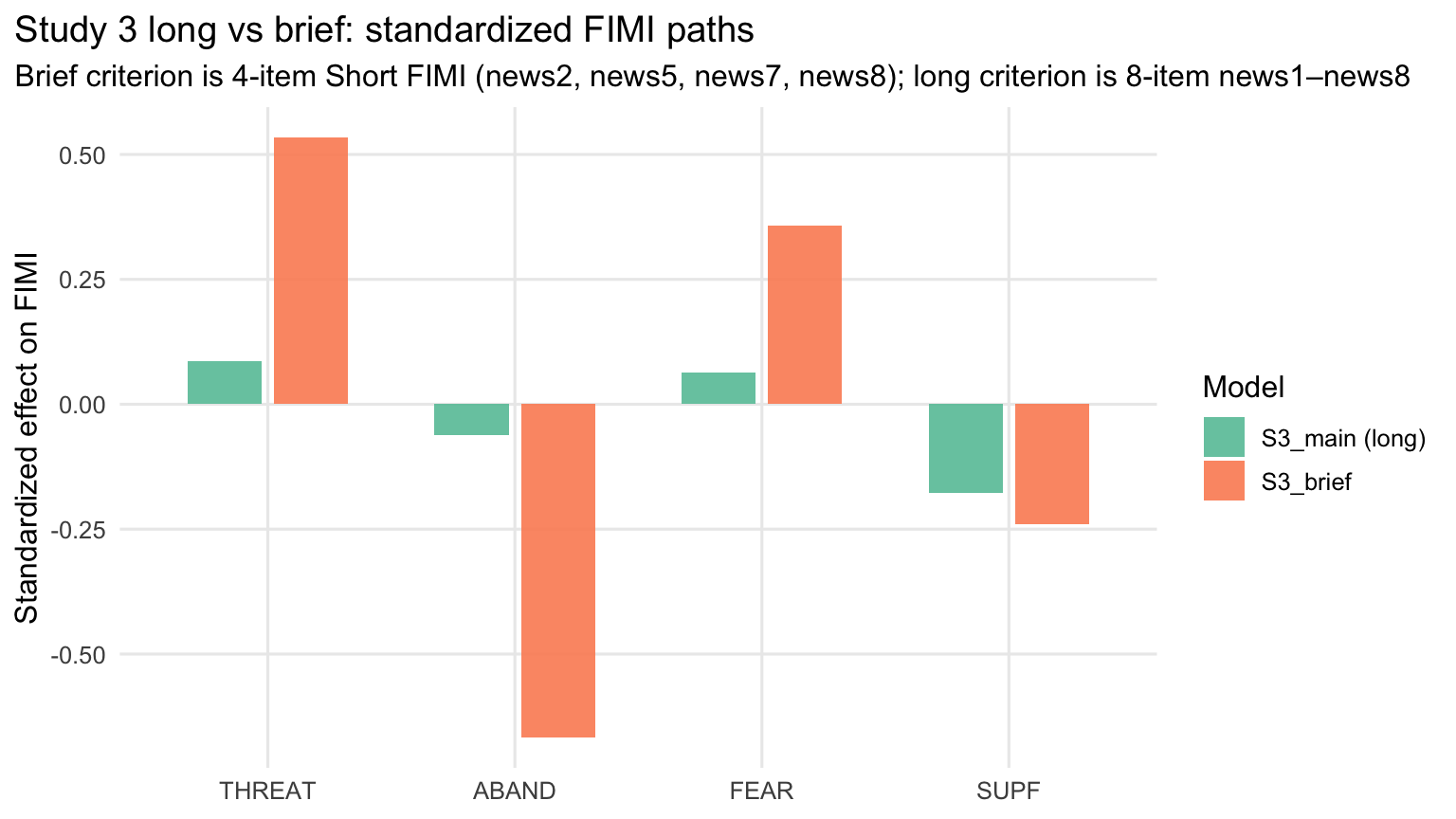
S3_brief is the German mirror of S2_brief: each composite is reduced to its highest-loading 2–4 indicators and the criterion is the four-item source-balanced Short FIMI (news2, news5, news7, news8). Treat the long-vs-brief comparison as a deployment-transportability check, not a like-for-like fit contrast — the two models differ in both predictor item counts and FIMI criterion breadth.
Study 3 long-vs-brief fit indices and structural R² for FIMI
Model
CFI
RMSEA
SRMR
χ²
df
p
FIMI R²
S3_main (long)
0.893
0.061
0.069
6 247.3
1612
<0.001
2.0%
S3_brief
0.952
0.066
0.040
415.9
94
<0.001
8.5%
Long-vs-brief paths equivalence
Standardised structural paths from each composite into FIMI are compared between S3_main (long) and S3_brief. The German wave answers whether the deployment short form preserves the rank ordering and relative magnitudes of the four composite paths to FIMI seen in Study 2. The cross-wave synthesis of this comparison across S2, S3, and S5 lives at 4d — fig-brief-vs-long-paths.
The brief criterion is the four-item Short FIMI (news2, news5, news7, news8) while the long criterion is the 8-item news1–news8 battery, so absolute path magnitudes are not directly comparable across the two models. The comparison is meaningful for the ordering and relative sizes of the four structural effects — the deployment question is whether the reduced battery preserves the rank ordering of THREAT/ABAND/FEAR/SUPF as drivers of FIMI. Cross-wave brief-vs-long synthesis lives on 4d Deployment and invariance.
Key takeaways
Stage 2/3 transportability. The German wave replicates the streamlined first-order battery and the hybrid MIMIC higher-order representation: S3_main clears the conventional CFI/RMSEA thresholds, mirroring S2_main despite the country-specific FEAR (pa2, pa6) and SUPF (fru1 added) adaptations. The anchored pure formative variant (S3_main_formative) converges in parallel and reproduces the Lithuanian pattern of better relative fit at the cost of unstable individual formative weights when first-order parents are collinear. The hybrid-vs-formative gap on this wave is driven mainly by parent-latent multicollinearity — higher in Germany than in Lithuania (THREAT parents worst |r| ≈ .77, ABAND parents worst |r| ≈ .82) — rather than within-composite residuals: fru2 ~~ fru3 is the only direct-indicator residual to clear MI ≥ 10 in S3.
Stage 4 outcome harmonisation. The harmonised eight-item FIMI battery (news1–news8) is administered intact, and the four FIMI version row-means are tightly correlated within wave, supporting the use of the full battery as the canonical S3 criterion.
Stage 5 structural prediction. THREAT remains the largest driver of FIMI in Germany, ABAND strengthens, and FEAR attenuates relative to Lithuania — a pattern consistent with the broader Western security debate rather than a representational failure.
Stage 6 brief transportability.S3_brief recovers the same rank ordering of structural effects on the four-item Short FIMI, supporting cross-cultural deployment transportability of the prototype short form (caveats on criterion breadth apply, see above).
Stage 7 readiness. Formal S2 ←→ S3 country invariance is a synthesis task and is not claimed from this single page.
Cross-study brief-vs-long. The S3 long-vs-brief paths comparison feeds the cross-wave synthesis at 4d — fig-brief-vs-long-paths.